


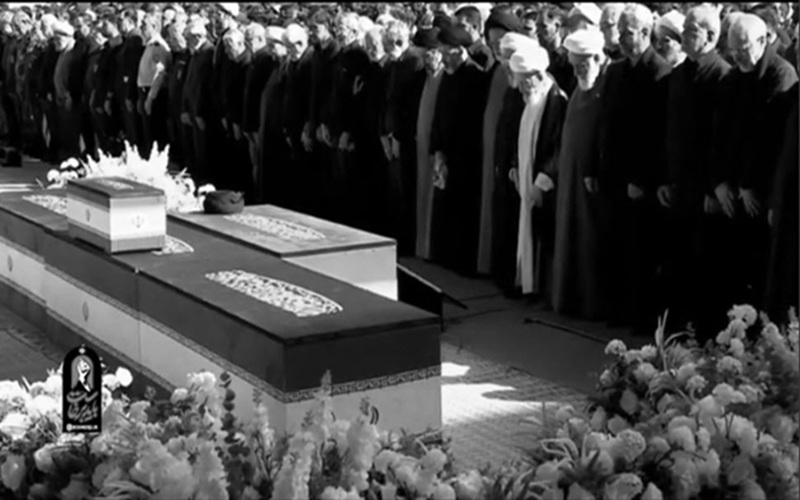

As millions of Iranians struggle with war, inflation, and poverty, the regime has staged one of the most expensive state funerals in its history. Yet despite its vast mobilization campaign, both domestic turnout and international participation fell short of the political message Tehran hoped to project.
The funeral of former Supreme Leader Ali Khamenei was designed to achieve far more than honoring the regime’s late leader. It was conceived as a carefully orchestrated demonstration of political legitimacy, institutional continuity, and international relevance at one of the most fragile moments in the regime’s history.
Stretching from Tehran to Qom, Mashhad, and even into the Shiite holy cities of Najaf and Karbala, the ceremonies represented one of the largest state-organized mobilization campaigns since the establishment of the regime. Officials claimed that tens of millions of people would participate while hundreds of foreign delegations were invited to attend.
Yet once the ceremonies concluded, a different picture emerged. Behind the spectacle lay unanswered questions about the enormous financial burden imposed on a country already devastated by war and economic collapse. Equally revealing was the limited response from both Iran’s strategic partners abroad and significant segments of its own population.
Rather than demonstrating unquestioned strength, the funeral ultimately highlighted many of the vulnerabilities the regime sought to conceal.
A Funeral Designed to Demonstrate Political Survival
Senior regime officials made little effort to hide the political objectives behind the ceremonies.
Former parliament speaker Gholam-Ali Haddad-Adel declared that 32 million “devoted supporters” had registered to participate, presenting the event as proof of overwhelming public loyalty to the Islamic Republic.
The funeral therefore became less a religious ceremony than a political production intended for both domestic and international audiences.
Every aspect of the event reflected this objective.
Nationwide public holidays were declared. Transportation systems operated around the clock without charge. State media devoted virtually continuous coverage to the ceremonies. Government agencies coordinated events across multiple cities while foreign delegations were invited to reinforce the image of international legitimacy.
The message was clear: despite war, leadership transition, and growing instability, the regime intended to portray itself as united, popular, and firmly in control.
Who Paid for the Spectacle?
While the regime’s authorities have released no official accounting of the funeral’s costs, the logistical scale suggests an operation consuming enormous public resources.
The expenses appear to have been financed through several channels.
Public Funds
Many of the most visible costs were borne directly by the state.
These included:
- Nationwide public holidays that disrupted economic activity.
- Free, 24-hour metro and bus services.
- Deployment of approximately 150,000 police and security personnel.
- Large-scale logistics, transportation, sanitation, and municipal services.
- Accommodation for thousands of participants arriving from across Iran and reportedly from neighboring countries.
Ultimately, these expenditures derive from public revenues at a time when the government continues to cite budget shortages to justify reductions in social spending.
State-Controlled Foundations
The regime’s extensive network of foundations, religious organizations, municipalities, and institutions operating under the Supreme Leader’s authority almost certainly played a central financial role.
These organizations control vast economic assets while operating with limited transparency and virtually no independent public oversight.
Like many previous state ceremonies, the funeral appears to have relied heavily on this opaque financial infrastructure.
Forced Mobilization of Public and Private Resources
Numerous reports also indicated that government employees, businesses, educational institutions, and hotels were pressured to contribute services or facilities.
Schools, universities, mosques, and religious centers reportedly served as temporary accommodation sites, while public venues were reassigned to support the ceremonies.
Such practices blur the distinction between voluntary participation and compulsory mobilization, a recurring feature of large-scale regime events.
The Price of Symbolism During Economic Collapse
The logistical dimensions alone illustrate the extraordinary scale of the operation.
The funeral reportedly involved:
- Approximately 150,000 security personnel.
- Continuous free public transportation.
- Massive temporary housing capacity across public institutions.
- Hundreds of thousands of tents and emergency facilities.
- Extensive hospitality for foreign delegations.
- Thousands of domestic and international journalists.
- Large-scale food distribution and logistical support.
- Transportation of Khamenei’s body to multiple cities and religious sites, including locations outside Iran.
Beyond these direct expenses, the broader economic cost included nationwide business disruptions, reduced commercial activity, transportation delays, and productivity losses resulting from widespread closures.
Some media outlets and analysts have estimated the total cost in the billions of dollars. While no independent audit has verified these figures, and no precise estimate can be confirmed, there is little doubt that the funeral ranks among the most expensive state ceremonies ever organized by the Iranian regime.
The timing has intensified public criticism.
The lavish spending comes only weeks after a devastating war, amid soaring inflation, widespread unemployment, severe infrastructure damage, and an economy in which a substantial majority of Iranians are estimated to live at or below the poverty line.
For many citizens, the contrast has been impossible to ignore.
The International Response Fell Short of Tehran’s Expectations
If the funeral was intended to project international influence, the attendance of foreign leaders painted a far less convincing picture.
Even pro-regime media acknowledged the disappointing level of participation.
The regime-affiliated outlet Rouydad 24, in an article titled “Dim Diplomacy and the Cold Message of Strategic Partners,” observed that among Iran’s fifteen neighboring countries, only Pakistan, Armenia, and Iraq sent their highest executive officials.
More striking was the response from Tehran’s principal strategic partners.
Russian President Vladimir Putin chose not to attend, sending former President Dmitry Medvedev instead. China limited its representation to a vice chairman of the National People’s Congress rather than dispatching a senior cabinet official. India similarly refrained from sending its foreign minister.
The publication concluded that these powers ultimately prioritized their broader geopolitical and economic interests over symbolic displays of solidarity with Tehran.
For a regime that has repeatedly portrayed Moscow and Beijing as pillars of a new international order, the subdued diplomatic response carried unmistakable political significance.
The Absence Everyone Noticed
Equally noteworthy was who did not appear.
State media had fueled expectations that Mojtaba Khamenei, the regime’s new supreme leader, would make a highly visible appearance during the ceremonies.
Instead, his continued absence became one of the most discussed aspects of the funeral.
Even Rouydad 24 acknowledged that domestic and international observers had expected the event to end weeks of speculation by publicly introducing the new leader.
That moment never came.
His absence fueled further questions about the succession process and suggested that the regime may still be managing internal sensitivities surrounding the transition.
A Display That Revealed More Than It Concealed
The Iranian regime invested enormous political, financial, and institutional capital in transforming Ali Khamenei’s funeral into a demonstration of permanence and authority.
Yet the event exposed contradictions that no carefully choreographed spectacle could erase.
It highlighted the vast public resources available for state propaganda even as officials plead poverty when confronted with demands for pensions, healthcare, reconstruction, and basic public services.
It underscored the increasingly cautious approach of countries Tehran describes as strategic allies.
And it demonstrated that even one of the largest state mobilization campaigns in the regime’s history could not fully eliminate questions surrounding legitimacy, succession, and public support.
In the end, Khamenei’s funeral became more than a farewell to the regime’s longest-serving Supreme Leader. It became an unintended snapshot of a political system attempting to project confidence while confronting mounting internal uncertainty and growing international caution.