


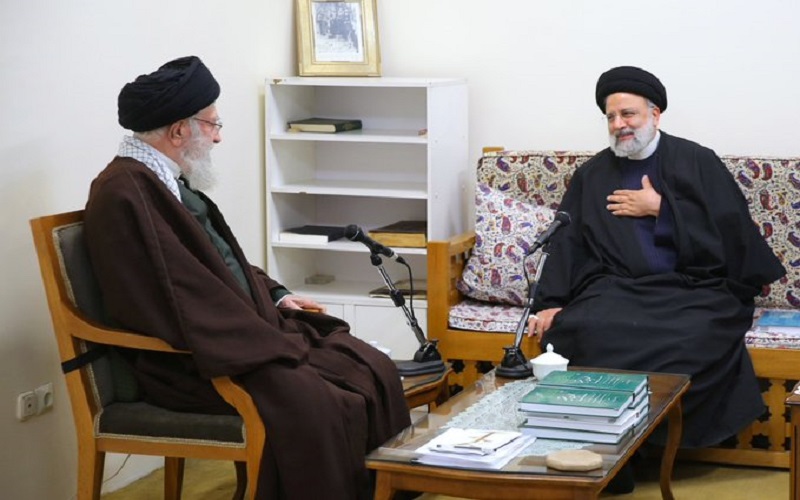

With the death of Ebrahim Raisi, the Iranian regime is compelled to hold early elections, exacerbating Supreme Leader Ali Khamenei’s nightmare of internal disputes among the regime’s elements and factions.
The impact on Khamenei is undeniable, though not due to Raisi’s personal influence. To fully grasp the significance, we must rewind to 2021. That year, Khamenei paid a hefty price to appoint Raisi as president. This decision necessitated a “bloody surgery” within the regime, expelling even those close to Khamenei and leading to bloody disputes among the regime’s elements. For Khamenei, this was crucial to silence critics and prevent further protests.
Figures like Ali Larijani were sacrificed to ensure Raisi’s easy selection, igniting a rift between Khamenei and the Larijani brothers, who had long served the regime. The 2021 presidential election faced an unprecedented boycott by the people, a historic first for the mullahs’ regime. Consequently, Khamenei eliminated a significant part of his own faction, alongside the so-called reformists, to secure Raisi’s presidency.
The regime’s sovereignty pyramid is shrinking, further exacerbated by eliminations in recent parliamentary and Assembly of Experts elections, where participation was even lower than in the presidential election. The exclusion of figures like former president Hassan Rouhani worsened the regime’s predicament. Now, with Raisi’s death, Khamenei, having bet everything on the so-called young Hezbollahi government, faces significant challenges.
According to the regime’s constitution, a new presidential election must be held within fifty days. Khamenei cannot choose Larijani, as his Guardian Council has already deemed him incompetent, nor can he rely on the so-called reformists, since Hassan Rouhani was expelled from the Assembly of Experts. Signs indicate the regime will soon face new uprisings. Thus, Khamenei is forced to proceed with early elections, deepening his nightmare as factional infighting intensifies.
This infighting is evident in the current parliament, notably between the Front of Islamic Revolution Stability, led by Hamid Rasaee, and Qalibaf, who unsuccessfully sought Mohammad Bagher Ghalibaf’s removal as speaker. Figures like Saeed Jalili, Ghalibaf, and Ali Shamkhani further complicate Khamenei’s situation.
The next two months will be a nightmare for Khamenei, escalating intra-factional conflict for the presidential seat. The absence of Raisi, who provided relative stability, paves the way for new claimants, posing additional problems for Khamenei.
Historically, gaps and disagreements at the top of sovereign power lead to uprisings and protests at the bottom, within society. This ancient, unwritten law continues to hold true.