The president’s feigned bewilderment over January’s massacre collapses under the weight of his complicity with Ali Khamenei
Over the past forty days, Iran regime’s president, Masoud Pezeshkian, has repeatedly expressed what appears to be concern about the aftermath of the regime’s bloody crackdown in January. He has publicly asked how the government became so estranged from the people, wondering what went wrong and how the state distanced itself from society.
Such statements are not merely implausible—they are an insult to the intelligence of the Iranian people.
Is it credible that the highest executive authority in the country is unaware of the political trajectory that brought Iran from the brief hopes of 1979 to the suffocating repression of 2026? Does Pezeshkian not understand how decades of governance under Ruhollah Khomeini and now Ali Khamenei transformed the promise of freedom into a system defined by executions, censorship, and structural violence?
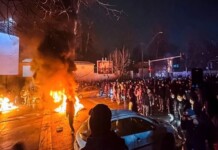
To pose such questions as if he were an outsider is political theater. The reality is stark: Pezeshkian stands alongside Khamenei as one of the officials responsible for the January 2026 massacre. His role is not that of a bewildered observer but of a senior functionary within a system that ordered, justified, and defended the crackdown.
Violence Is Not an Accident — It Is Policy
Even voices from within the regime have acknowledged the unprecedented scale of brutality unleashed in January. Internal commentaries have described the “intensity of violence” as the defining feature of the events, raising uncomfortable questions about the roots of the public’s rage.
Those same assessments point to a culture of institutionalized hostility:
- Opponents routinely labeled as enemies of the state.
- Protesters dismissed as “rioters” or “foreign agents.”
- Public figures slandered and insulted across official and semi-official platforms.
- Death wishes and incitement normalized in political discourse.
This environment did not emerge spontaneously. It was cultivated over years by the very political establishment Pezeshkian serves and defends. When entire segments of society are branded as disposable, repression becomes predictable.
The January massacre was not a breakdown of order—it was the logical culmination of systematic dehumanization.
Economic Collapse and Social Anger
If Pezeshkian genuinely wonders why public anger has reached explosive levels, he need only look at the economic devastation confronting ordinary families. Even a modest iftar meal for a family of four now costs over one million tomans—an unbearable burden in a country where wages have been hollowed out by inflation, corruption, and sanctions mismanagement.
The regime’s president knows these figures in granular detail. He has participated in the policy decisions that produced hyperinflation, currency collapse, and structural poverty. He has endorsed the same opaque oligarchic networks that dominate Iran’s political and economic order.
To ask “what did we do?” is to feign amnesia about policies he helped shape.
Alignment with the Supreme Leader
The deeper issue is ideological alignment. Pezeshkian and his predecessors have defined themselves in loyalty to the doctrine of Velayat-e Faqih. As long as Ali Khamenei remains the ultimate authority, presidents function not as independent executives but as administrators of his will.
The record shows that under this system, absolutism and monopolization of power are not aberrations—they are design features. The consequences have been criminalized repression at home and systemic exploitation across society.
Those who identify themselves with this structure cannot credibly distance themselves from its outcomes. They are not reluctant participants; they are operational pillars.
No More Political Theater
Iran’s uprising is not rooted in confusion or misunderstanding. It is the result of decades of accumulated grievances—political exclusion, economic despair, cultural repression, and state violence.
Masoud Pezeshkian is fully aware of this reality. He has access to intelligence briefings, economic reports, and security assessments unavailable to ordinary citizens. More importantly, he participates in decision-making at the highest levels of the state.
Responsibility, therefore, cannot be deflected upward to the Supreme Leader alone. Nor can it be diluted through rhetorical displays of concern.
If the regime’s supreme authority orders repression and the president executes and legitimizes it, both stand accountable before history.