


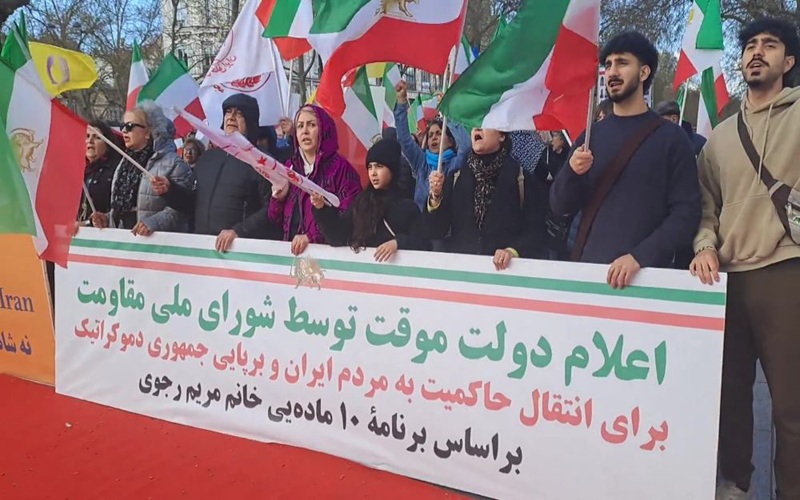

Maryam Rajavi’s proposed alternative positions the Iranian people—not foreign powers—as the decisive force for political transformation
The debate over Iran’s future has long been framed as a binary choice between continued appeasement of the ruling establishment or the risk of military confrontation. Yet a third option—democratic change led by the Iranian people—has increasingly gained traction, particularly through the framework advanced by Mrs. Maryam Rajavi, the president-elect of the National Council of Resistance of Iran (NCRI).
This approach presents itself not as an abstract ideal, but as a practical alternative to two policies that have repeatedly failed. On one side stands decades of appeasement by major global powers, a strategy that has neither moderated the Iranian regime’s behavior nor curtailed its ambitions. On the other lies the prospect of war—an outcome that tends to arise only when diplomatic concessions fail to restrain the regime’s nuclear and regional activities.
Proponents of democratic change argue that both paths ultimately reinforce instability. Appeasement, they contend, has enabled the regime to expand its repressive apparatus at home while projecting influence abroad. Military intervention, meanwhile, risks further destabilizing the region without addressing the root cause: the absence of popular sovereignty in Iran.
At the core of this alternative vision is the assertion that the Iranian people themselves must determine the country’s political future. The NCRI maintains that the current system lacks legitimacy due to its record of human rights abuses and actions deemed hostile both domestically and internationally. From this perspective, the question is not whether change should occur, but how it can be realized.
The concept of “democratic change” encompasses a spectrum of mechanisms recognized in international norms—from a free and internationally supervised referendum to more forceful forms of resistance, should peaceful avenues remain blocked. Advocates argue that the method ultimately depends on the regime’s response: if authorities allow genuine political participation, a non-violent transition becomes possible; if repression persists, more confrontational forms of resistance may emerge as both inevitable and, in their view, justifiable under international principles.
This framework underscores a conditional logic. The trajectory of change is not predetermined but shaped by the regime’s willingness—or refusal—to cede political space. In this sense, responsibility for escalation is framed as resting primarily with those in power.
However, supporters of this approach also point to a critical external factor: the role of international policy. They argue that years of conciliatory engagement have tilted the balance of power in favor of the Iranian regime. Beyond diplomacy, they criticize measures that have constrained opposition movements, including past decisions by Western governments to designate key opposition groups as terrorist organizations—a move widely seen by critics as limiting the operational space of regime opponents.
In speeches delivered to European policymakers, Rajavi has emphasized what she considers a minimal yet decisive expectation from the international community: refrain from supporting the ruling system against its own people. Her position rejects both military intervention and passive engagement, instead calling for a recalibration that allows Iranians to pursue change without external obstruction.
The central argument is straightforward. Democratic transformation in Iran does not require foreign imposition, but rather the removal of barriers that have historically constrained internal forces for change. Ending policies that favor the status quo, avoiding interference that weakens opposition movements, and recognizing the agency of the Iranian population are presented as essential steps.
From this perspective, the path forward is neither complex nor unattainable. It rests on a single principle: allowing the Iranian people to reclaim their sovereignty.