


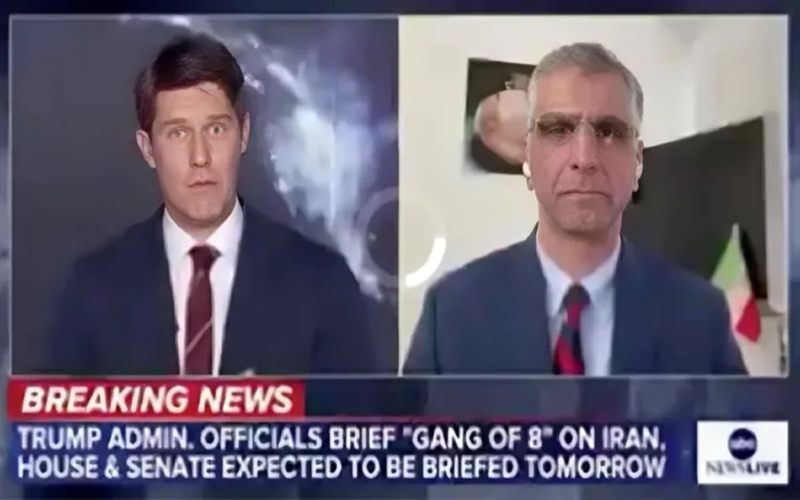

Political director of OIAC argues decades of appeasement have failed as internal resistance and regional tensions reshape the future of Iran
A recent interview broadcast by ABC News on March 24, 2026, featured Dr. Majid Sadeghpour, political director of the Organization of Iranian American Communities (OIAC), offering a stark assessment of Iran’s political trajectory. His remarks point to what he described as a decisive shift in both domestic and international dynamics surrounding the Iranian regime.
Sadeghpour argued that the current pressures facing the ruling system—both internal and external—have created a rare opening for change. According to him, the Iranian regime is now in a defensive position, and this environment provides an opportunity for the population to challenge its authority. However, he emphasized that the struggle between the Iranian people and the ruling establishment is not new, but rather a continuation of decades of confrontation.
He also linked recent military developments in the region to Iran’s controversial nuclear and missile programs, noting that these activities had long been exposed by opposition groups, particularly the National Council of Resistance of Iran. While external pressure plays a role, Sadeghpour maintained that the ultimate solution lies not in foreign intervention, but in the overthrow of the regime by the Iranian people themselves.
A central theme of the interview was the agency of the Iranian population in shaping the country’s future. Sadeghpour highlighted the role of organized resistance networks inside Iran, including groups affiliated with the People’s Mojahedin Organization of Iran, describing them as actively confronting state forces. He suggested that these networks are not only resisting but also preparing for a post-regime transition.
Looking ahead, he stressed the importance of defining a clear roadmap for Iran’s future political system. In this context, he pointed to the recently proposed transitional framework introduced by Maryam Rajavi, which outlines the structure of a temporary government and the broader vision for a democratic republic.
The interview also touched on shifting international rhetoric, including remarks by U.S. President Donald Trump encouraging Iranians to reclaim control over their country. Sadeghpour interpreted these signals as part of a broader transformation in global policy toward Iran, contrasting it with what he described as more than four decades of ineffective appeasement.
According to his analysis, that long-standing policy enabled the Iranian regime to expand its nuclear ambitions, advance its missile capabilities, and entrench a system of domestic repression. Now, he argued, the balance is beginning to tilt in favor of the Iranian people.
Sadeghpour also referred to recent acts of resistance, claiming that opposition forces have demonstrated an increased capacity to directly challenge the regime’s power centers. While such operations may not always achieve their immediate objectives, he suggested they reflect a growing capability and determination among regime opponents.
Taken together, his remarks portray a moment of heightened uncertainty for Iran regime’s leadership—and, in his view, a moment of possibility for its people.