



Reformist Warnings Against Retaliatory Provocations
On July 9, the reformist-aligned newspaper Ham Mihan published a strongly worded editorial warning that public threats against foreign leaders—particularly US President Donald Trump—risk provoking American retaliation. The editorial criticized the Iranian regime Judiciary’s apparent “double standards” for prosecuting “minor dissent” while failing to address public calls for assassination. It referenced Trump’s 2023 assassination attempt, cautioning that similar incidents could serve as a justification for US retaliation “regardless of Iranian denials.”
The remarks were a direct rebuke of Iran regime’s judiciary chief, Gholam Hossein Mohseni Ejei, and came just days after a June 30 fatwa issued by senior clerics declared both Trump and Israeli Prime Minister Benjamin Netanyahu “mohareb” (enemies of God), urging their killing. Some clerics and organizations even offered bounties and solicited public donations for the assassinations. Prominent hardliner and Assembly of Experts member Mohsen Araki defended the fatwa, equating threats to Supreme Leader Ali Khamenei with a “war against the Islamic world” and labeling US and Israeli leaders as enemies of Islam.
Parliamentarians Attack Pezeshkian’s Call for De-Escalation
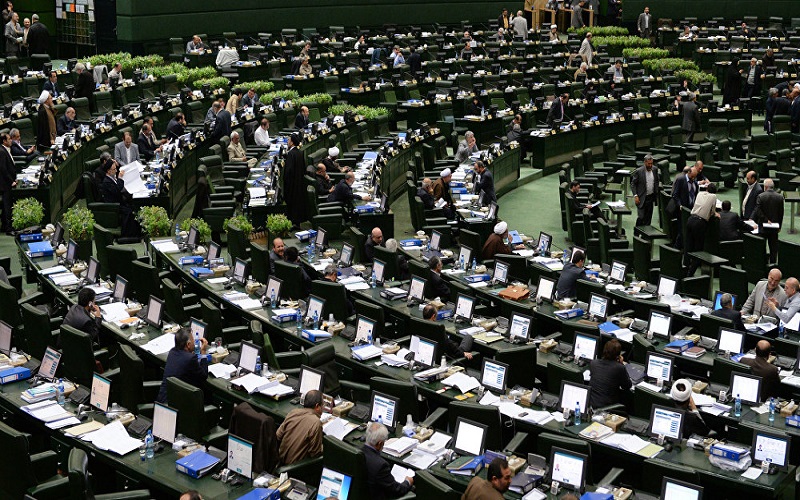
The tensions intensified further when 24 members of Iran regime’s parliament, including figures from the ultraconservative Paydari (Stability) Front, issued a July 10 letter condemning regime president Masoud Pezeshkian’s recent interview with American commentator Tucker Carlson. The letter accused Pezeshkian of undermining national unity and criticized him for failing to endorse the clerical fatwas targeting Trump and Netanyahu.
Pezeshkian’s moderate rhetoric—in which he expressed support for renewed nuclear talks and a willingness to cooperate with the International Atomic Energy Agency (IAEA)—was labeled “disappointing” by the lawmakers. They argued that signaling openness to dialogue projects “weakness” and could “embolden the US to impose more sanctions or launch another military strike.”
Hardliners Set Unachievable Preconditions for Talks
In parallel with these condemnations, media outlets affiliated with the regime’s Armed Forces General Staff outlined a series of rigid preconditions on July 10 that amount to a rejection of renewed US-Iran negotiations. These include:
- Official recognition of Israeli aggression,
- A full investigation of US involvement in the war,
- Financial reparations from the US, and
- Binding security guarantees to prevent future attacks.
The outlets warned that engaging in talks without these demands would “legitimize past attacks” and invite future ones. Such maximalist terms make meaningful negotiations all but impossible, and reflect the hardliners’ intent to block any diplomatic overtures that fall short of total regime victory.
Rouhani and Moderates Push for Strategic Retreat
In contrast, so-called moderate figures within the regime are pressing for a more pragmatic approach. Former regime president Hassan Rouhani has reportedly lobbied senior clerics in Qom to pressure Khamenei into halting uranium enrichment and accepting a ceasefire, warning that such steps are essential to “save the Islamic system from collapse.”
Rouhani’s efforts underscore the urgency felt among regime insiders who believe the regime’s survival is at stake. With the country facing mounting economic pressure, international isolation, and domestic unrest, some see a diplomatic offramp as the only viable path forward.
An Internal Struggle Over Strategy and Identity
The growing divide between so-called reformists and hardliners highlights the Iranian regime’s internal struggle not only over tactics but also over its ideological identity and long-term strategic vision. Hardliners remain committed to a confrontational foreign policy anchored in anti-Western rhetoric and revolutionary posturing. The so-called moderates, though still loyal to the regime, argue for engagement to preserve the regime’s foundations.
This internal battle is unfolding as Iran regime’s international position weakens and its capacity to withstand further economic or military pressure diminishes. The United States has shown no willingness to entertain the regime’s preconditions for talks, and without a shift in strategy, Tehran risks further isolation—or worse, a direct confrontation it cannot afford.
The outcome of this power struggle will shape not only the future of Iran’s nuclear program but also the stability of the region at large.