An opinion article published by the Washington Examiner argues that the Iranian regime’s growing repression reflects weakness rather than strength and urges Western governments to support the Iranian people’s organized resistance.
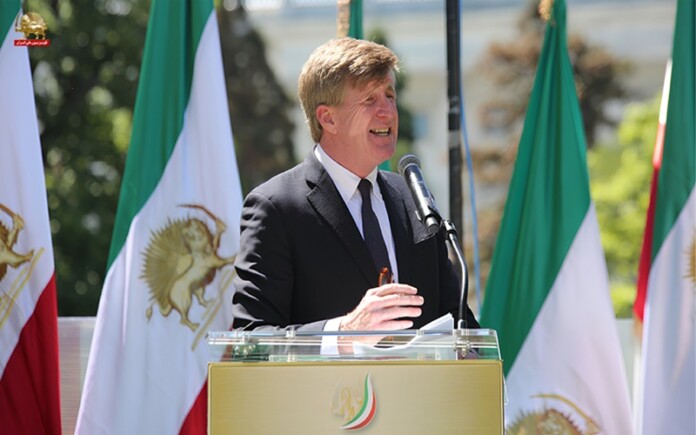
In an opinion article published by the Washington Examiner on August 3, former U.S. Congressman Patrick Kennedy argued that the Iranian regime’s escalating repression demonstrates its fear of its own people and that Western governments should abandon policies of hesitation in favor of supporting Iran’s democratic opposition.
Kennedy, who has participated in numerous international gatherings supporting democratic change in Iran, said he has witnessed growing international backing for the National Council of Resistance of Iran (NCRI) and its President-elect, Maryam Rajavi. According to him, participants from different countries share a common commitment to democracy, freedom, and universal human rights despite coming from diverse political and cultural backgrounds.
“Everyone in attendance was ultimately speaking the same language — a shared language of commitment to democratic principles and universal human rights.”
Regime’s Repression Reflects Fear, Not Strength
Kennedy argued that the Iranian regime’s increasing reliance on executions and violent crackdowns illustrates its vulnerability rather than its stability.
He described the regime as the world’s leading state sponsor of terrorism and pointed to its violent suppression of nationwide protests, saying that Tehran has repeatedly responded to public dissent with lethal force instead of political reform.
The article also argues that the regime has continued pursuing its nuclear ambitions despite mounting economic hardship and regional instability, portraying these policies as evidence that Tehran remains committed to confrontation rather than addressing the needs of its own population.
Executions Target Organized Opposition
A central focus of Kennedy’s article is the sharp increase in politically motivated executions.
He noted that since March, the regime has executed members of the People’s Mojahedin Organization of Iran (PMOI/MEK) alongside participants in the nationwide protest movement, including 26-year-old Mehdi Khanaki.
“The rate of politically motivated executions has risen dramatically in a country notorious for maintaining the world’s highest overall rate of executions per capita.”
Kennedy argued that these executions are intended to intimidate organized opposition but instead reveal the authorities’ growing concern over expanding domestic resistance.
Democratic Change Is the Only Sustainable Solution
According to Kennedy, decades of diplomatic engagement have failed to moderate Tehran’s behavior, leaving democratic change as the only realistic path forward.
He contended that the United States and its allies should recognize the regime’s continued political violence as a reason to support the Iranian people and their organized resistance instead of pursuing policies that assume the system can be reformed.
“The Iranian people long for a genuine democratic republic, emphatically rejecting both a return to the deposed monarchy and the maintenance of the oppressive status quo.”
Kennedy argued that repeated nationwide uprisings since 2017 demonstrate that demands for democratic change have persisted despite increasingly severe repression.
Growing Resistance Inside Iran
The opinion piece also highlights the activities of organized “Resistance Units” associated with the PMOI/MEK, arguing that their continued expansion despite widespread arrests and executions illustrates the resilience of the opposition movement.
Kennedy suggested that stronger international political support for the Iranian people would encourage further growth of democratic activism inside the country and increase pressure on the ruling establishment.
Lessons from History
Drawing historical comparisons, Kennedy recalled international support for South Africa’s anti-apartheid movement and the democratic revolutions that brought an end to communist rule across Eastern Europe.
He argued that many observers once believed those political systems were permanent, only to witness their rapid collapse once public movements gained sufficient momentum and international backing.
Call for Western Support
Kennedy concluded by urging the United States and its democratic allies to publicly support the NCRI as a democratic alternative and to adopt policies that protect Iranian activists while holding officials responsible for human rights abuses accountable.
“The same victory over oppression is not only achievable in Iran but inevitable. The only open question is whether the U.S. and its allies will stand on the right side of history.”
The article presents the regime’s intensified repression not as evidence of strength but as a sign of growing insecurity, arguing that sustained international support for the Iranian people’s democratic aspirations could play a decisive role in the country’s future.