


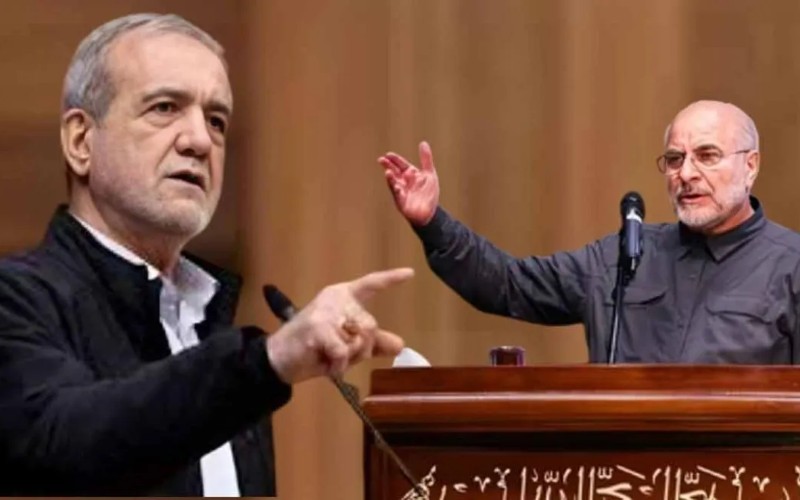

As living costs soar and public anger deepens, open clashes between Iran’s parliament and government reveal not reform, but a decaying system fighting to preserve itself
As Iran sinks into one of the most severe economic and livelihood crises in its modern history, open confrontations at the highest levels of power have become increasingly visible.
Unprecedented attacks by Mohammad Bagher Ghalibaf, Speaker of the regime’s Parliament, against the government of Masoud Pezeshkian—alongside explicit threats to impeach ministers and parallel calls by hardline figures such as Hamid Rasaei to remove Mohammad Reza Aref—are not routine political disagreements. They raise fundamental questions about power balance, governance failure, and the future of the regime’s economic management.
The core question is no longer whether internal disagreements exist, but whether these clashes signal an erosion of authority at the very top of the system.
Parliament’s Offensive and the Politics of Blame
In a recent parliamentary session, multiple lawmakers used unusually aggressive language to hold the Pezeshkian government solely responsible for runaway inflation and collapsing living standards. From MPs declaring that “people can no longer tolerate these prices” to demands for fast-tracked impeachments, a single narrative dominated the debate: shifting full responsibility for the crisis onto the government.
Ghalibaf’s remarks carried particular weight due to his position as Speaker. His explicit warning that impeachment proceedings would begin unless “necessary corrections” are implemented was a calculated political signal. Parliament is attempting to present itself as aligned with public suffering while deflecting responsibility away from the broader ruling structure.
This maneuver, however, is increasingly detached from public perception. Iranian society no longer blames a single government or branch of power. The anger is directed at the entire regime that has produced decades of economic mismanagement, corruption, and repression. From this perspective, parliamentary attacks are less about solutions and more about political theater.
An Economy Past the Point of Warning
The economic crisis has moved beyond abstract indicators and into daily survival. According to official statistics, food prices have risen by more than 66 percent over the past year. Bread and grains have nearly doubled in price, red meat has increased by around 85 percent, and dairy products and cooking oil by roughly 60 percent. Staples such as chicken, rice, fruits, and basic household food items are now unaffordable for large segments of the population.
These figures alone demonstrate that the crisis is structural, not managerial. Yet the ruling elite continues to stage internal conflicts as if replacing a few ministers could reverse a collapse decades in the making.
When Even Supreme Leader Backing No Longer Suffices
Historically, explicit support from the regime’s supreme leader Ali Khamenei has acted as a shield for governments, restraining other institutions from overt confrontation. The current situation is different. Despite the Supreme Leader’s backing of the Pezeshkian government, the Speaker of Parliament has openly escalated pressure without restraint.
This shift can be understood through three interrelated dynamics:
First, the weakening of Khamenei’s ability to control factional warfare;
Second, growing anxiety within each power bloc about its own future and a race to evade responsibility for the collapse;
Third, the scale of public dissatisfaction, which can no longer be concealed and is forcing conflicts into the open.
The Illusion of “Economic Reform”
Official rhetoric about “economic reform” routinely raises public expectations of price stability, improved livelihoods, and job security. In practice, however, past experience shows that such reforms are reduced to reshuffling ministers or replacing managers—moves that leave people’s lives unchanged.
This is because key economic decisions are not made by governments which are being selected by Khamenei self. Budget allocation, resource distribution, and strategic spending are dominated by unaccountable power centers, while enormous resources are consumed by nuclear ambitions, missile programs, and regional interventions.
As a result, even full cabinet overhauls cannot resolve the crisis. The root problem lies in the structure of power itself—a system built on monopoly, rent-seeking, and organized plunder, where wealth is circulated among a narrow ruling elite.
A Systemic “Black Hole”
Even regime-affiliated economists acknowledge this reality. Vahid Shaqaqi Shahri, for example, has described Iran’s economy as a “crisis-generating black hole”—a closed, non-competitive, rent-based, quasi-state structure whose powerful beneficiaries actively block any real reform.
Iran’s economy is not governed by market logic or accountable policy. Institutions such as the Islamic Revolutionary Guard Corps (IRGC) and foundations under the Supreme Leader operate beyond government oversight. Through conglomerates like Khatam al-Anbiya, the IRGC dominates large portions of construction, oil, gas, and infrastructure projects, reportedly controlling up to 30 percent of the economy.
Similarly, foundations such as Astan Quds Razavi and the Execution of Imam Khomeini’s Order control vast economic empires while remaining immune to transparency or public accountability. Massive budget allocations to these entities directly translate into pressure on ordinary people’s livelihoods.
Within such a structure, impeaching ministers is not a solution—it is a deliberate diversion from the real sources of economic devastation.
Factional Warfare, Not Public Concern
All recent warnings, threats, and political theatrics must be understood as part of an internal power struggle—one aimed at preserving positions and securing access to dwindling resources, not alleviating public suffering. Livelihood issues have become tools in factional pressure campaigns rather than genuine concerns.
What is unfolding is a direct reflection of unprecedented pressure on society, now manifesting as fractures at the top of the ruling system. As people’s tables grow emptier, divisions within the regime grow sharper and more public.
A Regime Fighting for Survival
Ghalibaf’s attacks on the Pezeshkian government and repeated impeachment threats do not mark the beginning of reform. They are warning signs of a collapsing social trust in the entire ruling structure. The cost of this crisis will not be borne by one government or one parliament, but by the regime as a whole.
Today’s open confrontations are rooted in deep social anger—anger that cannot be neutralized by changing political figures. What is now taking place is no longer merely a struggle over factional interests. It is a struggle over regime survival itself, with each bloc seeking to preserve the system in its own way.
This is the core reality of Iran’s current power struggle: a system under existential pressure, exposed by economic collapse, and increasingly unable to mask its internal decay.