


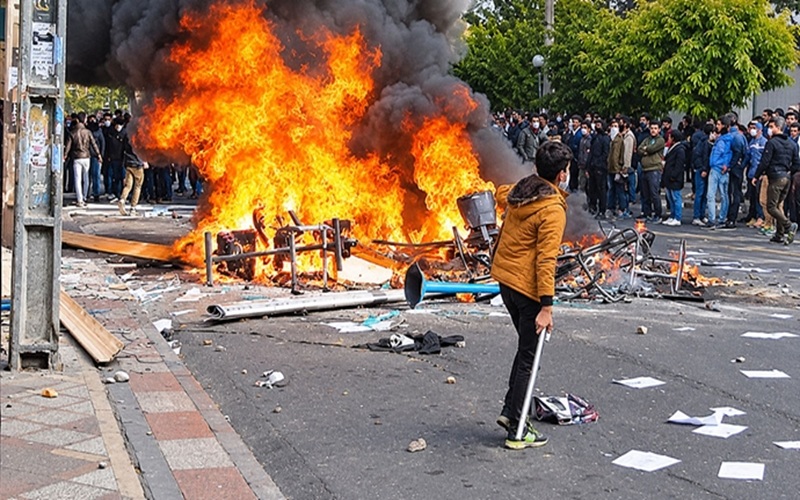

A regime-affiliated analyst warns that worsening economic and social grievances could trigger protests more violent than those of 2025, while a member of parliament acknowledges that soaring inflation, currency policies, and declining purchasing power have devastated nearly every income group.
Two striking admissions by figures within Iran’s ruling establishment expose the growing economic and political pressures confronting the regime. While a government-affiliated analyst warns that mounting economic and social dissatisfaction could produce another round of protests, potentially more violent than the 2025 uprising, a member of parliament acknowledges that the country’s middle class has effectively disappeared and that further price increases of 30 to 40 percent are approaching.
Taken together, their remarks reveal growing concern within the establishment that the regime’s economic policies, declining living standards, and inability to address public grievances are creating conditions for renewed unrest.
Regime analyst warns of protests more violent than the 2025 uprising
Parviz Amini, a regime-affiliated political analyst, has openly warned that worsening economic and social conditions could lead to a new wave of protests, potentially more violent than those witnessed in 2025.
Speaking to the state-affiliated Khabar Online website, Amini identified the combination of declining external war-related threats and increasing domestic dissatisfaction as a particularly dangerous scenario for the regime.
He explained that if the perceived threat of war diminishes while economic and social grievances continue to grow, the likelihood of renewed protests will increase. He specifically pointed to sudden price increases or another fuel-price crisis as potential triggers.
“All these factors could create the conditions for a repetition of the 2025 protests, even in a more violent form,” Amini warned.
His remarks amount to an acknowledgment that the underlying causes of public unrest remain unresolved. Rather than identifying the possibility of protests as an isolated political development, he linked it directly to the regime’s economic decisions and the deterioration of living conditions.
Amini also cautioned against what he called explosive decisions, pointing specifically to economic measures taken in 2019, 2022, and 2025 as among the most significant factors contributing to previous waves of protests.
His warning reflects the regime’s awareness that sudden increases in the cost of essential goods and fuel can turn accumulated public frustration into widespread demonstrations.
Parliamentarian admits Iran’s middle class has collapsed
The economic picture described by Mostafa Pourdehghan Ardakan, a member of the Iranian parliament’s Industry and Mines Committee, is equally alarming.
In remarks acknowledging the severity of the economic crisis, Pourdehghan said virtually all income groups were struggling with relative poverty, despite the government’s limited food-basket assistance and subsidies.
He described the situation as particularly dire, arguing that inadequate government support has failed to protect households against the accelerating cost of living.
One of his most significant admissions concerned the disappearance of Iran’s middle class.
“For three or four years, we have no longer had a middle class. The middle class is now in its third year of decline, and we no longer have anything that can be called a middle class,” he said.
The statement underscores the scale of economic impoverishment, as households that once had relatively stable incomes have increasingly lost their ability to afford basic necessities.
Further price increases of 30 to 40 percent expected
Pourdehghan warned that the removal of preferential foreign-exchange rates for 4,533 goods would trigger another substantial wave of price increases.
According to his explanation, these goods had previously benefited from an exchange rate of approximately 190,000 tomans per dollar. They must now be supplied using the free-market rate, which he put at approximately 260,000 tomans.
He estimated that the change would lead to price increases of between 30 and 40 percent for affected goods in the near future.
The consequences will be particularly severe for workers and employees whose incomes are fixed and cannot keep pace with inflation.
Pourdehghan noted that the average monthly salary of many workers and employees is between 20 million and 25 million tomans, leaving them increasingly unable to meet rising household expenses.
He also highlighted the rapid erosion of purchasing power, saying that 20 million tomans had lost approximately 10 percent of its purchasing power over just two months.
According to the figures he cited from the Central Bank, monthly inflation currently stands between 5 and 7 percent.
“This is no joke; it is bitter and painful,” he said.
Parliamentarian challenges government’s attempt to blame the war
Perhaps the most revealing part of Pourdehghan’s remarks concerned the government’s explanation for the economic crisis.
He recounted questioning the economy minister about whether the deterioration in people’s living conditions was caused by the war or by misguided economic policies.
According to Pourdehghan, the minister responded unequivocally that the war was solely responsible.
The parliamentarian rejected that explanation, directly challenging the government’s failure to acknowledge its own responsibility.
“You still have no understanding of the country’s current situation. You still think your policies are good and that these conditions have been created by the war, whereas that is not the case,” he said.
Pourdehghan argued that Iran had continued selling oil, including shipments previously held at sea, and that rising international oil prices had increased government revenues.
He noted that the budget had calculated oil revenues based on a price of $50 per barrel, while international prices had subsequently reached approximately $100. He said Iranian oil had been sold at discounted prices of between $70 and $80 per barrel.
Consequently, he attributed the deterioration in people’s livelihoods primarily to the regime’s monetary and foreign-exchange policies rather than the war.
He specifically pointed to decisions made by the Central Bank and the economic authorities as major contributors to the crisis.
Government subsidies fail as economic pressure intensifies
Pourdehghan also criticized government spending and the inadequacy of social assistance programs.
He said the government could provide only 25 percent of the food-basket assistance originally targeted by parliament. He recalled that lawmakers had opposed the currency shock precisely because they anticipated its devastating consequences for ordinary households.
“We knew these bitter developments would happen,” he said.
He further called on the president to address excessive government expenditure rather than presenting symbolic measures, such as switching off lights, as evidence of austerity.
His comments expose the gap between the government’s promises of economic relief and its actual capacity to support a population increasingly unable to afford basic goods.
Economic desperation deepens the regime’s political vulnerability
The significance of these two admissions extends beyond the economic figures themselves. They reveal a growing recognition within the regime’s own political and analytical circles that economic hardship is directly connected to the threat of renewed popular resistance.
Amini’s warning about potentially more violent protests identifies the danger of accumulated grievances being ignited by another sudden price shock. Pourdehghan’s remarks, meanwhile, describe the conditions behind that danger: the collapse of the middle class, rapidly declining purchasing power, rising prices, and economic policies that the authorities themselves acknowledge have inflicted serious damage.
The two statements also expose a central contradiction in the regime’s position. Its officials recognize that economic decisions have helped fuel previous uprisings, yet the policies responsible for impoverishment remain in place, while the government continues to deflect responsibility.
The warning is clear: Iran’s economic crisis is not merely a matter of declining living standards. It is also deepening the political conditions for renewed confrontation between an increasingly impoverished population and a regime fearful of another nationwide uprising.