


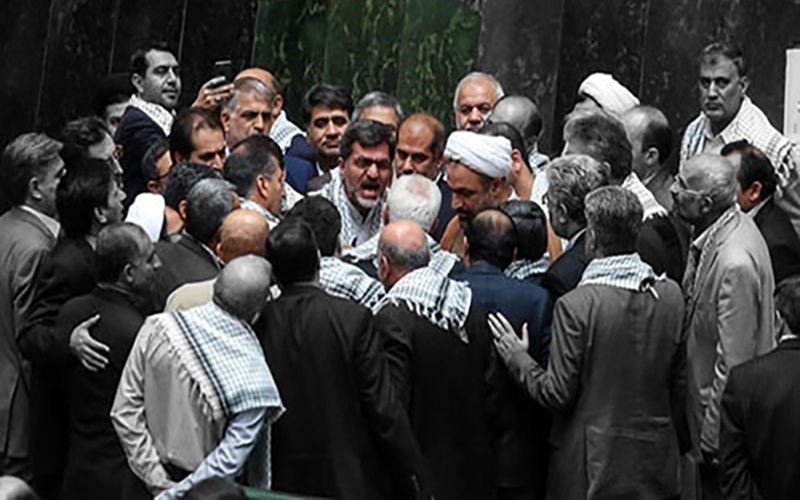

Street rallies once organized to defend the ruling system are now exposing unprecedented fractures within Iran’s ruling elite, revealing the growing weakness of Mojtaba Khamenei and a regime trapped in its own internal crises.
For years, Iran’s regime relied on orchestrated street gatherings and displays of loyalty to project an image of unity and strength. Yet the pro-regime rallies held on June 13, 2026, revealed something very different: a political system increasingly consumed by internal conflict, factional warfare, and a growing crisis of authority at its highest levels.
Rather than demonstrating unwavering support for the ruling clerical establishment, these gatherings exposed the fragile and unstable condition of the entire regime. The finalization of a new understanding between Tehran and Washington has detonated long-simmering tensions among rival factions, bringing to the surface deep disagreements over the future direction of the regime and highlighting the weakness of the regime’s new Supreme Leader, Mojtaba Khamenei.
The hereditary succession that followed Ali Khamenei’s era was intended to preserve continuity and consolidate power. Instead, it appears to have produced the opposite effect. Before Mojtaba Khamenei has even had the opportunity to establish his authority, some of the regime’s most loyal supporters have begun openly questioning and challenging policies associated with the leadership.
This shift is particularly striking because the rallies themselves were originally designed as instruments of regime control. During previous periods of political unrest and war, such gatherings were used to intimidate opponents and deter popular uprisings. Today, however, they increasingly serve as platforms for factional grievances and internal score-settling.
In Tehran, demonstrators directed their anger at senior officials involved in negotiations and foreign policy. Chants that effectively accused government representatives of betraying the sacrifices made in defense of the regime reflected a broader sentiment among hardline supporters who believe the leadership is retreating from long-standing ideological positions. Other slogans openly branded prominent officials as traitors and infiltrators, language once reserved for the regime’s external opponents.
The significance of these confrontations should not be underestimated. For decades, the regime cultivated a political culture in which public criticism of strategic decisions approved by the Supreme Leader was considered unacceptable. Openly questioning officials who represented the leadership’s policies was effectively crossing a red line. Today, that red line appears increasingly blurred.
The public interventions of hardline parliamentarians have further highlighted the erosion of centralized authority. Figures such as Amirhossein Sabeti and Hamid Rasaei have openly attacked members of the negotiating team and questioned the direction of government policy. Their criticism goes beyond routine political disagreement; it reflects a struggle over who will define the regime’s future and whether Mojtaba Khamenei possesses the authority to impose discipline on competing power centers.
Such disputes would have been far less visible during Ali Khamenei’s rule. While factional rivalries certainly existed, they were typically managed behind closed doors. The current spectacle of regime factions openly confronting one another in public suggests a weakening capacity to maintain internal cohesion.
Perhaps most revealing has been the reaction from state-affiliated media and senior officials. Outlets linked to elements of the Islamic Revolutionary Guard Corps have expressed alarm over the increasingly divisive rhetoric emerging from these gatherings. Their warnings about growing discord, attacks on state institutions, and criticism directed even at military commanders indicate genuine concern within the regime’s power structure.
Similarly, judiciary chief Gholam-Hossein Mohseni-Ejei has appealed for unity and vigilance against those seeking to exploit divisions within the system. Such calls for cohesion are telling. Governments that feel secure rarely need to publicly plead for unity among their own supporters.
The anxiety visible among the regime’s leading institutions reflects a broader reality: the leadership understands that once cracks begin to appear within the apparatus of repression, maintaining political control becomes significantly more difficult. Internal fragmentation weakens the regime’s ability to respond effectively to mounting social, economic, and political pressures.
The comments of Ahmad Alamolhoda, the Friday Prayer leader of Mashhad, further illustrate the extent of the crisis. By comparing negotiations with the United States to a classic predator-and-prey relationship, he sought to reassure hardliners that any agreement would remain subject to the approval of the Supreme Leader. Yet his remarks also appeared aimed at shielding Mojtaba Khamenei from responsibility for unpopular compromises while shifting blame toward rival factions.
Such defensive rhetoric underscores a central problem confronting the regime. If the new Supreme Leader truly possessed unquestioned authority, there would be little need for subordinates and loyal clerics to repeatedly emphasize his ultimate control. The effort to reassure supporters often reveals the very insecurity it seeks to conceal.
Equally significant is Mojtaba Khamenei’s relative silence during this period of escalating tensions. Whether interpreted as caution, weakness, or political calculation, the absence of decisive public leadership has only fueled perceptions of uncertainty at the top.
The pro-regime rallies of June 2026 therefore offer a revealing snapshot of a political system under strain. What was intended as a demonstration of loyalty has instead become evidence of growing fragmentation. Rival factions are increasingly willing to challenge one another in public, senior officials are openly questioned by hardline supporters, and state institutions are issuing increasingly urgent appeals for unity.
These developments do not reflect confidence or stability. They point to a regime struggling to manage the consequences of its own contradictions. As economic pressures persist, public dissatisfaction grows, and internal rivalries intensify, the Islamic Republic faces a challenge that may prove more dangerous than any external threat: the gradual unraveling of cohesion within its own ranks.