


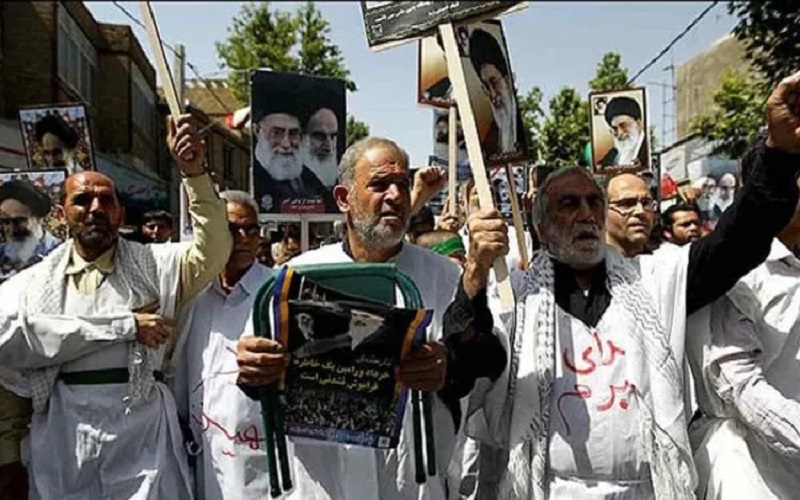

In recent days, the term “super-extremists” has gained traction in Iranian political discourse, sparking widespread discussion and analysis. This phenomenon, unprecedented in the mullahs’ rule, represents a new chapter in the regime’s ongoing strategy of repression.
The Early Years: The Birth of Government Thugs
In the early years of the Islamic Republic, when the regime’s foundations were still fragile, the phenomenon of government thugs emerged as a primary tool of enforcement. Armed with clubs, these enforcers sought to impose the ideology of the ruling clerics on the Iranian people through sheer force.
These thugs operated under the leadership of figures who personified brutality and repression. One such figure was Sadeq Khalkhali, who, without regard for legal norms, ordered the execution and assassination of thousands in the streets. His actions set a precedent for the regime’s systematic use of violence to silence opposition.
Historical Roots: Extremism Before the Revolution
The roots of extremism in Iran extend beyond the Islamic Republic. During the Pahlavi era, figures like Navab Safavi led extremist factions that carried out assassinations to eliminate political opponents. One of the most notable victims of this period was Ahmad Kasravi, assassinated by Safavi’s followers after being declared an apostate by Ruhollah Khomeini. These early acts of terror laid the groundwork for what would later become an institutionalized practice under the Islamic Republic.
Institutionalized Terror: Post-1979 Revolution
Following the 1979 revolution, the Islamic Republic formalized its use of extremist violence. The so-called “super-extremists” of the time formed armed squads that patrolled the streets, targeting and eliminating perceived enemies of the regime. Khomeini himself endorsed these actions, granting his followers a free hand to suppress dissent through intimidation, beatings, and outright murder.
The goal was clear: the physical elimination of political opponents while avoiding accountability for state-sanctioned violence. Many dissidents, particularly in the early years after the revolution, were assassinated or forcibly disappeared by these extremist groups operating under Khomeini’s directives.
Evolution of Extremist Tactics
By June 20, 1981, Khomeini had solidified his grip on power through maximum repression. Consequently, the role of super-extremists evolved. In the 1990s, their activities extended beyond Iran’s borders, leading to a wave of assassinations of political opponents in Europe and beyond. The serial killings of dissidents between 1988 and 1998 exemplified the regime’s continued reliance on assassination squads, both domestically and internationally.
The Role of Extremists in the Reformist-Principlist Divide
With the eventual factional split within the regime into so-called reformists and principlists, the role of the super-extremists also changed. Many of these enforcers aligned themselves with reformist figures, yet they continued to serve the regime’s interests when needed. They surfaced during political crises, either approving of repression or actively participating in it.
The regime’s violent apparatus took on various names over the years—”parallel intelligence agencies,” “vigilante groups,” “the ever-present Ummah,” “Hezbollah,” and the infamous plainclothes militia. Despite the shifting labels, their mission remained consistent: to eliminate opponents and advance the regime’s objectives through terror, intimidation, and violence.
A Temporary Decline and Resurgence of Super-Extremists
The appointment of Ebrahim Raisi as Iran’s president in 2021, a figure notorious for his role in mass executions, initially seemed to reduce the need for super-extremists. His direct control over the judiciary and security forces allowed for overt repression without relying as much on informal extremist groups.
However, following Raisi’s death in 2024 and amid a series of crippling political and economic setbacks for the regime, the use of super-extremists has resurfaced as a key tactic. The Iranian government, facing mounting pressure from domestic unrest and international isolation, appears to be once again deploying these groups to intimidate the population and crush opposition.
Conclusion
The phenomenon of super-extremists is not a new development but rather an evolving instrument of Iran’s ruling establishment. From the early days of club-wielding thugs to the sophisticated assassination squads operating abroad, these extremists have played a critical role in sustaining the regime’s power. As Iran faces increasing internal and external challenges, the return of super-extremists signals a renewed commitment to repression.