



Global consensus condemning Tehran’s regional aggression underscores the failure of appeasement and the urgency of accountability
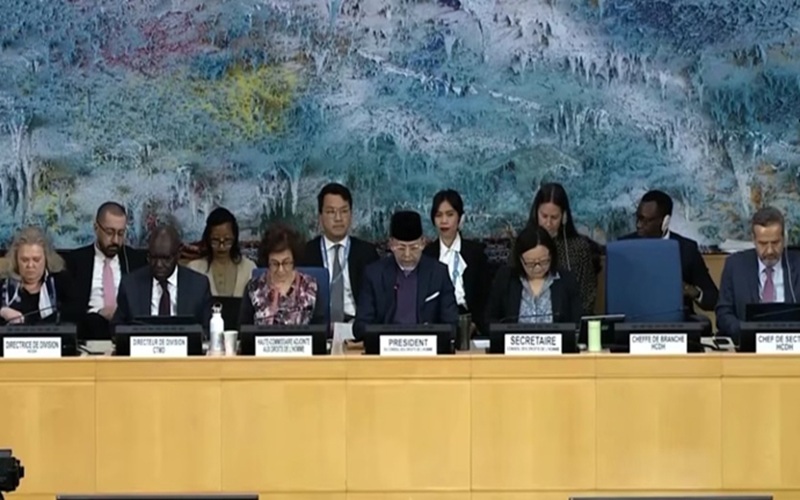
In an unusually unified display of international resolve, the United Nations Human Rights Council has adopted a unanimous resolution condemning Iran regime’s recent missile and drone attacks across the Persian Gulf region. The decision, taken during an emergency session in Geneva at the request of Gulf states, represents more than a routine diplomatic gesture—it signals a potential inflection point in how the international community confronts Tehran’s destabilizing conduct.
The resolution, jointly submitted by Bahrain, Kuwait, Oman, Qatar, Saudi Arabia, the United Arab Emirates, and Jordan, denounces Iran regime’s strikes on regional states as well as its effective closure of the Strait of Hormuz. It further calls for compensation for damages inflicted on civilian infrastructure and economies—an explicit acknowledgment of the scale and consequences of these attacks.
This rare unanimity is politically significant. For years, divisions among global powers have diluted international responses to Iran regime’s malign actions. This time, however, the message was coherent and unequivocal: cross-border attacks on civilian targets and critical infrastructure are unacceptable and must carry consequences.
At the session, Volker Türk issued a stark warning about the trajectory of the conflict. He emphasized that the expanding war in the Middle East risks drawing in countries far beyond the region, potentially creating a global crisis. He urged all parties to adhere strictly to international humanitarian law, stressing that deliberate attacks on civilians and non-military infrastructure could constitute war crimes. His remarks framed the issue not merely as a regional security challenge but as a fundamental test of the international legal order.
Representatives from multiple countries reinforced this legal and moral framing. European states, including France, the United Kingdom, Belgium, Spain, and the Netherlands, delivered coordinated condemnations of Iran regime’s actions. Their statements consistently highlighted several core concerns: the targeting of civilian populations, strikes on energy infrastructure, and attacks on commercial shipping routes.
France denounced the use of ballistic missiles and drones against neighboring countries, emphasizing the need for strict compliance with humanitarian law. The United Kingdom went further, criticizing attacks on unarmed commercial vessels and underscoring the strategic implications of disrupting maritime routes in the Gulf. Belgium and the Netherlands framed the issue within the broader context of international law, arguing that warfare does not grant license to violate human rights or target civilian infrastructure.
Meanwhile, Switzerland expanded the scope of criticism by linking Iran regime’s external aggression to its internal human rights record. Its representative highlighted ongoing executions and violent repression tied to domestic protests, suggesting that Tehran’s conduct abroad cannot be separated from its behavior at home.
Regional voices were equally forceful. Bahrain’s representative pointed to the direct human and economic toll of the attacks, describing strikes on densely populated areas, airports, ports, and energy facilities that resulted in casualties and widespread disruption. Japan and Cyprus echoed calls for an immediate halt to hostilities, warning of the broader implications for global stability and human rights protections.
Taken together, these statements reveal a convergence that extends beyond diplomatic rhetoric. The framing of Iran’s actions as violations of international law—and potentially as war crimes—marks a shift toward legal accountability rather than political containment.
This raises a critical question: does this resolution represent a substantive change in policy, or merely a temporary alignment driven by escalating conflict?
Skepticism is warranted. The international community has repeatedly condemned Tehran’s actions over the past decades, often without enforcing meaningful consequences. Yet the unanimity of this resolution, combined with its legal framing and the breadth of participating states, suggests that the cost-benefit calculus may be shifting.
If this moment is to carry real weight, it must be followed by concrete measures—diplomatic, economic, and legal. Without enforcement mechanisms, even the strongest language risks becoming symbolic.
What is clear, however, is that the narrative has changed. Iran’s regime is no longer being addressed primarily through the lens of negotiation or strategic patience. Instead, its actions are increasingly being treated as violations demanding accountability.
For policymakers, the implication is straightforward: the era of fragmented responses may be giving way to coordinated pressure. Whether that pressure translates into tangible outcomes will determine whether this resolution becomes a milestone—or just another missed opportunity.