


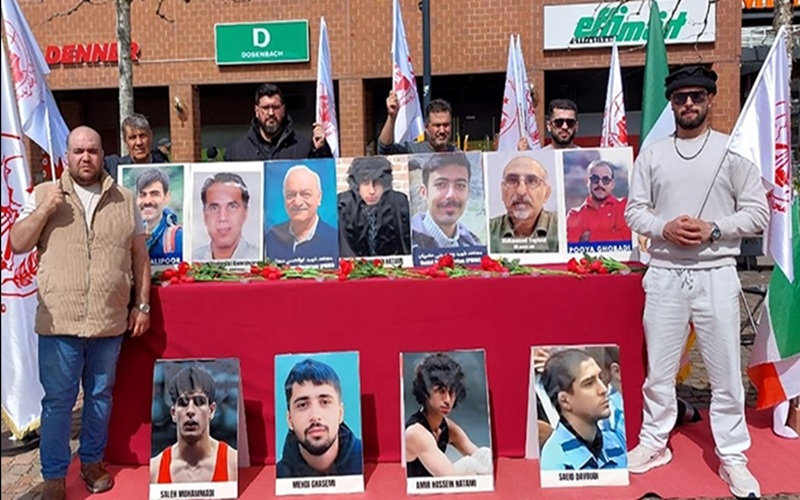

Why the Iranian regime escalates political executions amid external conflict and internal unrest
The execution of six members of the People’s Mojahedin Organization of Iran (PMOI/MEK) and affiliated Resistance Units between March 30 and April 4, 2026, followed by the killing of several defiant protesters, should not be understood as routine repression. These were deliberate political acts carried out at a moment of heightened domestic vulnerability and external pressure for Iran’s ruling establishment.
At first glance, the timing may appear counterintuitive. Why would a government facing international tension and strategic uncertainty escalate executions at home? The answer lies in the regime’s own threat perception. Tehran does not appear to be acting from a position of confidence. It appears to be responding to a convergence of threats that the leadership increasingly views as linked: external confrontation, internal protest, and the organizational resilience of anti-regime networks.
Maryam Rajavi, president-elect of the National Council of Resistance of Iran, has said these executions amount to a clear admission by the ruling clerics that their principal enemy is the Iranian people and the organized Resistance. That framing is politically useful, but it also captures an important reality. For years, the Iranian regime has tried to externalize its crises, presenting domestic unrest as the result of foreign interference. The current wave of executions suggests something different: the regime is now preoccupied with threats inside its own borders.
The so-called Resistance Units have become central to that concern. Unlike spontaneous protests, they represent an organized network with discipline, messaging, and a capacity for persistence. Their growing social influence, especially among disaffected youth, has clearly unsettled the authorities. The executions of figures such as Pouya Ghobadi and Babak Alipour were not isolated acts of punishment. They were intended to disrupt a broader political infrastructure the regime appears to see as increasingly dangerous.
That strategy may be backfiring. In political violence, coercive overreach often produces the opposite of deterrence. It can generate martyrs, deepen grievance, and strengthen the symbolic power of the targeted movement. Ghobadi and Alipour, both of whom reportedly endured years of imprisonment, torture, and repeated arrests, were executed not because they had been neutralized politically, but because they remained politically meaningful.
This is part of a long-standing pattern in the regime’s governance. The state has often relied on what amounts to deterrence through terror: public punishment, harsh sentences, and executions as a warning to society. But such tactics are most effective when fear remains intact. In 2026, that assumption is less reliable. A generation that has already witnessed repeated cycles of protest and crackdown may be less easily intimidated than the regime expects.
The broader context matters as well. As global attention shifts toward regional conflict and great-power competition, Tehran has a narrower window for domestic repression with reduced international scrutiny. That dynamic is not unique to Iran. Authoritarian systems often intensify coercion when they believe the outside world is distracted. What is happening now fits that pattern closely.
This raises uncomfortable questions for outside governments. Diplomatic engagement without accountability can normalize the use of execution as a tool of governance. The alternative is not necessarily isolation for its own sake, but clearer consequences: targeted legal pressure, coordinated diplomatic signaling, and greater scrutiny of the institutions carrying out repression. None of these measures will transform Iran overnight. But all are preferable to a policy that treats the current escalation as merely internal security management.
The execution of Bani Amerian, Montazer, Alipour, Ghobadi, Taghavi, and Daneshvar Kar may come to be seen as more than a sequence of individual tragedies. It may prove to be a marker of strategic exhaustion inside a system that increasingly depends on coercion to manage political instability. That is not a sign of regime strength. It is a sign that the state fears a challenge it can no longer comfortably contain.