


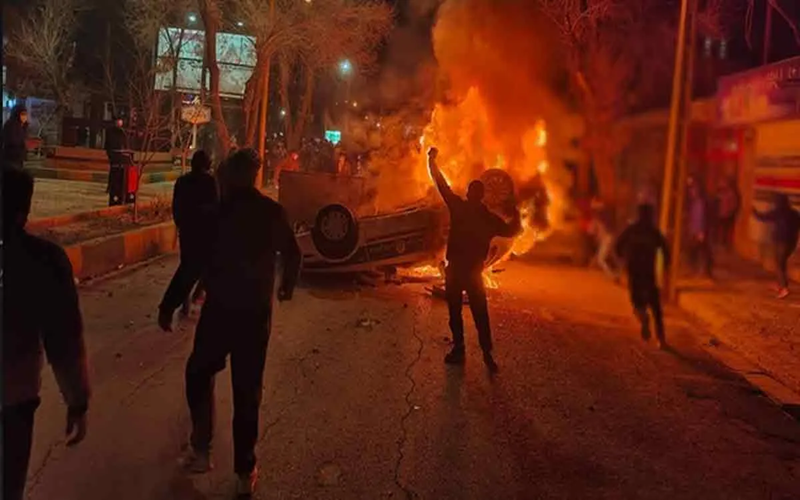

As the regime attempts to suppress traditional celebrations, activists say festivals such as Nowruz and Chaharshanbe Suri are becoming symbols of resistance and demands for democratic change.
As Iran approaches the spring of 2026 (Nowruz 1405), the country finds itself at a critical crossroads—between celebration and mourning, and between the aspirations for freedom and the persistence of authoritarian rule. The arrival of the Persian New Year traditionally marks a season of renewal and national unity. Yet critics of the mullahs’ regime argue that the regime is attempting to transform these cultural traditions into periods of enforced mourning.
According to observers, the authorities have sought to use the death of Ali Khamenei as a political pretext to restrict or discourage public celebrations associated with national traditions. Events such as Chaharshanbe Suri, Nowruz, and Sizdah Bedar have long symbolized renewal, community, and the endurance of Iranian cultural identity. Critics say the regime’s effort to impose mourning during this period reflects a broader attempt to suppress social energy and public gatherings.
Analysts and activists argue that authoritarian systems often attempt to limit expressions of joy, solidarity, and cultural identity when they perceive such expressions as potential catalysts for collective action. In this context, national festivals can take on a political dimension, serving as spaces where citizens express both cultural pride and social frustration.
For many Iranians, reclaiming these traditions has therefore become intertwined with broader calls for political change. Supporters of democratic reform say that preserving national customs is also a way of defending cultural identity against what they describe as attempts to reshape public life through ideological control.
This year’s celebrations of Chaharshanbe Suri—the traditional festival of fire held on the eve of the last Wednesday before Nowruz—are expected to be particularly symbolic. The festival historically represents purification, renewal, and the casting away of misfortune. In recent years, however, it has increasingly been viewed by some activists as an opportunity to express dissent and challenge restrictions imposed by security forces.
Reports suggest that regime authorities have mobilized extensive security measures during such events in the past, deploying police and security units to prevent gatherings or protests. Critics argue that these efforts reflect concern within the ruling establishment that spontaneous public celebrations could evolve into demonstrations.
At the same time, some political activists frame these cultural events as moments that highlight broader aspirations for a different political future. Supporters of the National Council of Resistance of Iran have linked the symbolism of these traditions to calls for democratic transformation, including support for the ten-point political platform proposed by Maryam Rajavi, which advocates a secular and democratic republic.
A central concern among many Iranians is how to move beyond authoritarian rule without falling into another cycle of dictatorship. Discussions within opposition circles often emphasize the importance of clear boundaries against both the return of monarchical rule and the continuation of clerical governance.
In this sense, the struggle over cultural traditions has come to represent more than a dispute over public celebrations. For many Iranians, it reflects a deeper contest over national identity, political legitimacy, and the future direction of the country.
As the season of renewal approaches, festivals that have endured for centuries may once again become a powerful reminder of Iran’s long-standing traditions—and of the enduring aspirations of its people for freedom and self-determination.