


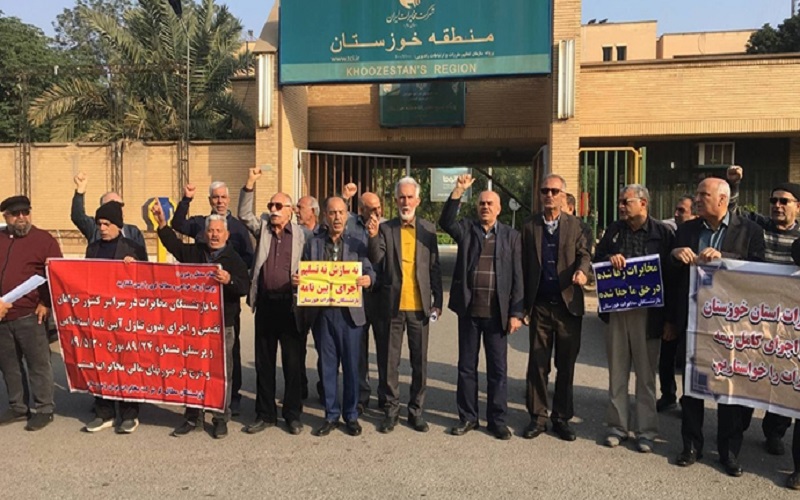

On Monday, January 13, several labor organizations and retirees in Iran issued a joint statement condemning the Iranian regime’s anti-labor policies, which they claim have alienated workers and wage earners across the country. Denouncing the government’s “wrong and anti-labor policies in all fields,” the statement warned of worsening conditions and a looming crisis for the working class.
The statement, signed by the Haftapeh Sugar Cane Workers Union, the Retired Union Group, the Coordinating Committee to Help Establish Labor Organizations, and a number of retired workers from Khuzestan Province, emphasized that Iran’s working class bears the primary burden of production in the country. It declared that workers are the “producers of the major wealth of society,” and that “the wheels of the economy move with this labor power.”
Wages Falling Far Behind the Cost of Living
The signatories criticized the government’s wage policies, describing them as “worse than in previous years.” They warned that continued suppression of wages would escalate the crisis, pushing society “closer to the edge of the abyss.”
The statement explained that workers’ wages, as the sole source of income for the working class, should at least meet the cost of living for an average urban family. The labor organizations demanded that wages be calculated based on the actual cost of living for a family of four in urban areas, as outlined in Article 41 of Iran’s Labor Law. This law requires that the minimum wage be determined based on inflation and the monthly cost of living.
However, activists and labor organizations argue that the government’s calculations are flawed. Official statistics place the monthly cost of living in large cities between 32 and 37 million tomans, but the signatories assert that the real cost for a family of four in 2024 is closer to 40 to 45 million tomans. In contrast, the minimum monthly wage for married workers with children is just 11 million tomans, with many workers earning even less.
Inflation and Housing Costs Crushing Workers
Omid Nasibi, a member of the Parliament’s Councils and Internal Affairs Commission, acknowledged the dire situation for workers, stating, “In the current inflationary conditions, the working class is unable to meet the cost of housing rent and livelihood. They are facing serious problems.” He added, “If inflation is not controlled, even with a 50% increase in salaries, there will be no improvement in people’s livelihoods.”
The government recently announced a 20% salary increase for employees next year, while reports suggest that workers’ wages could rise by 30%. However, these adjustments are far from sufficient. With inflation expected to rise further, the monthly cost of living in 2025 is projected to reach 55 to 60 million tomans, leaving workers and their families even further behind.
Wages Among the Lowest in the Region
Iranian workers currently receive some of the lowest wages in the world, lagging behind most neighboring countries. This disparity, coupled with skyrocketing inflation and the escalating cost of living, has placed immense pressure on the working class.
The labor organizations’ statement highlighted the regime’s failure to address these issues, arguing that its anti-labor policies have eroded its support among workers and wage earners. They called for unity among all oppressed classes, including workers, teachers, retirees, youth, women, farmers, and medical personnel, to confront the government’s policies.
Growing Protests and Government Crackdowns
In recent years, protests by workers, teachers, pensioners, and other wage earners have steadily increased. Demonstrators frequently chant slogans against the regime’s economic and labor policies, demanding fair wages and better working conditions.
Despite this growing unrest, the regime has responded with security and judicial measures aimed at suppressing protests. However, labor and social activists argue that the government’s repressive tactics have failed to quell the frustration of the working class.
A Call for Unity
As Iran’s economic crisis deepens, the working class and other marginalized groups are increasingly mobilizing to demand their rights. The joint statement by labor organizations underscores the urgent need for collective action, warning that without significant changes, the country’s economic and social fabric will continue to unravel.
With the cost of living outpacing wage increases and inflation showing no signs of abating, the Iranian regime faces mounting pressure from the very people it relies on to sustain its economy. The protests of workers, teachers, and retirees are not only a reflection of economic hardship but also a powerful indictment of policies that have left the working class struggling to survive.