


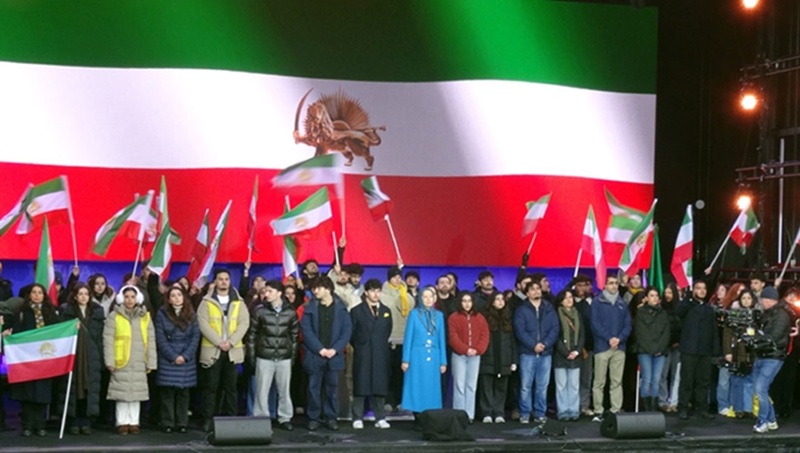

From 1979 to the January 2026 uprising, Iran’s ruling clerical system has remained locked in a relentless confrontation with its own youth.
When a senior judiciary official in Iran publicly admits that “90 percent of newly arrested individuals had no prior criminal record,” it is more than a statistical detail. It is a political confession.
The official, Hekmat-Ali Mozafari, deputy head of Iran regime’s judiciary, made this statement in reference to mass arrests during the January 2026 uprising. For observers unfamiliar with Iran’s political structure, the remark carries profound implications: the overwhelming majority of detainees were ordinary young citizens, not seasoned political activists or repeat offenders.
This is not an anomaly. It is the continuation of a 47-year pattern.
A System Born in Confrontation with Its Youth
To understand this dynamic, one must return to 1979, when the Revolution overthrew the monarchy of Mohammad Reza Shah. The revolution was largely powered by young people—students, workers, and politically engaged youth demanding political freedom and social justice.
However, once in power, Ruhollah Khomeini, hijacked the revolution and established a theocratic system known as Velayat-e Faqih (Guardianship of the Islamic Jurist), granting ultimate authority to a Supreme Leader. This structure centralized religious and political power in a way that left little room for pluralism or dissent.
Almost immediately after consolidating power, Khomeini turned against large segments of the same young generation that had fueled the revolution. Political prisons filled with students and activists. Public executions became a tool of intimidation.
The most notorious episode occurred in 1988, when thousands of political prisoners—many of them young—were executed following secret trials. The event, widely known as the 1988 prison massacre, remains one of the darkest chapters in modern Iranian history.
War, Repression, and Social Control
During the 1980–1988 Iran–Iraq War, young Iranians were sent in large numbers to the front lines. While the war was initiated after Iraq’s invasion, the regime used it to consolidate power internally, suppress opposition, and frame dissent as treason.
After Khomeini’s death in 1989, his successor, Ali Khamenei, inherited both the office and its underlying tensions with the youth.
Over the decades, the state expanded mechanisms of social control: ideological vetting in universities, surveillance in schools, morality policing in public spaces, and extensive censorship in media and culture. The regime attempted to shape young minds through religious indoctrination, media manipulation, and state-controlled narratives.
Yet the outcome has often been the opposite of what was intended. Instead of ideological consolidation, Iran has witnessed one of the highest brain-drain rates in the region. Instead of loyalty, widespread disillusionment.
The Reformist Mirage
In the late 1990s and 2000s, a so-called “reformist” movement emerged within the system, promising gradual change. For a time, parts of the youth invested hope in this process.
But after repeated crackdowns—particularly following the disputed 2009 presidential election—public trust eroded. A now-famous slogan from later protests summed up the sentiment: “Reformists, hardliners—the game is over.”
For many young Iranians, political factionalism inside the system no longer represented meaningful choice. The divide was seen as tactical rather than structural, leaving the core of clerical rule intact.
From 2009 to 2026: Escalation, Not Resolution
Major protest waves erupted in 2009, 2017–2018, 2019, 2022, and now again in January 2026. Each time, the demographic profile has remained consistent: young, digitally connected, economically pressured, and politically disillusioned citizens.
Each time, the state has responded with arrests, lethal force, and mass prosecutions.
Mozafari’s admission that 90 percent of the newly arrested have no criminal background underscores a crucial point: the regime is not battling organized criminal networks. It is confronting a generation.
This is not merely a security issue; it is a structural legitimacy crisis.
A Generational Deadlock
Since 1979, Iran’s clerical establishment has repeatedly attempted to manage, reshape, co-opt, or suppress its youth. It has used war, ideology, reformist promises, cultural engineering, and force.
Yet the pattern suggests an enduring impasse.
The state operates with a worldview rooted in religious jurisprudence and centralized authority. Meanwhile, successive generations have grown up in an era shaped by global connectivity, social media, economic hardship, and exposure to alternative models of governance.
The resulting clash is not episodic—it is systemic.
The Meaning of the “90 Percent”
The “90 percent” is not simply a figure tied to one uprising. It represents the widening gap between Iran’s governing elite and its society.
If nearly all those arrested are first-time detainees, it signals that political dissent is spreading beyond organized groups into the broader population. It suggests that protest participation is becoming normalized rather than exceptional.
For the regime, this presents a dilemma: repression can deter temporarily, but it cannot indefinitely extinguish a demographic reality. Iran is a young country. Its median age remains under 35. Every year, new cohorts enter adulthood with accumulated grievances—economic stagnation, limited freedoms, and political exclusion.
For nearly five decades, the ruling system has met these pressures with coercion. Yet each cycle of repression appears to sow the seeds for broader unrest.
Mozafari’s remark may have been intended as a procedural observation. Instead, it inadvertently highlights a deeper truth: Iran’s regime has been locked in a generational struggle since its inception.
And that struggle shows no signs of ending.