



Six years after the November 2019 uprising, the nationwide revolt remains a defining chapter in Iran’s struggle for freedom, exposing the regime’s vulnerability, the determination of ordinary Iranians, and the scale of resistance to clerical rule.
The November 2019 uprising marked a turning point in Iran’s modern struggle for freedom. What began on November 15, 2019, with a sudden increase in fuel prices rapidly developed into a nationwide confrontation with the ruling theocracy. Beneath the immediate economic grievances lay decades of accumulated anger over poverty, corruption, discrimination, repression, and systematic injustice.
Within days, protesters had moved far beyond demands for economic relief. Their slogans directly challenged the foundations of the regime, bringing the demand for an end to religious dictatorship into the streets. The scale, geographic reach, and intensity of the revolt demonstrated that Iran’s crisis was not simply economic or social. It was fundamentally political.
From Fuel Price Protests to a Nationwide Revolt
On Saturday, November 16, despite heavy rain and snowfall in several regions, protesters poured into major streets and highways across the country. Demonstrators blocked roads, set tires ablaze, and erected barriers, disrupting the regime’s ability to control key urban routes.
The slogans quickly moved beyond the fuel price increase. Chants such as “Death to Khamenei,” “Death to the Dictator,” and “Dictator, have some shame and leave the country” made clear that the protests were directed at the regime’s political leadership.
The uprising spread to more than 160 cities. Demonstrations and confrontations were reported in Tehran, Shiraz, Isfahan, Shahriar, Qods, and Behbahan, among many other locations.
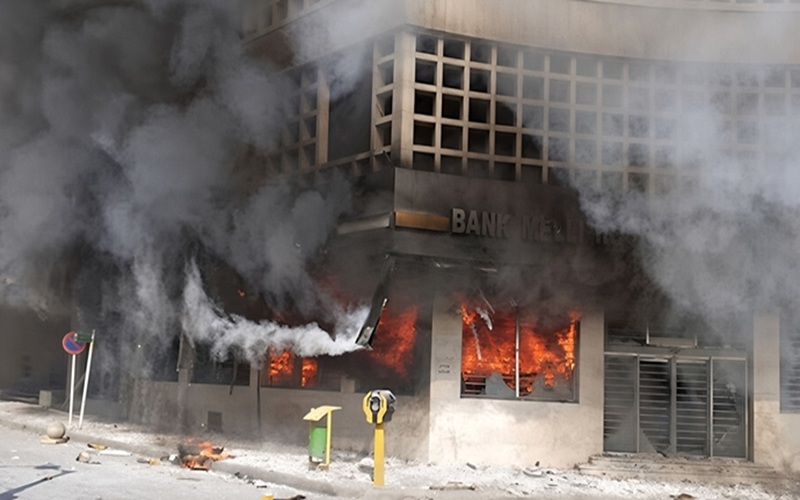
A defining feature of the revolt was the direct confrontation between protesters and institutions identified with the regime’s machinery of repression and economic control. Banks, Basij and IRGC facilities, police stations, fuel stations, governor’s offices, Friday prayer offices, and religious seminaries became focal points of the unrest.
The distinction between state institutions and ordinary people’s property was also a recurring feature in accounts of the uprising. Protesters directed their actions against institutions associated with the ruling establishment, while the movement’s broader demands reflected the economic and political grievances of ordinary citizens.
The Regime’s Own Officials Revealed the Scale of the Crisis
Perhaps the clearest indication of the uprising’s impact came from the regime’s own officials and security commanders. Their subsequent statements revealed the extent of the unrest and the alarm it generated within the ruling establishment.
Alireza Adyani, head of the Law Enforcement Force’s ideological and political organization, described the November events as more profound and complicated than the protests of 1999, 2009, and 2017. He referred to unrest in 165 cities, 25 provinces, and 900 locations.
IRGC Brigadier General Salar Abnoush, a Basij operational commander, offered a revealing assessment of the regime’s predicament. Recalling his presence during the events, he stated: “As someone who was on the scene, I believe only God saved us!”
Ali Fadavi, then deputy commander of the IRGC, compared the scale of confrontations across 28 provinces to conditions during a major military operation. IRGC political deputy Yadollah Javani also acknowledged that the uprising was unprecedented in the regime’s history, pointing to the spread of unrest across 110 locations in Isfahan Province alone.
Mojtaba Zolnour, a regime parliamentarian, cited the burning of 900 fuel stations, 147 confrontations in Tehran, and a crisis unfolding at 800 locations nationwide in a single day. He also described coordinated actions by small groups of protesters against Basij bases.
Then-Interior Minister Abdolreza Rahmani Fazli acknowledged widespread confrontations in areas including Malard, Baharestan, and Eslamshahr. He also referred to attacks on more than 50 military centers and hundreds of protesters advancing toward the headquarters of state broadcaster IRIB.
These admissions offer a revealing picture of how rapidly the uprising challenged the regime’s security apparatus. The authorities ultimately resorted to a nationwide internet shutdown, cutting off a critical channel of communication and documentation as the crackdown intensified.
The Poor and Marginalized at the Forefront
The geographical spread of the November uprising demonstrated that opposition to the regime was not confined to Tehran or a particular social group. From Khorasan to Khuzestan, from Sistan and Baluchestan to Azerbaijan, and from Kurdistan to Fars Province and the Persian Gulf coast, people from different communities joined the protests.
Among the cities swept up in the revolt were Ahvaz, Abadan, Mahshahr, Khorramabad, Tabriz, Rasht, Sanandaj, Marivan, Kermanshah, Karaj, Gorgan, and Sirjan.
Young people, workers, the poor, and residents of marginalized communities played a prominent role. Their participation reflected the accumulated consequences of economic deprivation and political exclusion under the regime.
Shiraz emerged as one of the major centers of resistance. The city was still recovering from the devastating floods of April 2019, which had exposed the authorities’ failures in crisis management. In November, residents again confronted the ruling establishment.
Accounts of the uprising reported that at least 120 facilities associated with the Basij, police, military installations, and banks were attacked in Shiraz during the initial days. Major routes were blocked, while confrontations placed considerable pressure on the regime’s security forces.
Subsequent accounts by regime intelligence and security institutions indicated that the authorities had faced serious difficulties maintaining control over parts of the city. The government ultimately relied on overwhelming force to reassert its presence.
The November Uprising and the Limits of Repression
The regime’s response to the November 2019 uprising exposed the central contradiction of its rule. Faced with a population demanding fundamental political change, the authorities relied on lethal force, mass arrests, and an internet blackout rather than addressing the grievances driving the protests.
The internet shutdown was particularly significant. By severing access to online communication, the regime sought to isolate protesters, obstruct the flow of information, and conceal the scale of its crackdown from the outside world.
But the violence could not erase what had happened in the streets. The uprising demonstrated the depth of public opposition to the ruling establishment and the determination of people who had reached the limits of their tolerance for economic exploitation and political repression.
A Legacy That Continues to Shape Iran’s Struggle
The significance of November 2019 extends beyond the immediate events of those days. The uprising established an important reference point in Iran’s continuing confrontation between society and the ruling establishment.
It demonstrated that economic grievances could rapidly develop into a nationwide political movement, that opposition to the regime crossed geographical and social boundaries, and that the authorities viewed such mobilization as a serious challenge to their continued rule.
The January 2026 uprising and the protests that followed took place in a different political and social context, but the experience of November 2019 remains an important part of the history of popular resistance in Iran.
The central message of November 2019 was unmistakable: the demand for change was not limited to lower fuel prices, improved living conditions, or isolated reforms. It concerned the political system itself.
The regime answered that demand with bullets, repression, and censorship. Yet the events of November left a lasting mark on Iran’s struggle for freedom. They revealed the depth of the country’s political crisis and underscored the determination of a population unwilling to accept poverty, discrimination, and dictatorship as its permanent destiny.