



A historical analysis of Iran’s successive uprisings and the gradual collapse of the regime’s political legitimacy
Over the past 26 years, Iran has witnessed six major uprisings, each with distinct characteristics yet deeply interconnected in their political and historical impact. Rather than isolated eruptions of unrest, these movements functioned as complementary phases in Iran’s social and political evolution, gradually transforming public dissent into a unified national demand for the overthrow of the ruling regime.
Each uprising contributed independently to reshaping political consciousness, eroding the regime’s legitimacy, and redefining the relationship between state and society.
The July 1999 student uprising marked the first major rupture. It shattered nearly two decades of enforced silence on university campuses, where absolute ideological control had prevailed since the early years of the regime. This uprising represented a direct challenge to the regime’s monopolization of political discourse and opened a limited but unprecedented space for dissenting views. However, the regime retained full institutional control, and repression quickly restored outward stability.
A decade later, the June 2009–February 2010 uprising, initially framed around the slogan “Where is my vote?”, reflected far deeper grievances. Beneath the electoral dispute lay accumulated anger stemming from the mass executions and repression of the 1980s under both Ruhollah Khomeini and Ali Khamenei. As protests persisted, demands moved beyond electoral reform toward the rejection of the regime’s authority itself. This period introduced a new political discourse within the ruling structure and produced a profound internal rupture that has never fully healed.
The January 2018 uprising represented a decisive break from regime-controlled narratives. For the first time, large segments of society disengaged from the long-standing factional rivalry between so-called “reformists” and “hardliners.” The collapse of faith in internal reform liberated social energy previously trapped within the regime’s political framework and marked a transition toward a discourse entirely external to the system.
The November 2019 uprising intensified this shift. Fueled by both class-based anger and decades of political repression, the protests delivered a systemic indictment of the regime’s economic and political architecture. The uprising clearly identified the Supreme Leader’s office and its affiliated institutions as the epicenter of corruption and repression. While brutally suppressed, it simultaneously radicalized social demands and deepened fractures within the regime’s power structure.
The September 2022–January 2023 uprising, ignited by the state killing of Mahsa Amini, expanded the struggle further. Rooted in opposition to the regime’s institutionalized misogyny, the movement placed the principle of absolute opposition to dictatorship—past, present, and future—at the center of its political identity. The confrontation was no longer confined to policy or leadership; it became a historical demarcation between the front of freedom and the front of authoritarianism. This discourse has persisted in waves and remains active.
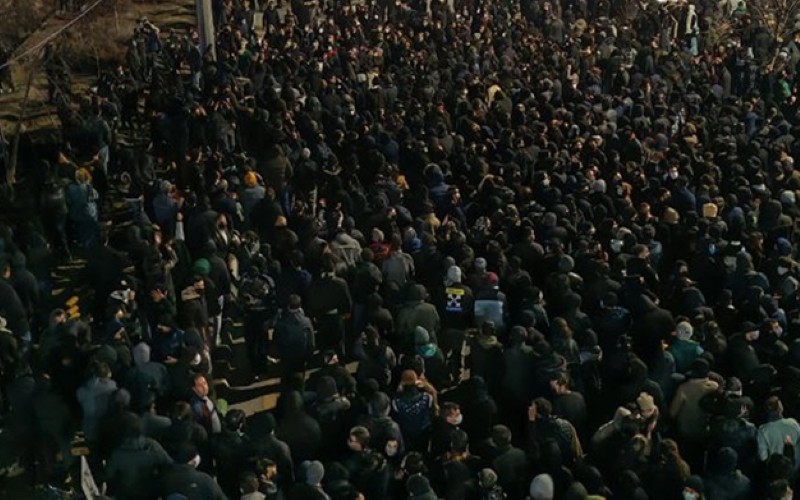
The January 2026 uprising stands as the cumulative outcome of all five previous movements. It consolidated class-based grievances, rejection of systemic corruption, long-standing frustration over unaddressed demands, and collective outrage at decades of repression and humiliation. For the first time, the regime’s overthrow emerged not as a marginal aspiration but as a broad, nationwide consensus.
At this stage, the dominant political discourse confronting the regime has become singular and unequivocal: the end of Iran’s occupation by the Mullahs through the complete dismantling of the regime.
As the final months of 1404 (Persian calendar) unfolded, this discourse began to mobilize unprecedented levels of social energy, shaping a nationwide struggle marked by both advances and setbacks. Positioned at the apex of Iran’s contemporary history, this movement represents an attempt to decisively sever the country’s future from all forms of dictatorship and to realize a long-suppressed national aspiration: a free and democratic Iran.