


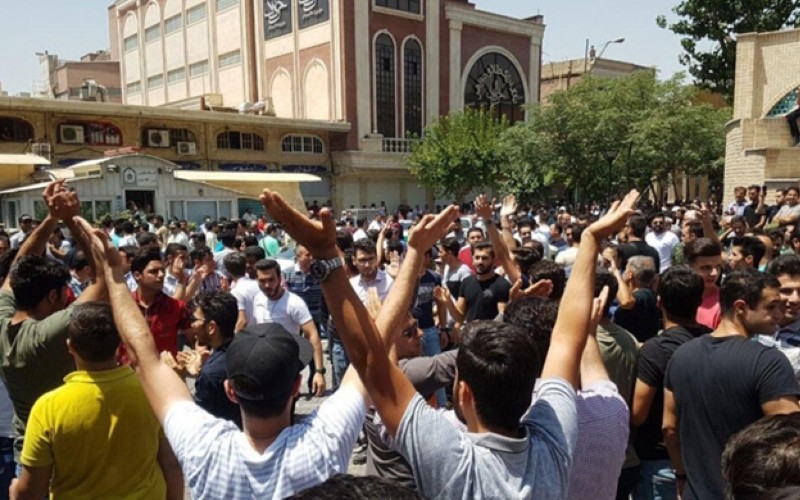

How official narratives around economic protests expose Tehran’s deeper fear of social uprising and loss of control
A close reading of Iran’s media on Wednesday, December 31, offers a revealing snapshot of the regime’s mindset. More than inflation, currency collapse, or widespread poverty, what truly alarms Tehran is the possibility that economic despair may once for all spill decisively into the streets—and stay there.
The dominant theme across regime media is not problem-solving but containment. The regime’s propaganda apparatus is working overtime to separate “legitimate” economic complaints from what it repeatedly labels as “riots,” “chaos,” or “foreign plots.” This rhetorical separation is not accidental; it is an admission of fear. The regime knows from experience that once bread-and-butter grievances connect with public space and collective action, repression becomes both costlier and less effective.
Security Panic Behind Ideological Language
Hardline outlets such as Kayhan and Vatan-e Emrooz are especially instructive. Their insistence that protests are driven by “organized networks,” “Israeli agents,” or “foreign-backed teams of dozens” is less an analysis than a reflex. It reflects an entrenched inability—and unwillingness—to acknowledge society as an autonomous political actor.
By portraying bazaar protests and strikes as security operations rather than social reactions, the regime signals its deepest anxiety: that traditional social bases it once claimed to represent, including merchants and small business owners, are no longer reliable buffers against unrest. The repeated warnings to the regime’s officials, not to “confuse the people with rioters” are, in reality, warnings to the system itself that the boundary between the two is eroding.
Equally telling is the obsession with “taking over the street.” For decades, the regime has tolerated limited, controlled dissent so long as it remained fragmented and confined. What it fears is continuity, visibility, and momentum. When regime media caution against protests “becoming street-based,” they are acknowledging that the street—not elections, not parliament—is where their legitimacy unravels.
Blame-Shifting as a Symptom of Weakness
Across these outlets, structural causes of the crisis—systemic corruption, sanctions driven by regime policy, economic mismanagement, and ideological priorities—are conspicuously absent. Instead, responsibility is displaced onto vague enemies and unnamed “saboteurs.” This pattern is not merely dishonest; it is strategically revealing.
A confident state addresses grievances. A fragile one criminalizes them.
Even when regime-aligned commentators concede the depth of economic suffering, they frame reform not as a right owed to citizens but as a security tactic to prevent unrest. Livelihoods are discussed less as human necessities and more as tools for social pacification. This is the language of a ruling system that views society not as a constituency but as a risk factor.
Cracks Within the Official Narrative
Not all regime-linked media maintain the same level of denial. Some in fear of the people’s rage, openly describe collapsing living standards, the erosion of constitutional rights, and a widening gap between state and society. Their warnings about a “burning crisis” and the exhaustion of public patience inadvertently confirm what the regime’s officials try to suppress: the legitimacy crisis is real, cumulative, and accelerating.
Yet even these internal critiques stop short of challenging the foundations of power. They plead for the state to “listen” while acknowledging that it has consistently refused to do so. In doing this, they expose another uncomfortable truth: the regime hears society clearly—it simply chooses repression over response.
Fear as the Unifying Thread
Taken together, these media reactions form a coherent picture. The regime is not confused about the protests; it is frightened by them. It understands that economic collapse is no longer a technocratic issue but a political trigger. It recognizes that every strike, every shuttered building representing the regime, and every gathering chips away at the myth of control.
The louder the talk of “foreign plots,” the clearer the reality becomes: the regime’s primary adversary is not abroad. It is the society beneath its feet—angry, exhausted, and increasingly unwilling to remain silent.
For observers of Iran, the message is unmistakable. When a state devotes more energy to delegitimizing protest than to addressing hunger, housing, and dignity, it is already governing in defensive mode. And defensive regimes, history shows, rarely regain the initiative.
What the regime’s media reveal today is not strength, but fear—and fear is a poor foundation for long-term rule.