


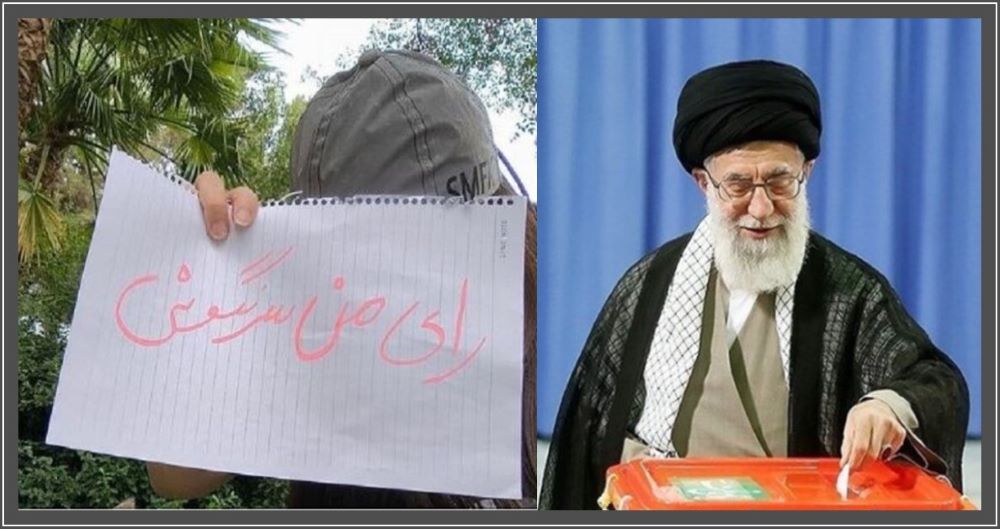

As widespread public participation was lacking in the second round of the government vote to determine the successor to Ebrahim Raisi on Friday, July 5th, reports indicated severe internet disruptions or outages in several cities, including Tehran, Ahvaz, and Rasht.
According to reports, the internet was cut off in several cities, including Ahvaz and Rasht, or its speed was significantly reduced in cities like Tehran.
Some social media users attributed this action to preventing the spread of news and images related to empty polling stations.
According to statistics announced by the Iranian regime, the participation rate in this vote was about 40%, and the majority of Iranian voters boycotted the first round. However, there are serious doubts about the accuracy of these statistics. Many accuse the government of manipulating the results and inflating the number of votes cast, claiming that the actual participation rate was much lower than reported.
The People’s Mojahedin Organization of Iran (PMOI), the main opposition to the Iranian regime, stated that the participation rate in the first round was 12%.
According to these governmental statistics, the participation rate in the first round of voting for government candidates to determine Ebrahim Raisi’s successor, held on Friday, June 28th, was 40%.
On the other hand, political prisoners, journalists, civil and political activists, and grieving families continued to refrain from voting.
According to civil and human rights activists, political prisoners in Evin and Ghezel Hesar prisons refused to vote.
After the ballot boxes were taken to Evin prison, over a hundred political prisoners refused to participate in this electoral circus.
While images and videos from dozens of cities in Iran indicated widespread public non-participation in the voting, the spokesperson for the Ministry of Interior’s Election Headquarters, Mohsen Eslami, announced a two-hour extension of the voting time until 8 PM. This time was later extended to midnight.
Ali Khamenei, the Supreme Leader of the Iranian regime, finally acknowledged on July 3rd, after four days of silence, that public participation in the first round of voting among the regime’s preferred candidates to succeed Raisi was “less than expected.”
While the majority of Iranian citizens boycotted the government voting and likened it to a “circus” and a “show,” Ali Khamenei claimed on Wednesday, July 3rd: “The idea that those who did not vote in the first round are against the regime is completely wrong.”
This comes after he had emphasized the importance of participation in the voting before the recent vote to replace Raisi, saying that “high participation” would bring “pride to the Islamic Republic.”
Additionally, the regime’s Ministry of Interior sent text messages urging people to participate in the elections. The lack of public participation in these elections is unprecedented in the history of the Iranian regime.
Mrs. Maryam Rajavi, the President-elect of the National Council of Resistance of Iran (NCRI), referred to the election boycott by the people in a message on her X account and said: ” Congratulations to the Iranian people for their determination to overthrow the religious dictatorship. This marks another crushing sledgehammer of a boycott to the principle of the velayat-e faqih (absolute clerical rule) and Khamenei’s farcical electoral masquerade. The disgraced and futile attempts to manipulate turnout figures in this second round of election sham have crumbled. This represents a universal “no” to religious despotism, a decisive vote by the Iranian people to overthrow regime and to establish a democratic republic. In a democratic Iran, there will be no room for despotism, remnants of clerics or the Shah, executions, or torture. ”
Congratulations to the Iranian people for their determination to overthrow the religious dictatorship. This marks another crushing sledgehammer of a boycott to the principle of the velayat-e faqih (absolute clerical rule) and Khamenei's farcical electoral masquerade.
The…— Maryam Rajavi (@Maryam_Rajavi) July 5, 2024