


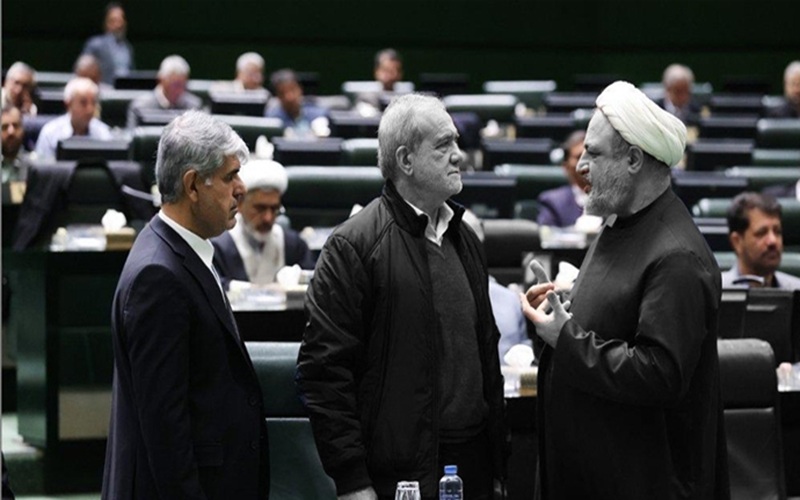

Public feuds over negotiations, succession, and state policy expose deep fractures within Iran’s ruling establishment, underscoring the growing weakness of the country’s hereditary leadership.
Five months after the death of Ali Khamenei, Iran’s ruling establishment is experiencing one of its most severe internal crises in decades. Public disputes among senior officials, competing political factions, state media, and clerical institutions have intensified, revealing a leadership struggling to maintain cohesion under mounting political and social pressure.
What had long been managed behind closed doors has increasingly spilled into the public arena. Rival factions now openly accuse one another of betrayal, weakness, and even attempts to seize power, illustrating the growing instability surrounding the country’s hereditary leadership.
A Leadership Increasingly Unable to Speak With One Voice
The widening divisions have become so pronounced that even routine policy issues have turned into battlegrounds for political infighting. Statements by senior officials are quickly met with denunciations from rival factions, leaving the regime unable to project a unified position on key national issues.
The latest dispute centers on the regime’s reported memorandum of understanding with the United States. President Masoud Pezeshkian described the agreement as the product of “collective wisdom” and consensus within the Supreme National Security Council, portraying it as a decision reached through institutional coordination.
His remarks were almost immediately challenged.
The Assembly of Experts issued a sharply worded statement condemning what it described as “voices of surrender” disguised as calls for peace. The statement declared that any advocacy of compromise constituted an “unforgivable betrayal” and insisted that authorities must confront such positions through legal measures.
The statement also reaffirmed calls for retaliation over those killed during the recent conflict, citing the Supreme Leader’s pledge that revenge “must certainly take place.”
State Media Joins the Political Offensive
The dispute rapidly expanded into Iran’s state-controlled media.
The hardline newspaper Kayhan attacked advocates of negotiations, accusing them of attempting to revive what it described as the failed strategy of diplomacy while encouraging surrender to foreign adversaries. The newspaper argued that proponents of engagement were promoting weakness at a time when, according to its narrative, external opponents were themselves under pressure.
Meanwhile, hardline parliamentarian Hamid Rasaei mocked claims by Parliament Speaker Mohammad Bagher Ghalibaf that he and former parliament speaker Ali Larijani had played a decisive role in mobilizing public support after Khamenei’s death.
Rasaei pointed to previous statements from the Supreme National Security Council, arguing that authorities had actually urged residents to leave Tehran rather than encouraging public gatherings. He accused Ghalibaf of exaggerating achievements beyond his official responsibilities.
The attacks triggered immediate responses from figures aligned with Ghalibaf.
Saberin News accused Ghalibaf’s critics of conducting a coordinated character assassination campaign, while Ghalibaf adviser Mohammad Saeed Rasouli alleged that opponents had attempted to block Ghalibaf’s re-election and had encouraged political unrest through provocative public statements. He further warned against rhetoric suggesting a coup, insisting that such actions would not go unanswered.
State Television Draws Criticism
Even the regime’s own broadcasting organization has become a subject of criticism.
Government-affiliated media questioned the handling of an important statement issued by the Supreme Leader’s office after state television reportedly delayed broadcasting it until sixteen minutes into its flagship evening news bulletin.
Critics argued that less significant reports—including coverage of Arbaeen-related events and routine public activities—were prioritized ahead of what was officially described as an important leadership statement. The unusual editorial decision fueled speculation about growing tensions even within institutions traditionally viewed as tightly controlled by the regime.
Pezeshkian Interview Abruptly Delayed
The controversy surrounding reports of President Pezeshkian’s possible resignation added another layer to the ongoing political conflict.
Following intensified speculation, the president’s office announced that a planned four-night televised interview with the public would be postponed, officially attributing the delay to Arbaeen mourning ceremonies.
The timing of the postponement nevertheless attracted attention, as it coincided with escalating disputes over Pezeshkian’s political future and competing narratives promoted by rival factions.
Negotiations Become Another Front in the Power Struggle
The question of negotiations with the United States has become one of the clearest symbols of the regime’s internal divisions.
Hardline voices continue to portray any diplomatic engagement as surrender, accusing supporters of negotiations of serving foreign interests and advocating unilateral concessions, including weakening Iran’s military capabilities.
In contrast, the newspaper Jomhouri Eslami criticized what it called “warmongers” within the political establishment. The paper argued that those advocating confrontation enjoy personal security while encouraging conflict that would further burden the country. It also accused hardline factions of attempting to force Pezeshkian’s resignation in order to regain control of executive institutions.
The newspaper urged the president to demonstrate the same determination he allegedly showed in signing the memorandum of understanding by resisting pressure from factions seeking renewed confrontation.
Nuclear Rhetoric Adds to the Tensions
The increasingly polarized atmosphere has also produced more extreme rhetoric.
Cleric Bagher Kharazi reportedly argued that the regime’s only path to survival would be to develop and detonate a nuclear weapon—remarks that further highlighted the increasingly radical positions emerging amid the political crisis.
Such statements reflect not confidence but the deep sense of insecurity that now characterizes debates inside the ruling establishment.
Growing Signs of Institutional Fragility
The escalating public confrontations suggest that the succession following Khamenei’s death has failed to restore political stability. Instead, competing factions appear increasingly willing to challenge one another openly, often using state institutions and official media as platforms for their disputes.
These conflicts are unfolding against a backdrop of persistent economic hardship, growing social dissatisfaction, and continued political repression. Rather than presenting a united front, the leadership appears increasingly divided over how to respond to mounting domestic and international pressures.
As these rivalries intensify, the regime’s ability to maintain internal cohesion appears increasingly uncertain, exposing vulnerabilities that were previously concealed behind the appearance of centralized authority.