


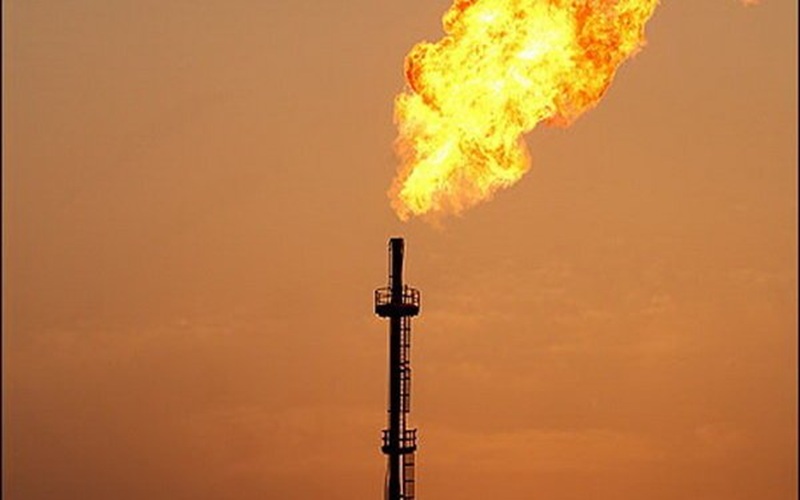

Despite possessing the world’s second-largest natural gas reserves, Iran continues to waste vast amounts of associated gas through flaring, deepening energy shortages and economic losses.
Even before summer has ended and Iranians have recovered from months of rolling electricity blackouts, officials are already warning of another severe natural gas shortage this winter. The prospect of renewed energy rationing underscores a long-running contradiction: despite holding the world’s second-largest proven natural gas reserves, Iran continues to struggle to meet domestic demand while wasting enormous quantities of valuable gas through flaring.
Experts say years of underinvestment, deteriorating infrastructure, and policy failures have left the country increasingly vulnerable to recurring energy crises, while billions of dollars in national wealth are literally burned into the atmosphere each year.
Officials Warn of Major Winter Gas Deficit
Mohammad Jafar Ghaem-Panah, executive deputy to President Masoud Pezeshkian, recently acknowledged that Iran is expected to face a daily natural gas deficit of approximately 100 million cubic meters during the coming winter.
“Even if the coming winter is not particularly cold, the country will still face an energy deficit that must be managed.”
Ghaem-Panah linked part of the expected shortage to damage sustained by refineries during recent military conflict. However, Iran has experienced recurring winter gas shortages for years, long before those events.
The continuing shortages point to deeper structural problems that include aging infrastructure, declining pressure in major gas fields, chronic underinvestment, and the regime’s inability to modernize the country’s energy sector.
Massive Quantities of Gas Are Still Being Burned
One of the most striking examples of mismanagement is the continued practice of flaring associated petroleum gas.
According to data from the National Iranian Oil Company (NIOC), approximately 80 million cubic meters of associated gas are produced every day during oil extraction. While part of this gas is processed and delivered to NGL facilities, millions of cubic meters continue to be burned because of insufficient collection and processing infrastructure.
The Iranian Parliament Research Center estimated that Iran flared approximately 50.5 million cubic meters of gas per day in 2022.
That volume was nearly equal to the production capacity of two phases of the South Pars gas field and roughly comparable to Iran’s daily natural gas exports during the same year.
The center estimated that gas flaring resulted in approximately $33.8 billion in lost economic value over the past decade.
If the gas burned in 2022 alone had been collected and exported, it could have generated an estimated $4.6 billion in revenue.
Iran Among the World’s Largest Gas Flaring Countries
According to the World Bank’s Global Gas Flaring Tracker, Iran ranked as the second-largest gas flaring country in the world in 2025, behind only Russia.
The report found:
- Russia flared approximately 30.28 billion cubic meters of gas.
- Iran flared approximately 29.93 billion cubic meters.
Although Russia’s oil production is estimated to be more than twice that of Iran, its flaring volume exceeded Iran’s by only about one percent.
The difference becomes even more striking when measured by flaring intensity—the amount of gas burned for every barrel of oil produced.
According to the World Bank:
- Iran: 19.55 cubic meters per barrel
- Saudi Arabia: 0.69 cubic meters
- United Arab Emirates: 0.98 cubic meters
- Qatar: 2.43 cubic meters
These figures place Iran among the least efficient major oil producers in utilizing associated gas resources.
Neighboring Producers Have Reduced Gas Waste
Regional energy producers have invested heavily in capturing associated gas instead of burning it.
Saudi Arabia began developing its Master Gas System in the 1970s, allowing associated gas to be collected and supplied to power generation and industry.
The United Arab Emirates has similarly expanded gas collection infrastructure through investments led by the Abu Dhabi National Oil Company (ADNOC), helping reduce gas flaring intensity to one of the world’s lowest levels.
The World Bank’s 2026 assessment listed the UAE among the countries with the lowest flaring intensity globally.
Rather than wasting associated gas, these countries use it to:
- Generate electricity.
- Supply petrochemical industries.
- Produce liquefied natural gas (LNG).
- Create additional economic value.
Billions of Dollars Lost Every Year
Iran burned approximately 22.8 billion cubic meters of associated gas in 2024, the highest annual volume recorded in the country based on available data.
Using European benchmark gas prices, analysts estimate the economic loss at approximately $9 billion.
That translates into:
- Around $1.04 million worth of natural gas burned every hour throughout 2024.
Between 2012 and 2024, Iran flared approximately 203 billion cubic meters of natural gas.
According to calculations by the Open Data Iran project, that volume was worth approximately $85.6 billion—roughly one-quarter of Iran’s estimated $341 billion GDP in 2025.
Over those thirteen years, Iran burned an average of nearly $750,000 worth of gas every hour.
Officials Continue to Acknowledge the Scale of the Problem
Despite repeated promises to reduce gas flaring, official figures suggest little progress has been made.
In February 2026, President Masoud Pezeshkian acknowledged that Iran continues to burn approximately 50 million cubic meters of gas every day.
He estimated the daily economic loss at roughly $17 million, adding that each million cubic meters of gas burned represents approximately $330,000 in lost value.
Structural Problems Continue to Drive Energy Waste
Energy specialists have long argued that Iran’s persistent gas flaring stems from structural failures rather than technological limitations.
Among the principal causes are:
- Aging oil and gas infrastructure.
- Chronic underinvestment.
- International sanctions restricting access to capital and technology.
- Weak governance and ineffective regulatory policies.
Critics also argue that the regime has consistently prioritized regional military spending and support for proxy groups over investments needed to modernize Iran’s domestic energy infrastructure.
The World Bank similarly notes that technologies needed to capture and utilize associated gas are already widely available. According to the institution, the primary barriers are inadequate investment, insufficient pipeline and market infrastructure, weak regulatory frameworks, and poor governance.
An Energy Crisis That Could Be Avoided
Capturing associated gas would not only prevent billions of dollars in annual losses but also help alleviate many of Iran’s recurring energy shortages.
Recovered gas could be used to generate electricity, supply petrochemical plants, and provide fuel for domestic industries while reducing harmful emissions and improving air quality in oil-producing regions.
Instead, as another winter approaches, Iran faces the prospect of renewed gas shortages despite possessing some of the world’s largest natural gas reserves—a stark illustration of how decades of mismanagement, underinvestment, and policy failures continue to undermine the country’s energy security and economic potential.