


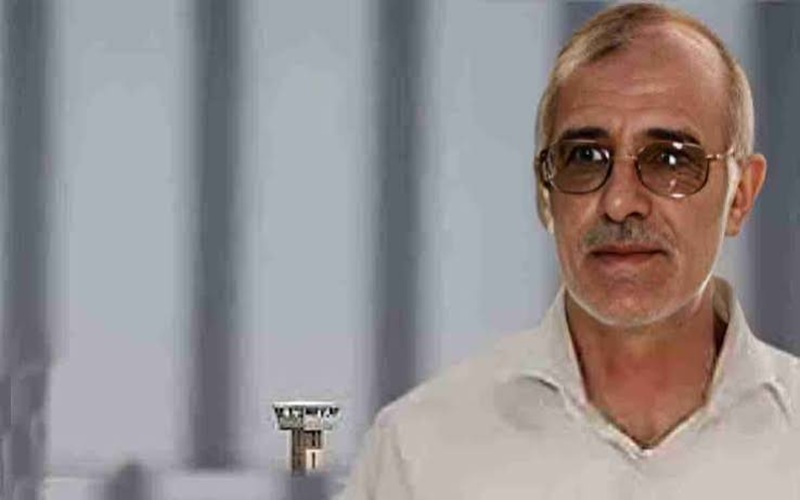

From Qezel Hesar Prison, political prisoner Ali Moezzi marks the 61st anniversary of the PMOI, calling for support for an organized democratic alternative and urging Iranians not to surrender their future to others.
Political prisoner Ali Moezzi has issued a message from Qezel Hesar Prison in Iran marking the 61st anniversary of the founding of the People’s Mojahedin Organization of Iran (PMOI/MEK), describing the organization as a product of decades of struggle and sacrifice and calling on the Iranian people to take an active role in determining their country’s future.
In his message, written in September 2026, Moezzi described the PMOI’s founding principles as centered on “unity, liberation, and freedom,” while emphasizing its opposition to colonialism, reaction, dictatorship, and political dependence.
“Sixty-one years of the evolutionary life of the People’s Mojahedin Organization of Iran—congratulations to Sister Maryam, to the soul of souls, and to the heroic people of Iran,” he wrote.
He characterized the organization as a movement whose members, in his words, have sought to separate religious faith from the political exploitation and repression carried out in its name.
“The Mojahed has removed the dust from the face of religion,” Moezzi wrote. “The People’s Mojahedin love God and God’s people, struggle for God and the people, and have no fear of the reproaches and obstacles created by their critics, censors, demonizers, those who create smoke and noise, those who block the way, and those who spread despair.”
From the Founding Generation to Organized Resistance
Moezzi used the image of a tree to describe the evolution of the PMOI over more than six decades. He traced what he described as the movement’s development from its founding in 1965 through successive phases of political and armed struggle, the establishment of the National Council of Resistance of Iran (NCRI), the formation of the National Liberation Army, the organizational transformations that followed, and the emergence of Resistance Units.
“The young sapling planted in September 1965, after 61 years—from Hanif to Massoud and to Maryam, passing through ups and downs and bloody tsunamis, watered by the rushing river of the blood of the finest children of this land, has now become a mighty tree and a steadfast support for the people of Iran, with its branches spread across the world,” he wrote.
He presented the movement’s different organizational phases as successive manifestations of the same political current, arguing that each stage has served a particular function in the broader struggle against dictatorship.
From urban guerrilla fighters and post-revolution militias to resistance fighters in the 1980s, the NCRI, the National Liberation Army in Camp Ashraf, the internal transformation of the organization, the emergence of women in senior roles, and the Resistance Units and supporters associated with Ashraf, Moezzi asked whether each represented another product of what he called the movement’s “blessed tree.”
“Let Us Not Allow Others to Write Our Destiny”
A central theme of Moezzi’s message is the need for Iranian society to determine its own political future rather than allowing outside forces or competing political currents to impose a solution.
“Looking back at the past, we realize that without a doubt, the glorious future of Iran and the Iranian people depends on the continuity and solidarity of the people of our homeland with this treasure that they have nurtured—and nothing else,” he wrote.
He argued that various political paths taken over the decades have already been tested, and urged Iranians to draw lessons from that history.
“The roads, the wrong roads, and the byways have all had their trial,” Moezzi stated.
Against this backdrop, he issued a direct appeal to the Iranian people:
“Let us not allow others to write our destiny. Let us not leave this capital and national treasure idle; let us hold firmly to this steadfast rock.”
Organized Resistance and the People
Moezzi linked the effectiveness of resistance to the relationship between organized political structures and broader society. He argued that neither mass anger without organization nor an organization disconnected from society can independently produce fundamental political change.
“Organized resistance needs the masses, and the shapeless masses need this organized resistance,” he wrote.
He portrayed Iranian society as facing severe economic and social pressures, referring to people who are angry, desperate, trapped in hardship and hunger, and deprived of avenues for earning a livelihood.
For Moezzi, the political alternative he supports represents a means through which popular demands for freedom and equality can be translated into organized political action.
“Supporting and joining an independent and democratic alternative is the guarantee of freedom, democracy, and equality for tomorrow’s Iran,” he wrote.
A Call for Continued Resistance
The message concludes with slogans calling for continued resistance against oppression and rejecting both monarchical and clerical forms of dictatorship.
“Do not remain calm for even a moment, for the blood of the people is being wasted,” Moezzi wrote.
He concluded with the slogan:
“Death to the oppressor, whether he is Shah or Leader.”
And he expressed his hope for the success of what he described as the Iranian people’s democratic revolution:
“Long live the democratic revolution of the people of Iran.”
Issued from Qezel Hesar Prison, Moezzi’s message combines a commemoration of the PMOI’s 61-year history with a political appeal directed at Iranian society. Its central argument is that Iran’s future should be determined by its people through unity, organized resistance, and support for an independent democratic alternative rather than through another imposed form of dictatorship.