


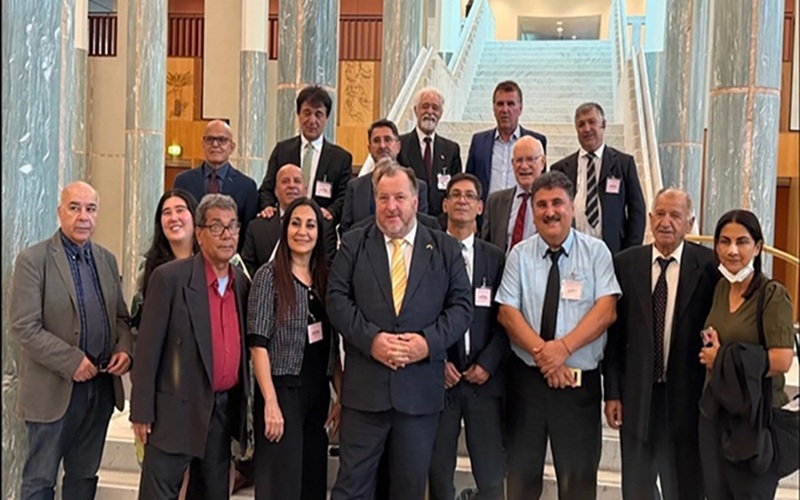

Lawmakers in Canberra reaffirm backing for democratic change in Iran, emphasizing unity, human rights, and rejection of dictatorship in all forms
As the Iranian regime intensifies domestic repression while escalating tensions abroad, efforts to contain public unrest and divert the trajectory of uprisings have become increasingly apparent. In this context, international backing for the organized resistance of the Iranian people is emerging as a critical factor in shaping the country’s political future.
A parliamentary meeting held on March 25, 2026, in Canberra offered a clear indication of this growing alignment between global policymakers and the aspirations of the Iranian people. The session brought together Australian lawmakers from across the political spectrum, underscoring a unified stance in support of democratic change in Iran.
Rob Mitchell, Chair of the Australian Parliament’s Standing Committee on Industry, Innovation and Science, highlighted the bipartisan consensus within Australia in supporting Iran’s resistance movement. He reaffirmed his endorsement of Maryam Rajavi’s Ten-Point Plan, describing it as a credible framework for establishing a free and democratic Iran. Mitchell emphasized that the Iranian people deserve fundamental rights, including free and fair elections, religious freedom, and the ability to determine their own future. He also stressed that any return to authoritarian rule—whether monarchical or theocratic—must be firmly rejected.
His remarks come at a time when Tehran is actively attempting to shape international narratives through lobbying efforts and proxy voices abroad, often promoting alternative scenarios that critics argue are designed to derail genuine democratic change.
Gabriel Ng, another member of parliament, pointed to the repeated uprisings in Iran and the regime’s violent crackdowns. He reiterated Australia’s solidarity with the Iranian people, emphasizing support for their pursuit of democratic rights and human rights protections. Ng also noted that Canberra has taken concrete steps in response to Tehran’s actions, including diplomatic measures and expanded sanctions targeting the regime.
The session also featured remarks from Lisa Darmanin, a senior government senator and chair of the Senate Economics Legislation Committee. She underscored the prominent role of women in Iran’s protest movements, highlighting their leadership and resilience in the face of repression. Addressing Rajavi, Darmanin praised her leadership and perseverance, framing it as emblematic of the broader struggle led by Iranian women.
In closing, Mitchell reiterated that the breadth of participation in the meeting—from multiple parties and institutional levels—reflects a genuine and sustained commitment within Australia to support the Iranian resistance. He conveyed confidence that this support would not only continue but expand in the future.
Far from being a symbolic gesture, the Canberra meeting signals the consolidation of a tangible international pathway for change in Iran—one rooted in popular demands, organized resistance, and a defined democratic alternative.