


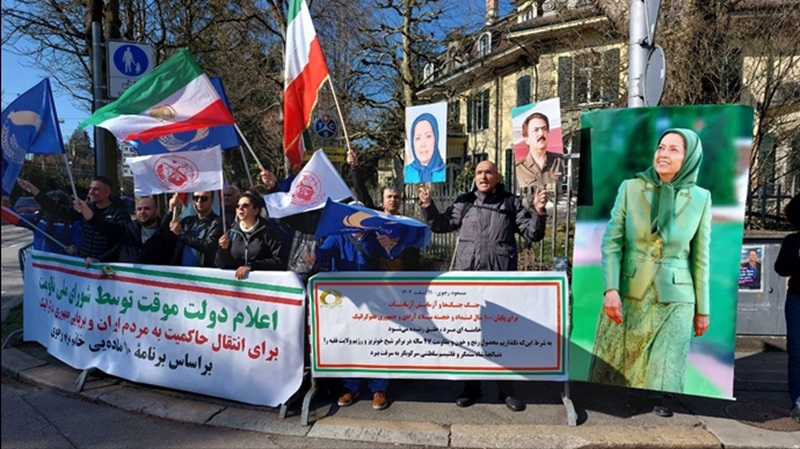

Political leaders across Europe and North America endorse the Ten-Point Plan for a democratic republic, while messages from Iranian cities signal domestic backing for the proposed transition.
Following the announcement by the National Council of Resistance of Iran of the formation of a provisional government based on a Ten-Point Plan to transfer sovereignty to the Iranian people, prominent political figures from Europe and North America have publicly welcomed the initiative. Simultaneously, messages attributed to Resistance Units inside Iran suggest that support for the proposal is not confined to political circles abroad.
Transatlantic Endorsements
In London, David Alton underscored the importance of unity around democratic principles, stating:
“All Iranians who believe in democracy must stand together, seek a just and peaceful resolution of the conflict – and together forge a nation led by Iranians committed to living peacefully alongside its neighbours in the region. The 10 point plan based on democracy, human rights and the rule of law remains the best blueprint for national unity and an end to horrific dictatorship and oppression.”
All Iranians who believe in democracy must stand together, seek a just and peaceful resolution of the conflict – and together forge a nation led by Iranians committed to living peacefully alongside its neighbours in the region. The 10 point plan based on democracy, human rights… pic.twitter.com/knWtmWRz0F
— Lord (David) Alton (@DavidAltonHL) March 2, 2026
From the United States, former Secretary of State Mike Pompeo wrote succinctly:
“Iran’s democratic opposition is ready to step up and lead.”
Iran's democratic opposition is ready to step up and lead. https://t.co/PkrJp0iSBN
— Mike Pompeo (@mikepompeo) March 1, 2026
Former Speaker of the House Newt Gingrich referred to the announcement in the context of recent regional tensions, noting:
“The National Council of Resistance of Iran, an anti-Iranian regime group, announced on Saturday a ‘provisional government to transfer sovereignty’ to the Iranian people and establish a Democratic Republic after the United States and Israel launched strikes against the regime.”
The National Council of Resistance of Iran, an anti-Iranian regime group, announced on Saturday a "provisional government to transfer sovereignty" to the Iranian people and establish a Democratic Republic after the United States and Israel launched strikes against the regime.…
— Newt Gingrich (@newtgingrich) March 1, 2026
In Canada, former Foreign Minister John Baird shared part of a message from Maryam Rajavi regarding the transfer of sovereignty to the Iranian people, while former Conservative Party leader Candice Bergen expressed hope that Iranians would soon be able to elect their own government and experience “freedom, equality, peace and opportunity.”
European Voices
Across Europe, support was similarly visible. Former Slovenian Prime Minister Janez Janša summarized his position in a brief but pointed message:
“Way ahead: #FreeIran”
Way ahead: #FreeIran pic.twitter.com/d1eNpMfAm6
— Janez Janša (@JJansaSDS) February 28, 2026
Meanwhile, Colombian-French politician Ingrid Betancourt offered a more detailed endorsement of Rajavi’s leadership:
“This woman leads Iran’s resistance. She calls for ending tyranny and for unity with Iranians suffering. The regime threatens the world, but first its own people. The January 2026 bloodshed marked a point of no return. Iran must move toward democracy; Rajavi’s call is a first step toward national unity.”
This woman leads Iran’s resistance. She calls for ending tyranny and for unity with Iranians suffering. The regime threatens the world, but first its own people. The January 2026 bloodshed marked a point of no return. Iran must move toward democracy; Rajavi’s call is a first step…
— Ingrid Betancourt Pulecio (@IBetancourtCol) March 1, 2026
Echoes from Inside Iran
Beyond international reactions, what may carry greater political weight is the reported response from within Iran itself. Messages circulated from cities including Mashhad, Tehran, Bojnord, Ahvaz, Shiraz, Isfahan, Qom, Bukan, Kermanshah, and Qazvin expressing support for the “announcement of a provisional government to transfer sovereignty to the Iranian nation” and for the “National Liberation Army of Iran.”
This convergence—endorsements from established international political figures alongside declarations of support from activists and Resistance Units inside the country—seeks to project the image of a democratic alternative with both global recognition and domestic resonance.
Whether this dual dynamic will translate into tangible political change remains uncertain. However, the alignment of external political backing with internal expressions of support marks a notable development in the evolving debate over Iran’s political future and the prospect of a transition toward a democratic republic.