


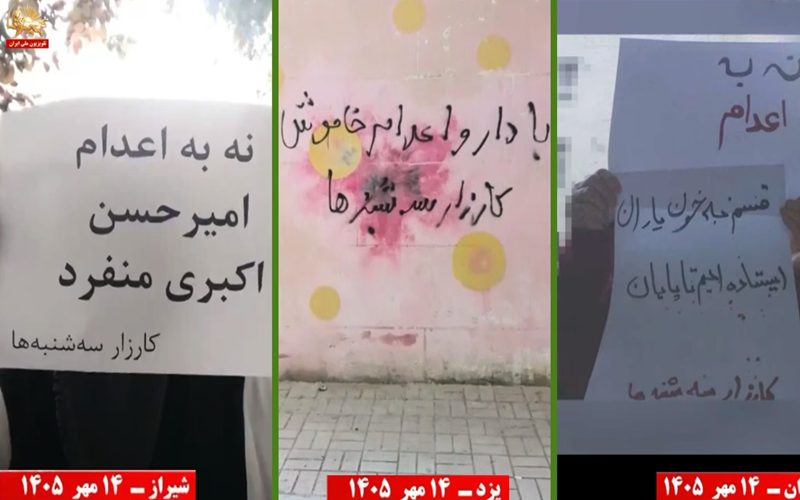

From Tehran and Karaj to Shiraz, Mashhad, Isfahan, Ahvaz, and other cities, young supporters of the Resistance are continuing to challenge the regime’s use of executions as an instrument of repression.
The campaign against executions in Iran is continuing to find expression across the country, with young supporters of the Resistance carrying out coordinated activities in a growing number of cities. Recent actions have included street postings, wall writing, banners, and photo campaigns calling for an end to executions and the release of prisoners facing death sentences.
The activities, associated with the “No to Execution Tuesdays” campaign, have been reported in Tehran, Karaj, Shiraz, Qaemshahr, Mashhad, Isfahan, Ahvaz, Shahrekord, Yazd, Nishapur, Kamalshahr, and Robat Karim.
The message running through these actions is direct: “No to executions,” “No prison, no executions,” and “Yes to life.”
A nationwide message against executions
In Tehran, a photo campaign carried slogans including “No to Execution” and “By the blood of our fallen comrades, we stand until the end.” The actions also highlighted the campaign against the execution of prisoners sentenced to death.
In Karaj, activists called specifically for the cancellation of the death sentences of Mansour Jamali, Manouchehr Fallah, Eisa Chari, Ehsan Faridi, and Zahra Tabari.
In Shiraz, an action called for an end to the death sentence of Amir-Hossein Akbari Monfared, while activities in Qaemshahr carried the broader messages, “No prison, no executions, no more killing” and “The gallows and hanging must be dismantled in Iran.”
The campaign’s message was also visible in Mashhad and Isfahan, where activists installed materials bearing the slogans “No to Execution” and “No to Execution, Yes to Life.”
In Ahvaz and Shahrekord, activists highlighted the cases of Alireza Mordasi and Eisa Chari, calling for an end to their executions.
“We will not be silenced by executions”
In Yazd, activists wrote on walls: “We will not be silenced by the gallows and executions.” In Nishapur and Kamalshahr, posters carried the messages “By the blood of our fallen comrades, we stand until the end” and “No to Execution, Yes to Life.”
Robat Karim saw several forms of activity, including photo campaigns and poster installations. Messages there urged people to hear the voices of prisoners under death sentence before it was too late and denounced execution as inhumane.
One message also highlighted the Ten-Point Plan’s call for the abolition of the death penalty, connecting the immediate campaign against executions with the broader vision for a future democratic Iran.
Executions as an instrument of repression
The persistence of these activities is significant because executions remain one of the regime’s principal tools for spreading fear and suppressing dissent. The “No to Execution Tuesdays” campaign has developed into a sustained prison-based and street-level movement, bringing together prisoners, activists, and supporters outside the prisons around a common demand to end executions.
The latest activities demonstrate that the campaign is not confined to prison walls. Its slogans are being carried into neighborhoods and public spaces across Iran, directly challenging the regime’s attempt to use the death penalty to intimidate society.
The repeated appearance of the slogan “No to Execution, Yes to Life” also reflects a broader rejection of the regime’s culture of repression. From Tehran to Zahedan and from major cities to smaller urban centers, the call to abolish executions has become part of a wider struggle against political repression and for fundamental rights.
As the “No to Execution Tuesdays” campaign continues, these activities underscore a growing determination among Resistance supporters to keep the plight of death-row prisoners visible and prevent executions from becoming normalized as an instrument of state control.