

Tehran plans new power reactors, expands uranium mining and fuel production, and seeks greater nuclear self-sufficiency as cooperation with international inspectors remains a central point of dispute.
Mohammad Reza Kardan, head of the Iran Nuclear Regulatory Authority, outlined the regime’s ambitions during the recent IAEA General Conference in Vienna. He argued that Iran needed nuclear energy to guarantee its energy security and said the 20,000-megawatt target had originally been approved before the 1979 revolution.
Kardan also acknowledged the difficulties created by international sanctions, particularly in obtaining technology, recruiting specialists, and maintaining communication with foreign nuclear regulators.
His remarks reflect a broader strategy pursued by the Atomic Energy Organization of Iran (AEOI): developing domestic capabilities across the nuclear industry to reduce dependence on foreign suppliers and maintain the regime’s ability to expand its nuclear infrastructure despite international restrictions.
Three reactors under construction as Tehran plans further expansion
AEOI chief Mohammad Eslami has outlined plans extending well beyond the operation of the existing Bushehr nuclear power plant.
According to information presented by Iranian officials at the IAEA conference, three nuclear power reactors are currently under construction, while preparations for another facility are underway. The organization is also conducting a two-year process to identify additional sites for future nuclear power plants.
The regime’s immediate plans include the construction of additional units at Bushehr and the development of a new four-reactor facility at Sirik, in the southern province of Hormozgan.
Bushehr Unit 2 is scheduled to begin commercial operation in 2029, while construction preparations for Unit 3 are also advancing. The two additional units are being developed with Russian VVER-1000 reactor technology under agreements with Russia’s state nuclear corporation, Rosatom.
Iranian regime officials have also highlighted the performance of Bushehr Unit 1, arguing that electricity generated by the facility over the past decade has been worth twice the government’s investment in its construction.
However, the expansion of nuclear power generation is only one component of the program. Tehran is simultaneously developing the industrial infrastructure required to produce nuclear fuel domestically.
Expanding uranium production and the nuclear fuel cycle
The regime is seeking to reduce its dependence on foreign suppliers by expanding uranium exploration, mining, processing, and fuel manufacturing.
Iranian officials have identified existing uranium mining operations in Hoshuomi, Narigan, and Saganda, alongside facilities for producing uranium oxide concentrate, commonly known as yellowcake.
The AEOI’s plans for the coming years include expanding uranium exploration across more than half of the country’s territory, constructing additional ore-processing facilities, and developing plants for converting uranium into uranium oxide and uranium hexafluoride (UF6).
The latter is particularly significant because uranium hexafluoride is the chemical form used in gas centrifuges for uranium enrichment.
The regime also intends to expand domestic production of zirconium cladding, fuel rods, and fuel assemblies for light-water reactors, as well as specialized fuel for research reactors.
These developments indicate that Tehran is pursuing a more comprehensive nuclear industrial base, rather than limiting its ambitions to electricity generation.
The AEOI has additionally announced plans to develop accident-tolerant nuclear fuel and facilities for the disposal of low- and intermediate-level radioactive waste.
Nuclear research extends beyond electricity generation
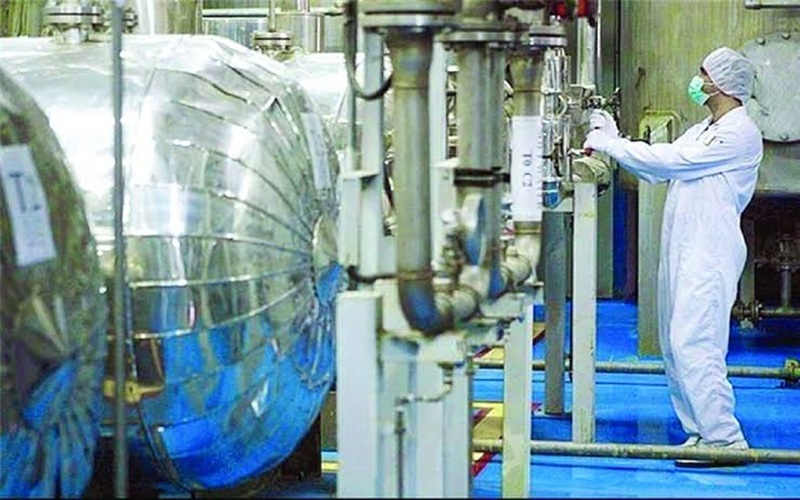
Iran’s nuclear activities also encompass research, medical applications, agriculture, and industrial technologies.
The Tehran Research Reactor, a five-megawatt facility operating since 1967, is used for scientific research and radioisotope production. Its applications include nuclear medicine, materials testing, and specialized research.
A new 10-megawatt research reactor, IRR10, has been under construction in Isfahan since 2022. It is intended to support nuclear fuel testing, radioisotope production, and scientific training.
The regime also reports expanding the use of radiation technologies in agriculture and food processing. Six radiation facilities are currently operating, with another six under construction. Iranian officials say these facilities are intended to improve food safety and reduce agricultural losses by approximately 30 percent.
Other applications include crop development, pest control, food disinfection, and the production of new agricultural materials.
While these activities have legitimate civilian applications, their development forms part of the same broader nuclear infrastructure whose transparency and international monitoring remain contentious.
Sanctions and foreign restrictions shaped the development of Bushehr
The history of the Bushehr nuclear power plant illustrates the extent to which Iran’s nuclear program has been affected by international political developments.
Construction originally began in 1975 under a contract with Germany’s Kraftwerk Union, a joint venture involving Siemens and AEG-Telefunken. The project initially involved two reactors based on German nuclear technology.
Following the 1979 revolution, the deterioration of Iran’s relations with Western countries and the withdrawal of the German contractor brought construction to a halt. The facilities were subsequently damaged during Iraqi air strikes in the Iran-Iraq war.
Iran approached several foreign nuclear suppliers during the 1980s in an effort to resume construction, but these attempts did not produce an agreement.
In 1992, Tehran reached an agreement with Russia to continue the project. Completing the facility presented considerable technical difficulties because Russian engineers had to integrate new technology with the partially completed German infrastructure. Much of the original equipment had been left behind without comprehensive technical documentation.
Bushehr Unit 1 was eventually connected to Iran’s electricity grid in 2011. The experience reinforced the regime’s emphasis on developing domestic nuclear expertise and reducing reliance on foreign suppliers.
A similar problem emerged with the Tehran Research Reactor after the United States discontinued its supply of highly enriched uranium fuel following the revolution. The reactor was eventually converted to use low-enriched uranium, initially supplied by Argentina. When concerns arose about future fuel supplies in 2009, Iran subsequently pursued domestic enrichment capabilities.
These developments are now being invoked by Iranian officials to justify the expansion of the country’s nuclear fuel cycle.
Nuclear expansion continues amid unresolved IAEA disputes
The regime’s nuclear expansion is taking place against the background of the unresolved dispute over its international commitments and the scope of IAEA inspections.
Under the July 2015 Joint Comprehensive Plan of Action (JCPOA), Iran agreed to restrictions on its nuclear activities in exchange for sanctions relief. The agreement was negotiated with the United States, the United Kingdom, France, Russia, China, and Germany.
Following Washington’s withdrawal from the agreement in 2018, Tehran progressively resumed activities that had been restricted under the deal.
Cooperation with the IAEA has also deteriorated. Restrictions on inspections and the reduced availability of information about Iran’s nuclear activities have complicated the agency’s ability to establish a comprehensive picture of the program.
IAEA Director General Rafael Grossi recently held discussions with Iranian Foreign Minister Abbas Araqchi about the possibility of restoring more meaningful cooperation.
Following the talks, Grossi told Reuters that he had observed an expressed willingness from Tehran to re-engage with the agency. He nevertheless stressed that preparatory work was necessary, particularly to establish clarity about activities carried out during the period of reduced cooperation.
The regime’s President Masoud Pezeshkian has also expressed readiness to resume negotiations over the JCPOA, arguing that broader discussions could follow if the agreement’s commitments were fully implemented.
However, diplomatic statements have not resolved the fundamental monitoring questions. IAEA Board of Governors resolutions demanding greater cooperation over outstanding safeguards issues and access for inspectors have been followed by further tensions between Tehran and the agency.
The central issue is not simply whether Iran can operate nuclear power plants or develop civilian nuclear technologies. It is whether the regime will provide the transparency and cooperation necessary for the international community to verify the nature and extent of its nuclear activities.
Calls to reconsider the nuclear weapons prohibition add to concerns
The debate over Iran’s nuclear ambitions has also reached the regime’s domestic political institutions.
Members of the the regime’s parliament have recently called on the Supreme National Security Council to review the country’s defense doctrine and reconsider the prohibition on developing nuclear weapons.
Such statements add another dimension to international concerns, particularly as the regime continues expanding its uranium-related infrastructure while cooperation with international inspectors remains restricted.
Iran is a signatory to the Nuclear Non-Proliferation Treaty (NPT), having signed it in 1968 and ratified it in 1970. Its obligations under the treaty include safeguards requirements intended to ensure that nuclear materials and facilities are not diverted toward weapons development.
The parliamentary calls do not establish that a decision to develop nuclear weapons has been made. Nevertheless, they highlight the continuing political debate surrounding the regime’s nuclear doctrine.
Energy security cannot replace international transparency
The regime presents its expanding nuclear program as a matter of energy security, technological independence, and national development. Its stated 20,000-megawatt target, however, involves much more than building electricity-generating reactors.
The simultaneous expansion of uranium mining, conversion, fuel manufacturing, and research infrastructure demonstrates the breadth of Tehran’s ambitions.
The history of the program shows that sanctions and restrictions have complicated foreign cooperation, while successive governments in Tehran have responded by developing domestic capabilities. Yet technological self-sufficiency does not resolve the questions surrounding transparency, safeguards, and international verification.
As the regime moves forward with new reactors and an expanded nuclear fuel cycle, restoring meaningful cooperation with the IAEA remains essential to establishing confidence in the peaceful nature of its activities. Without verifiable transparency, further expansion is likely to sustain rather than resolve the international dispute over Iran’s nuclear program.