


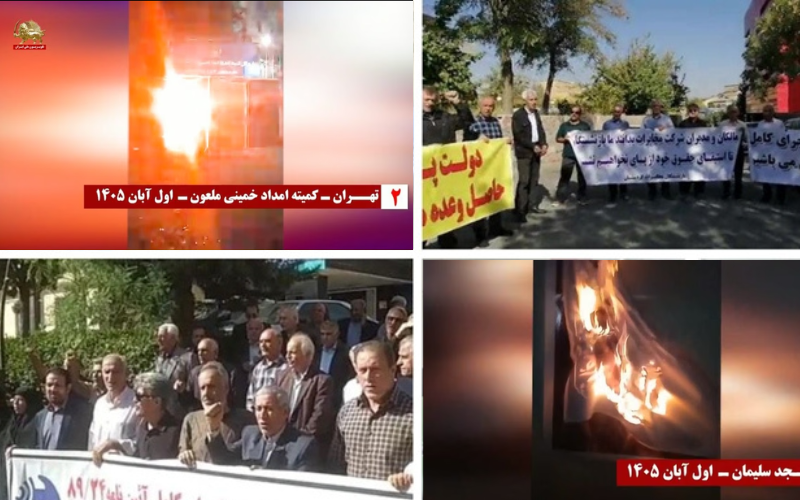

From political messaging to acts of resistance, the Resistance Units seek to connect the daily hardships of Iranian society with a fundamental political solution, relying on organization, strategic direction, and persistence under repression.
Iran’s economic crisis is not simply a question of declining living standards. For millions of people, it has become a struggle to secure the most basic necessities of life. Against this backdrop, the growing activities of the Resistance Units associated with the People’s Mojahedin Organization of Iran (PMOI/MEK) seek to connect public grievances with a broader challenge to the ruling system.
Their central message is that Iran’s social and economic problems cannot be separated from the political structure that governs the country. By linking everyday hardships to calls for fundamental change, the Resistance Units seek to transform widespread discontent into organized opposition.
Economic hardship fuels public discontent
The gap between wages and living costs illustrates the depth of Iran’s economic crisis. Even under relatively favorable circumstances, both parents in a family of four may need to work 12 to 14 hours a day to bring their combined monthly income to around 40 million tomans—approximately $170 at the exchange rate cited in the original account.
Such an income may not even cover rent, leaving little for food, healthcare, education, and other essential expenses. Long working hours also deprive parents of time with their children. This scenario assumes that both adults can find work, yet even their combined earnings may be insufficient to provide a decent standard of living.
The underlying problem extends beyond inadequate wage increases. When the cost of living rises faster than earnings, working families remain trapped in insecurity despite their labor. The result is a widening divide between those who produce society’s wealth and those who control a disproportionate share of its benefits.
For the Resistance Units, these economic grievances are inseparable from the political system responsible for governing Iran. Their message is that lasting relief requires fundamental political change, not limited adjustments that leave the underlying structures of power untouched.
This argument carries particular significance around the anniversary of the November 2019 uprising, when nationwide protests challenged the regime and security forces killed large numbers of demonstrators. The January 2026 uprising and the regime’s continuing executions further underscore the confrontation between demands for change and the machinery of repression.
From everyday grievances to organized resistance
Recent activities attributed to the Resistance Units illustrate their effort to connect specific social grievances with political opposition.
According to the reported figures, the units carried out ten operations described as “fiery” in response to security forces’ attack on Tehran’s wholesale produce market. Another ten followed the demolition of cafés along the coastal boulevard in Khorramshahr. The activities also included 30 instances of image-making and political messaging marking October 22, alongside 60 propaganda activities in different locations.
One of these actions reportedly took place during President Masoud Pezeshkian’s visit to Mashhad, where participants shouted, “Get out of Mashhad!”
The grievances behind these activities range from the treatment of traders to the destruction of small businesses and opposition to political repression. The Resistance Units seek to present such incidents not as isolated complaints but as expressions of a broader conflict between society and the ruling establishment.
Their approach combines political messaging with more confrontational forms of activity. The objective, as presented by the movement, is to maintain a visible presence, communicate opposition to the regime, and challenge the impression that repression has eliminated organized resistance.
Organization and strategic direction sustain activity
The persistence of the Resistance Units rests on more than individual acts of defiance. Organization provides a framework for sustaining activities, learning from experience, improving capabilities, withstanding setbacks, and maintaining political connections.
Without organizational continuity, acts of protest can remain isolated and disappear from public view. A structured movement, by contrast, can seek to preserve its presence over time and connect local grievances to a broader political program.
Strategic direction is equally important. The Resistance Units’ approach emphasizes adapting methods to conditions inside Iran and the regime’s responses, rather than relying exclusively on forms of opposition that avoid confrontation but leave the underlying political conflict unaddressed.
A third factor is the willingness of participants to accept the risks associated with political activity. In a system that severely punishes organized opposition, involvement can carry grave personal consequences. This commitment helps explain the persistence of such networks, even as it exposes their members to substantial danger.
Repression cannot resolve Iran’s political crisis
The regime’s judicial campaign against members and supporters of the PMOI adds another dimension to the confrontation. Proceedings involving 104 PMOI members have reportedly resumed, while the regime characterizes the organization’s activities through the Resistance Units as a capital offense. Even expressions of support may expose individuals to prosecution.
These measures form part of a broader climate of repression in which executions and prosecutions are used against political opponents. Yet coercion does not address the economic insecurity, social inequalities, and restrictions on political freedom that fuel public discontent.
Iran’s working families continue to struggle with rising living costs. Traders, small-business owners, and other groups face their own conflicts with the authorities. The Resistance Units seek to connect these different experiences to a common political demand: an end to the current system and the establishment of a democratic alternative.
The scale and consequences of this challenge remain uncertain. But the continued presence of organized opposition demonstrates that the regime’s efforts to suppress dissent have not eliminated the struggle over Iran’s political future.
Ultimately, the significance of the Resistance Units lies in their attempt to bridge the gap between social grievances and organized political action. Their strategy rests on the conviction that economic hardship, repression, and the absence of political freedoms are interconnected—and that addressing them requires more than isolated protests or temporary concessions. It requires confronting the system that has made these grievances a defining feature of life in Iran.