


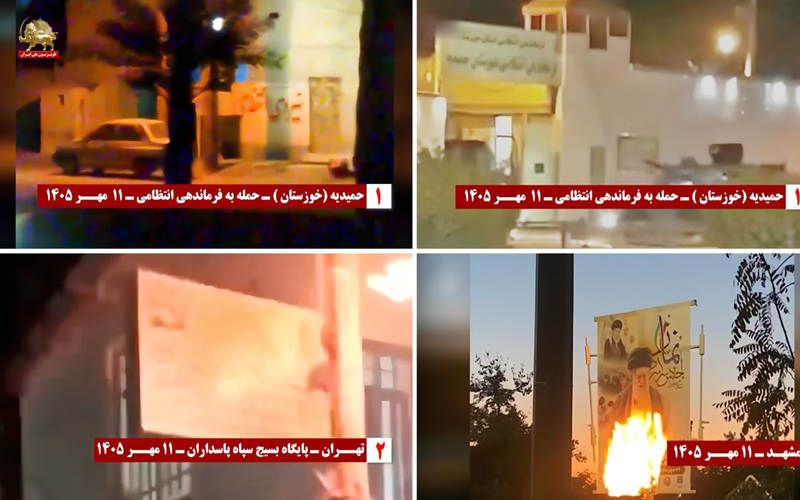

Coordinated acts of defiance reported in Hamidiyeh, Tehran, Mashhad, Karaj, Shahriar, Yazd, Gorgan, Birjand, Aligoodarz, and Bushehr following the executions of two January uprising protesters
The execution of two young protesters from Iran’s January 2026 uprising has triggered a new wave of defiant actions attributed to PMOI Resistance Units across several cities.
On September 30, the Iranian regime executed Ali Hemmati, 21, and Majid Nik-Andish, 25, in Mashhad. The two were accused by the regime’s judiciary of being among the “leaders” of protests in the Tabarsi area of the city during the January uprising. The charges cited by the judiciary included acts such as blocking streets, damaging banks, using Molotov cocktails, and confronting security forces.
The executions came after the regime had already executed three other young men—Mehdi Rasouli, Mohammadreza Miri, and Ebrahim Dowlat-Abadi—in May over their alleged role in the same unrest in Tabarsi.
The executions have reinforced warnings from the Iranian Resistance that the regime is using capital punishment as an instrument of intimidation against protesters and political opponents.
In response, PMOI Resistance Units reported 20 acts of defiance in Hamidiyeh, Tehran, Mashhad, Karaj, Shahriar, Yazd, Gorgan, Birjand, Aligoodarz, and Bushehr.
Resistance Units answer executions with coordinated actions
According to reports attributed to the PMOI Resistance Units, the activities included attacks on regime symbols and propaganda installations as well as actions targeting regime security and militia centers.
In Hamidiyeh, an attack was reportedly carried out against a police command center using gunfire. In Tehran, a Basij base affiliated with the Islamic Revolutionary Guard Corps (IRGC) was reportedly targeted with a Molotov cocktail, while another Basij facility was reportedly set on fire in Karaj.
A series of actions focused on dismantling the regime’s propaganda imagery. In Tehran, banners depicting Ali Khamenei and regime commanders killed in the war were reportedly burned. Similar actions targeting Khamenei’s banners were reported in Shahriar, Mashhad, Yazd, Gorgan, Bushehr, and Birjand.
Mashhad, the city where Hemmati and Nik-Andish were executed, saw multiple reported actions. Resistance Units said they burned Khamenei banners at four locations, as well as banners depicting Khomeini, Khamenei, and Mojtaba Khamenei. A billboard featuring Khamenei was also reportedly set on fire.
In Mashhad, banners depicting Qassem Soleimani and the regime’s proxy forces were also reportedly burned.
In Gorgan, reported actions targeted banners portraying Khamenei and regime commanders killed in the war. In Aligoodarz, Resistance Units reported burning a Khamenei banner and a sign identifying an intelligence ministry espionage headquarters.
Executions fail to silence dissent
The reported actions came as the regime sought to portray Hemmati and Nik-Andish as major figures in the January uprising. By publicly identifying them as “leaders” of the unrest, the regime has sought to reinforce its narrative that protesters constitute a security threat rather than citizens demanding fundamental political change.
The executions, however, have been met with renewed acts of defiance.
Maryam Rajavi, President-elect of the National Council of Resistance of Iran (NCRI), condemned the executions and called on the international community to take immediate measures to stop executions, particularly those targeting political prisoners and prisoners arrested during uprisings.
Rajavi said the executions demonstrate the regime’s fear of renewed popular unrest and are intended to intimidate a society that has repeatedly challenged the ruling system. She also warned that international inaction encourages the regime to continue executions and other systematic violations of human rights.
The latest activities attributed to the PMOI Resistance Units underscore a broader pattern: the regime’s use of executions as a tool of repression is being met not only with condemnation but with continued acts of organized resistance.
The executions of Ali Hemmati and Majid Nik-Andish were intended to send a warning to Iran’s protesting youth. The response reported across ten cities suggests that the executions have instead become another rallying point for opposition to the regime.