


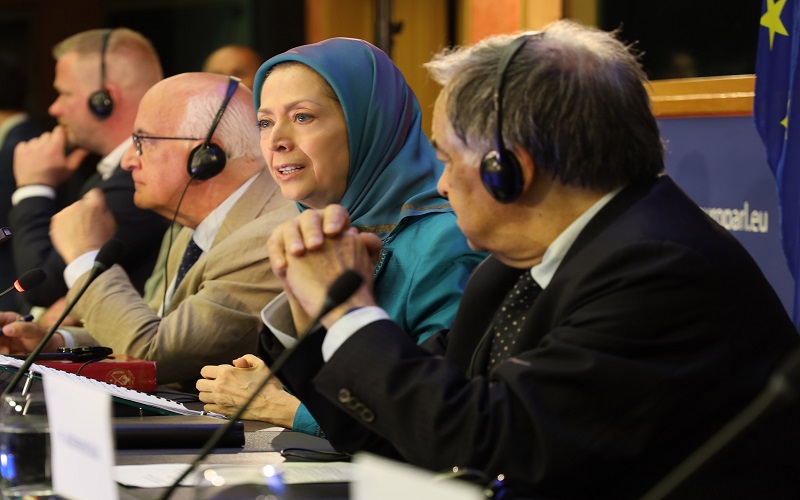

Strasbourg, June 18, 2025 — In a charged and resolute address to the European Parliament on Wednesday, Maryam Rajavi, President-elect of the National Council of Resistance of Iran (NCRI), declared that the only path to lasting peace in Iran and the region lies in the overthrow of the ruling regime by the Iranian people and their organized resistance.
Speaking seven months after her last address to the Parliament, Rajavi returned to Strasbourg with a stark message: the crisis in Iran has reached a tipping point, and appeasement has failed.
“The Crisis of Overthrow Has Engulfed the Regime”
Rajavi opened her speech by highlighting the worsening internal crisis facing the Iranian regime. “The crisis of overthrow has now engulfed the entire clerical dictatorship,” she said, referencing the recent developments in the region, including the June 13 outbreak of war. But she emphasized that the core conflict remains unchanged: “The central and ongoing conflict — unfolding over the past 44 years — is the struggle of the people of Iran and the Iranian Resistance against the ruling religious fascism.”
She reiterated a position she first laid out in the European Parliament over two decades ago: that neither military intervention nor appeasement can bring change to Iran. Instead, she reaffirmed the “Third Option” — regime change by the Iranian people and the organized Resistance.
“A Viper Never Gives Birth to a Dove”
Rajavi dismissed the notion of reform within the Islamic Republic as a dangerous illusion. “Religious dictatorship is inherently incapable of reform,” she said. The regime, she warned, will never abandon its nuclear ambitions, terrorism, or regional meddling. She recalled how it was the NCRI that first revealed the regime’s secret nuclear facilities in 2002 — a disclosure later confirmed by U.S. officials as pivotal in alerting the international community.
“The world was unaware of the regime’s bomb-making project. It was the Iranian Resistance that exposed it,” Rajavi stated.
“The Outcome of Appeasement: War”
Rajavi pointed to current geopolitical instability and rising conflict as the consequences of years of Western appeasement. “We warned that appeasement would ultimately lead to war,” she said, referencing a speech she gave to the same body in 2004. “Let us not allow the Munich experience to be repeated — with clerics armed with nuclear bombs.”
In her view, Iran’s Supreme Leader, Ali Khamenei, fears reform more than war. “He sees any concession as the quickest path to his own downfall,” she warned. “He does not fear death enough to take his own life, yet he is willing to plunge the defenseless Iranian people into war, terror, and insecurity — all to cling to his fragile and failing regime.”
“The Iranian People Will Not Tolerate Any Form of Dictatorship”
Rajavi underscored the Iranian people’s unwavering demand for democracy — rejecting both the current regime and the monarchy that preceded it. “That is precisely why we say: neither the Shah nor the mullahs,” she said. “The people of Iran will accept no form of dictatorship and demand freedom.”
She hailed the NCRI as the only democratic alternative grounded in a 60-year history of resistance, emphasizing that it cannot be imposed by foreign powers, as was the case in past Iranian political upheavals. “The NCRI is now in its 44th year. It has a clear platform and the trust of the Iranian people.”
“Western Silence Enables the Regime’s Crimes”
Rajavi sharply criticized Western governments and media for ignoring the Iranian regime’s ongoing atrocities. “Since [regime president] Pezeshkian took office in August 2024, more than 1,350 prisoners have been executed,” she said. “Iran has the highest per-capita execution rate in the world.” Yet despite repeated European Parliament resolutions condemning these abuses, the EU has not designated the Islamic Revolutionary Guard Corps (IRGC) as a terrorist entity — a step Rajavi and her allies say is long overdue.
She also condemned the “systematic demonization” of the Resistance, arguing that it has served to protect the regime rather than challenge its grip on power.
A Vision for a Free Iran
Rajavi laid out the NCRI’s democratic vision for the future of Iran — one that includes the separation of religion and state, gender equality, the abolition of the death penalty, and a foreign policy based on peace and cooperation.
“Our platform was adopted over four decades ago,” she said. “We do not seek money or weapons. We seek only the recognition of our Resistance — nothing more.”
She reaffirmed that after the fall of the regime, the NCRI would immediately step aside for an elected Constituent Assembly. “No later than six months after the overthrow, free elections will be held under universal suffrage,” she said. “The mandate of the Resistance’s transitional government will end at that point.”
She concluded with a quote from Resistance leader Massoud Rajavi: “We will not return to the past, nor will we remain stuck in the present — the future will undoubtedly be realized. Yes, a democratic and free Iran.”
Call to Action
Rajavi ended her remarks with a direct appeal to European lawmakers: “The time has come for the European Parliament to call on the EU and its member states to recognize the Iranian people’s struggle to overthrow the regime.”
She urged official recognition of the Resistance’s legitimacy and the ongoing fight of Iran’s “defiant and freedom-loving youth” against the regime’s repressive apparatus — especially the IRGC.
“The people of Iran want the overthrow of this regime,” she said. “We have risen up to bring about that change — to replace the regime with a democratic republic. That is the fundamental issue in Iran.”