


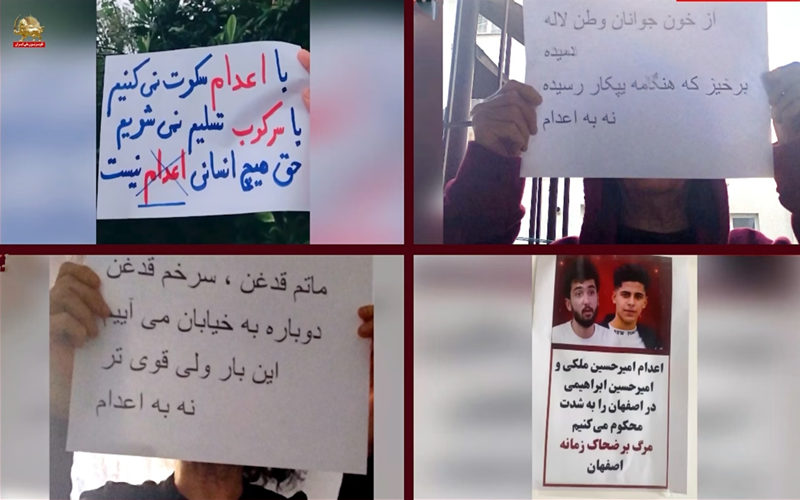

Coordinated activities in seven provinces call for the abolition of executions, freedom for political prisoners, and an end to the regime’s campaign of repression.
Resistance supporters and Resistance Units carried out a coordinated series of anti-execution activities across Tehran and several Iranian cities on November 10, 2026, expressing solidarity with political prisoners and supporting the nationwide No to Execution Tuesdays campaign.
The activities included distributing leaflets, displaying protest banners, organizing photo campaigns, and broadcasting audio messages. They took place amid an intensifying wave of executions by Iran’s regime, highlighting growing opposition to the use of capital punishment as an instrument of political repression and intimidation.
The campaign reached Tehran and cities in the provinces of Isfahan, Zanjan, Hamadan, Semnan, Gilan, and Kerman. Its central messages called for the abolition of the death penalty, the immediate release of political prisoners, and continued resistance against the regime’s repression.
Tehran: Calls to Stop Executions and Free Political Prisoners
In Tehran, Resistance supporters organized photo campaigns and displayed leaflets demanding the cancellation of death sentences and the release of prisoners facing execution.
Their messages specifically highlighted the cases of political prisoners Zahra Tabari, Arghavan Fallahi, and Manouchehr Fallah, calling for an end to the death sentences and warning about the danger facing those imprisoned.
Other slogans emphasized the political purpose of executions, declaring that every death sentence inflicts another wound on the struggle for freedom.
Among the messages displayed were:
- “Every execution sentence is a wound on the body of freedom.”
- “Political prisoners must be freed.”
- “The prisoners of the 2022 uprising and the December 2025 protests must be released.”
- “We swear by the blood of our comrades that we will stand firm to the end.”
- “Your executions will only ignite the uprising.”
- “Execution is a lifeline for the fascist regime. Let us all rise against it.”
The activities underscored the connection between opposition to executions and the broader demand for political freedom in Iran.
Isfahan, Zanjan, and Hamadan Condemn Executions of Young Prisoners
In Isfahan, Zanjan, and Hamadan, Resistance supporters focused particularly on condemning the executions of Amirhossein Maleki and Amirhossein Ebrahimi, who were executed in Isfahan.
In Isfahan, leaflets declared opposition to the inhuman punishment of execution and explicitly condemned the killing of the two young men.
In Zanjan, photo campaigns honored the executed prisoners and called for continued resistance. Messages included:
- “From the blood of our comrades, a thousand storms will rise.”
- “Salute to Amirhossein Ebrahimi and Amirhossein Maleki.”
- “I will not remain silent in the face of executions. We will not surrender to repression.”
- “No human being deserves execution.”
In Hamadan, activists displayed messages demanding an Iran without executions and the release of political prisoners. One slogan declared that repression and executions could no longer suppress the people’s determination:
“No more repression, no more executions. The execution regime has no peaceful future.”
Audio Messages and Leaflet Campaigns in Semnan and Gilan
In Semnan, Lahijan, and Rasht, Resistance supporters expanded the campaign through audio messages and public displays of anti-execution slogans.
In Semnan, messages declared that freedom could not be killed with a hangman’s rope. Audio broadcasts voiced support for the No to Execution Tuesdays campaign and called on the international community to take effective action against the escalating executions in Iran.
One message described executions as an attempt by the regime to secure its survival by killing young people. It called on governments and people of conscience worldwide to take practical measures against the execution wave, concluding with the slogans: “No to Execution, Yes to Freedom.”
In Lahijan, audio messages condemned the killing of prisoners and warned that executions would not extinguish the people’s determination to resist.
Displayed slogans included:
- “From the blood of the nation’s youth, tulips have blossomed. Rise, for the hour of struggle has arrived.”
- “We may give our lives, but we will never bow our heads.”
- “Stop the executions. No to Execution.”
In Rasht, activists displayed messages emphasizing resilience and the determination to continue the struggle:
- “No mourning, no submission. We will return to the streets, stronger this time.”
- “The determination of the executed resistance members cannot be executed; it multiplies.”
- “No to Execution.”
These messages presented the campaign not merely as a protest against individual death sentences, but as a rejection of the regime’s broader strategy of using executions to silence dissent.
Kerman: Solidarity With No to Execution Tuesdays
In Kerman, Resistance supporters also displayed anti-execution slogans and expressed solidarity with the nationwide campaign.
One message described No to Execution Tuesdays as the voice of resistance and perseverance against executions. Another invoked a traditional Persian verse emphasizing the courage of those prepared to sacrifice their lives rather than surrender.
No to Execution Tuesdays: A Growing Challenge to State Repression
The November 10 activities demonstrate the geographical reach and diverse methods of the Resistance Units’ campaign against executions. From Tehran to smaller cities across the country, supporters used public displays, audio broadcasts, and photo campaigns to amplify the demands of political prisoners and their families.
The No to Execution Tuesdays campaign has become an enduring expression of solidarity with prisoners on death row and opposition to the regime’s use of capital punishment. Its message extends beyond individual cases: the death penalty is a central instrument of political intimidation, and ending executions is inseparable from the struggle for freedom in Iran.
By continuing these activities despite the risks of repression, Resistance supporters are challenging the regime’s attempt to impose silence through executions and keeping the demand for an Iran without the death penalty in the public sphere.