


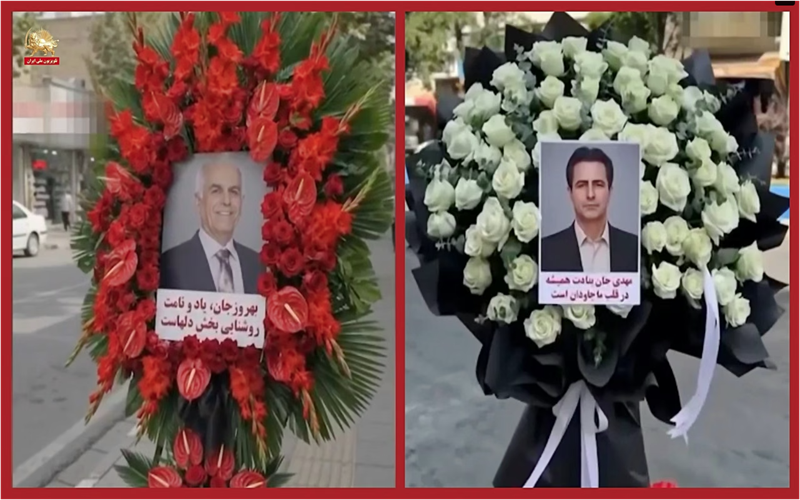

Across multiple Iranian cities, Resistance Units commemorated PMOI members Behrouz Ehsani and Mehdi Hassani one year after their execution, renewing their pledge to continue the struggle against Iran’s regime and calling for international action against the regime’s escalating executions.
Resistance Units and supporters of the Iranian Resistance commemorated the first anniversary of the execution of PMOI (MEK) members Behrouz Ehsani and Mehdi Hassani with memorial ceremonies in cities across Iran, including Karaj, Qods City (Shahr-e Qods), Gonbad-e Kavus, and Mashhad. The nationwide acts of remembrance featured flowers placed at memorial sites and renewed pledges to continue the struggle for freedom, honoring two men whose executions have become symbols of the Iranian regime’s escalating repression.
The anniversary comes as Iran’s regime continues to expand its use of the death penalty against political prisoners and dissidents, prompting repeated warnings from international human rights organizations.
Resistance Units Renew Their Commitment
In Karaj, members of the Resistance Units gathered to pay tribute to Behrouz Ehsani and Mehdi Hassani, reaffirming their commitment to the ideals for which the two men lost their lives.
Messages displayed during the commemoration declared:
- “Behrouz, you will forever remain our pride.”
- “Mehdi, your memory will always live in our hearts.”
At Behesht-e Sakineh Cemetery in Karaj, flowers were laid in memory of Behrouz Ehsani, while additional commemorative ceremonies took place in Gonbad-e Kavus, Qods City, and Mashhad.
Supporters also displayed messages linking the sacrifices of fallen Resistance members with the ongoing struggle of political prisoners throughout Iran, emphasizing that the blood of those executed strengthens the determination of future generations.
Executed on the Anniversary of the 1988 Massacre
Behrouz Ehsani and Mehdi Hassani were executed in Qezel Hesar Prison on the morning of July 27, 2025, deliberately coinciding with the anniversary of the 1988 massacre of approximately 30,000 political prisoners, most of whom were members or supporters of the PMOI.
The executions followed nearly three years of imprisonment, interrogation, and severe torture.
Behrouz Ehsani, 70, a former political prisoner from the 1980s and a native of Urmia, was arrested in Tehran in December 2022.
Mehdi Hassani, 48, from Rey, was arrested in Zanjan in October 2022.
After prolonged detention and torture inside Ward 209 of Evin Prison, both men were sentenced to death in September 2024 by Revolutionary Court Judge Iman Afshari solely because of their alleged membership in the PMOI. Iran’s Supreme Court later upheld the sentences and rejected four separate requests for judicial review.
Maryam Rajavi Condemned the Executions
Following their execution, Maryam Rajavi, President-elect of the National Council of Resistance of Iran (NCRI), described the killings as another desperate attempt by Supreme Leader Ali Khamenei to prolong the regime’s survival through terror.
She argued that rather than intimidating society, the executions would deepen public anger and strengthen the determination of Iranian youth to confront the ruling dictatorship.
Rajavi also called on the United Nations and democratic governments to move beyond verbal condemnations and adopt concrete measures against the regime, warning that years of international inaction have only emboldened Tehran to continue executions, repression, terrorism, and regional destabilization.
She further noted that at least 14 other political prisoners accused of supporting the PMOI remain under death sentences and face imminent risk of execution.
Iran: Brutal Execution of PMOI Members Behrouz Ehsani and Mehdi Hassani
Final Letters of Defiance
Both prisoners left powerful statements before their executions, refusing to seek clemency or renounce their political beliefs.
After receiving his death sentence, Behrouz Ehsani wrote that he would never bargain over his life, declaring that he was prepared to sacrifice himself for the liberation of the Iranian people. He emphasized that the regime survives through executions and repression and urged Iranians, international institutions, and human rights organizations to take immediate action against capital punishment in Iran before more lives were lost.
He also voiced support for the growing “No to Executions Tuesdays” campaign, the weekly hunger strike movement initiated by political prisoners, arguing that global silence had encouraged the regime’s continued use of executions.
Mehdi Hassani likewise refused every opportunity to distance himself from the PMOI in exchange for leniency. In letters written from prison, he stated that the regime had entered its weakest period because of mounting domestic and international crises.
He called on Iranians to reject both dictatorship and monarchy alike, urging a clear break with both the Shah and the ruling clerical establishment. Hassani pledged to remain faithful to the Resistance until the regime’s overthrow and declared that he accepted his execution with pride if it served the cause of Iran’s freedom.
He rejected suggestions that he express remorse, reaffirming that he would never retreat from his support for the PMOI, even by “one percent.”
A Symbol of Continuing Resistance
The nationwide commemorations held by the Resistance Units underscore that Behrouz Ehsani and Mehdi Hassani remain enduring symbols of resistance against the Iranian regime.
By gathering in multiple cities despite severe security risks, participants demonstrated that the executions failed to silence the movement. Instead, one year later, Resistance supporters renewed their pledge to continue the struggle for a democratic republic, while honoring the memory of two men whose final words reflected unwavering commitment to freedom and opposition to tyranny.