


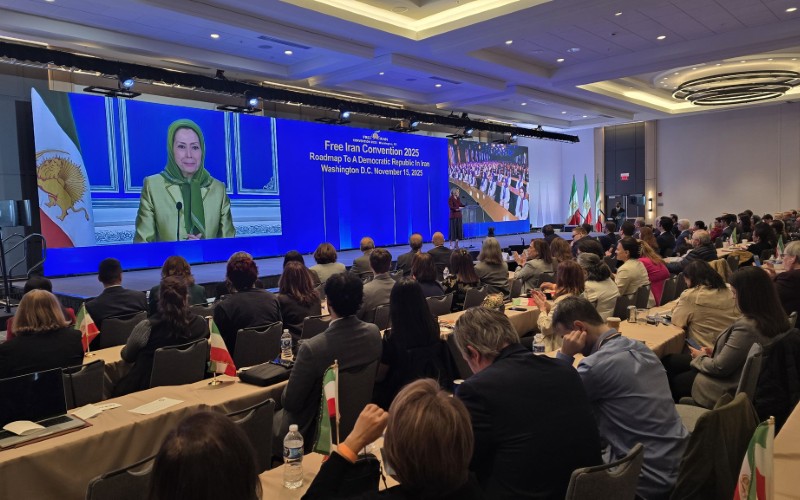

Panelists at the Free Iran Convention 2025 Detail Economic Ruin, Institutional Illegitimacy, and the Rise of Organized Defiance.
A Decisive Moment for a Free Iran
The Free Iran Convention 2025 recently convened an extraordinary gathering of Iranian scientists, professionals, and young people united in the shared demand for the overthrow of the Iranian regime, a religious tyranny. Conveners noted that this assembly occurs “At this decisive moment, when the regime is at its weakest political and social point”. Attendees gathered with a shared purpose: “to help chart the path toward a prosperous, free, democratic republic in Iran”.
For 44 years, the National Council of Resistance of Iran (NCRI) has served as the only genuine democratic alternative to the mullahs’ regime. A central strategic principle of the NCRI has been the uncompromising rejection of two dictatorships: the theocracy of the mullahs and the monarchy that preceded it. The NCRI vision is reflected in the Ten-Point Plan of Mrs. Maryam Rajavi, which offers a clear vision for the future, including separation of religion and state, full equality between men and women, an independent judiciary, and a non-nuclear Iran.
As participants committed to building a new future, noting, “Today, we don’t just imagine a free Iran, we commit to building it”, scholars on the panel, “Society Ripe for Change,” presented evidence dissecting the nation’s readiness for transformational political change.
Economic Plunder as a Tool for Repression
Professor Kazem Kazerounian detailed the catastrophic state of the Iranian economy, emphasizing that the crisis is structural and is not a result of sanctions. He characterized the economy as having “become a tool for repression and plunder, a tool for looting the country”.
Key indicators of this collapse include:
- Poverty: Close to 80% of Iranians live below the poverty line.
- Inequity: Extreme disparity exists, where “1% of the country owns more than 30% of the riches of the country”.
- Inflation: Food inflation is near 60%, and medicine prices have risen by 700 to 800 times over the past three to four years.
- Unemployment: About 13 million people are unemployed, representing nearly half of the workforce, and nearly 80% of the Iranian workforce lacks stable jobs.
- Military Dominance: The IRGC (Sepah Pasdaran) officially controls one-third of the economy, with the actual figure closer to 60%. This leads to a vicious cycle of plunder and repression.
Professor Kazerounian also highlighted the immense financial burden of the nuclear program, which is estimated to have cost approximately $2 trillion since the 1990s—resources that could have been used to build the country. In summary, he concluded that “discontent has become defiance and resistance, and that is leading to an accelerating path towards total regime collapse”.
The Regime’s Failing Pillars of Survival
Dr. Hossein Saiedian addressed the core foundational problem of the Iranian regime: “its illegitimacy. It has never been a legitimate government”. Since it cannot rule by the ballot box, the regime has built its identity on three survival pillars: internal repression, export of terrorism (or revolution), and the development of nuclear weapons. Dr. Saiedian argued that the regime has “miserably lost on all of those fronts”.
A crucial strategic failure was the exposure of the regime’s nuclear program. This project was “stopped dead in its tracks” not by a foreign intelligence agency, but by the Iranian Resistance itself. In 2002, “the NCRI-US delivered a breakthrough revelation of the secret Natanz site,” an act that put a tightening rope around the regime, leading to crippling international sanctions and diplomatic isolation.
Regarding repression, the numbers are shocking: executions have tripled during the past three years from 553 to over 1,600. This escalating violence is characterized as “a desperate grip of a regime whose only remaining language remains pure violence”. Furthermore, the regime heavily targets ethnic and religious minorities; for instance, the Baluchi community, which constitutes 5% of the population, accounts for 20% of executions.
The regime also uses the judiciary for repression, with 2,000,000 arrests every year. Shockingly lengthy prison terms and death sentences are given simply for expressing support for the MEK. For example, two recognized Olympiad winners were given 16-year sentences for showing support for the MEK, with no physical activities involved.
Sustained Revolt and Organized Defiance
Dr. Ashraf Zadshir examined how these crises have manifested in a sustained revolt, marking a turning point from which the regime cannot return. Three nationwide revolts shook all 31 provinces in 2017, 2019, and 2022.
The December 2017 uprising spread to 142 cities, shattering the myth of competing regime factions with the key slogan, “Reformer, hardliner, the game is now over”. The September 2022 uprising, triggered by the death of Mahsa Amini, led to a generational rebellion demanding complete political change. The consensus was clear, summarized by the slogan: “Down with the oppressor, be it the Shah or the Leader”.
Today, opposition has evolved into a permanent state of defiance. MEK-affiliated Resistance Units are now active across all 31 provinces and have become a structured and organized force. Last year alone, these Resistance Units carried out over 39,000 acts of defiance. Additionally, election boycotts have contributed to the collapsing political facade of the regime, with voter turnout dropping as low as 8 to 10%.
The sources conclude that the regime’s survival strategy, built on repression and corruption, ironically creates the conditions for rebellion, meaning “the regime’s logic of survival has become its logic of self-destruction”. The Iranian people are showing that an explosion of freedom is not just possible, “it is inevitable”.