


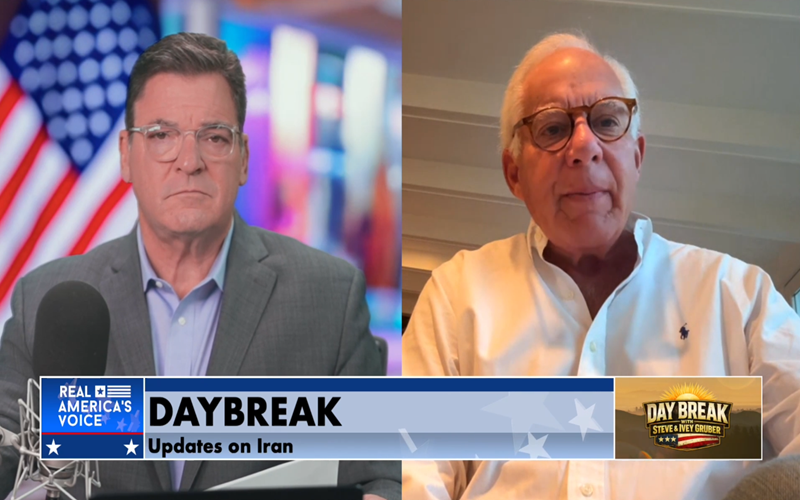

As debates intensify over the scope and duration of U.S. military and economic pressure against Tehran, former U.S. Senator Robert Torricelli (D-NJ) is urging Washington to stay the course. Breaking ranks with voices advocating for an immediate withdrawal, the veteran lawmaker argues that while authoritarian regimes often display surface-level resilience, Tehran’s foundational security apparatus is severely compromised—paving the way for internal collapse if pressure remains unyielding.
In a recent broadcast interview on Daybreak, Torricelli—a longtime legal counsel and prominent American advocate for the National Council of Resistance of Iran (NCRI)—laid out a clear strategic roadmap: dismantle the Islamic Revolutionary Guard Corps (IRGC) from the air and sea, reject the “false dilemma” that Iran has no credible opposition, and allow the Iranian people to reclaim their nation.
A Degraded Regime Behind a Resilient Facade
Addressing public frustration that heavy bombardment and sanctions have yet to topple the clerical regime, Torricelli cautioned against mistaking suppression for strength.
“Authoritarian regimes that have the ability to clamp down on any kind of dissent always have a bit more resilience than you’d expect,” Torricelli acknowledged. “Don’t get confused because it hasn’t folded that it isn’t weakened.”
According to Torricelli, prolonged pressure has steadily eroded the regime’s internal security capabilities and devastated its economic lifeline. However, he emphasized that foreign militaries will not—and should not—be the force that physically replaces the government.
“In the end, of course, the regime only falls because people internally, the Iranian people themselves, rebel against it and end it,” Torricelli said. “And I still think that happens.”
The Peril of Premature Withdrawal
With political debates heating up on Capitol Hill and on the campaign trail—where many lawmakers are calling for an immediate exit—Torricelli warned that abruptly cutting short the mission would carry catastrophic geopolitical consequences.
“Whether you agreed with the initial attack or not, we could all differ on strategies… but now that it happened, you can’t simply pick up and leave,” he warned. “The ramifications for American power would be enormous, and the regime would be emboldened now to go on a prolonged attack.”
For Torricelli, preventing a nuclear-armed Tehran remains a foundational imperative that has spanned four decades of bipartisan consensus. “It’s an outlaw regime, and it has to be brought down,” he stated, noting that leaving the job half-finished leaves American personnel, regional allies, and global maritime passages vulnerable to unchecked aggression.
Dismantling the State Department’s “False Choice”
A central pillar of Torricelli’s argument was a pointed critique of traditional foreign-policy orthodoxy. He took direct aim at the State Department for perpetuating what he termed a “false narrative” that the West must choose between the theocracy, regional chaos, or restoring the former monarchy.
“The State Department traditionally is always behind the curve,” Torricelli noted. “This idea that we have a choice between chaos or the current regime, or the current regime and bringing back the Shah, is ridiculous.”
Highlighting Iran’s vast diaspora, professional class, and institutional memory, Torricelli pointed specifically to the People’s Mojahedin Organization of Iran (MEK) and the NCRI, led by Maryam Rajavi, as a structured and viable opposition already operating on the ground.
“Mrs. Rajavi, who’s the leader of the MEK in Paris, has put together as skilled a group of professionals as I’ve ever seen in an opposition group,” Torricelli said. “They’ve laid out plans to govern. They have the personnel to govern. They have tentacles in every city in Iran where they now have resistance groups. Of course there’s a resistance, and of course there’s an opposition.”
The intense domestic crackdowns by the IRGC, he argued, are direct evidence that Tehran views this organized network as an existential threat.
The Path Forward: Decapitate the IRGC, Keep the Straits Open
Looking ahead, Torricelli outlined what “finishing the job” looks like—making clear that it does not necessitate American boots on the ground.
Instead, he advocated for a focused, three-pronged strategy:
-
Targeting the IRGC: Continue precise airstrikes to neutralize the apparatus responsible for crushing domestic protests and projecting terror abroad.
-
Naval Superiority: Fully deploy U.S. naval assets to guarantee uninterrupted transit through the vital Strait of Hormuz.
-
Maximum Economic Isolation: Maintain strangling sanctions to prevent the regime from replenishing its security forces.
“We have to finish because we don’t have any choice,” Torricelli concluded. “If the IRGC did not exist, if it was weakened, if the core of the regime was weakened, the Iranian people themselves would be in a position to win this fight and take back their government.”