


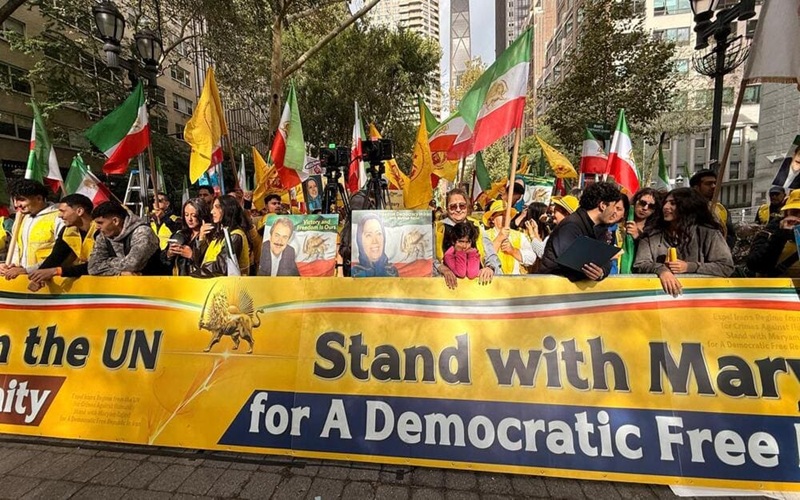

Three speakers at the Sept. 23 UN rally called for democratic change in Iran, rejecting both clerical rule and monarchy and backing the Iranian people.
As world leaders gathered inside the United Nations General Assembly in New York on September 23, thousands rallied outside to denounce Iran regime President Masoud Pezeshkian and the regime’s human rights violations and to express support for a democratic republic in Iran.
Speaking at the rally, former U.S. Senator Robert Torricelli, Ambassador Marc Ginsberg, and former New York Mayor Rudy Giuliani each focused on different aspects of the Iranian crisis. Their speeches converged on several themes: the regime’s repression, the continuing resistance of the Iranian people, rejection of both clerical rule and monarchy, and the need for international support for a democratic transition led by the Iranian people.
Torricelli: “The ground has shifted”
Robert Torricelli began by addressing the international leaders entering the UN General Assembly and directly challenged the legitimacy of Pezeshkian’s presence there.
“Pezeshkian has blood on his hands. He has no right to represent the proud people of Iran,” Torricelli said, calling on UN delegates to reject the Iranian regime.
He argued that the regime had exposed its character through its repression of protesters and that the political situation in Iran had fundamentally changed.
“Make no mistake: the ground under your feet has shifted,” he said. “They revealed themselves. The ground has shifted under their feet.”
Torricelli also highlighted the role of young Iranians and Resistance Units operating across the country. He praised those who organize and act despite the risk of arrest or death, saying they represent the determination of a new generation to secure a freer Iran.
At the same time, Torricelli explicitly rejected the prospect of replacing the current dictatorship with another form of authoritarian rule.
“If ever we believed it then, we believe it now: no to the mullahs, no to the kings!” he declared. “We do not want a dictatorship of the left or of the right, of religion or of politics. We want a free Iran.”
Addressing Iranians inside the country’s military, police, prisons, and economic institutions, Torricelli called on individuals to refuse participation in repression. He stressed that the struggle for freedom ultimately belongs to Iranians themselves.
“This revolution is not American, it is not European; it is Iranian,” he said.
Torricelli concluded by pointing to Maryam Rajavi’s Ten-Point Plan as the political alternative he believes should be considered by the international community.
“There is an alternative,” he said. “Read the Ten-Point Plan.”
Ginsberg: “We cannot wait”
Ambassador Marc Ginsberg focused on the urgency of translating international expressions of solidarity into concrete political action.
“We gather with a solemn mission, a vital mission that cannot wait for another war, another crisis, or another president,” Ginsberg said. “We cannot wait.”
He pointed to voices coming from inside Iran, including prisoners, families of those killed during protests, and young people facing execution.
Among those he highlighted were the Rahimi sisters, whom he described as having been imprisoned, tortured, and sexually assaulted by the regime. He presented their case as one example of the broader human-rights crisis facing Iranians.
Ginsberg also addressed the question of U.S. involvement. While arguing that Americans have a stake in Iran’s future, he distinguished support for democratic change from sending U.S. forces into another war.
“The American people wish for an end to the regime, an end to the suffering of Iran’s people, and an end to the threat that a nuclear Iran poses not just to the world, but also to the everyday life of Americans,” he said.
He added: “They may not want an endless war, they don’t want American casualties or boots on the ground. What they want, what we want, what you want, is for the United States to live up to its promise to serve as Iran’s arsenal of democracy!”
Ginsberg described his vision of a future Iran as one in which the Iranian people—not a monarch, supreme leader, or foreign power—determine the country’s future.
“We are for an Iran in which the people, not a pretentious Hollywood shah, not a supreme leader, not a foreign power determine their future,” he said.
He then highlighted Maryam Rajavi’s transitional plan and Ten Freedoms, describing them as a proposed framework for a political transition, elections, a Constitutional Assembly, and a new constitutional order.
Ginsberg also called on the U.S. Congress and administration to use existing legislation and proposed measures to support democratic forces in Iran.
But he emphasized a fundamental limitation on the role of foreign governments: “Americans cannot give Iranians their freedom. Americans cannot and should not choose their leaders. Only the Iranian opposition and the Iranian people together can accomplish that.”
He ended by returning to the voices of Iranians inside the country.
“They want the world to remember this war is not about the Strait of Hormuz. This is a war about the freedom of the Iranian people!”
Giuliani: “We’re going to go through it so we have a representative democracy”
Rudy Giuliani focused heavily on the history of the MEK’s confrontation with both the Shah and the current regime, as well as what he described as the organization’s role in exposing Iran’s nuclear activities.
Giuliani condemned Pezeshkian’s appearance at the UN and questioned how an Iranian regime leader could address the international community while the regime continues to execute and repress its opponents.
“We’re here to say the Reign of Terror has to end! There must be regime change!” he told the crowd.
Giuliani then addressed a central political question: what comes after the current regime?
He rejected the idea that regime change should result in another authoritarian system.
“So we’re going to go from a theocracy to a crooked monarchy? No, no,” he said. “If we’re going to go through all this, we’re going to go through it so we have a representative democracy!”
He presented the MEK and NCRI as an organized alternative and emphasized the movement’s decades-long confrontation with both the Shah and the current regime.
Giuliani also highlighted the MEK’s 2002 disclosure of Iran’s nuclear facilities at Natanz and Arak, arguing that subsequent disclosures had helped expose the regime’s nuclear activities.
He cited statements attributed to senior Iranian officials—including Ali Khamenei, Ebrahim Raisi, Mohammad Bagher Ghalibaf, and Iranian security officials—as evidence that the regime itself views the MEK as an important force within the opposition.
Giuliani then returned to Maryam Rajavi’s Ten-Point Plan, highlighting provisions concerning the end of clerical rule, freedom of speech, women’s rights, gender equality, an independent judiciary, autonomy for ethnic minorities, equal employment opportunities, and a non-nuclear Iran.
“I want you to memorize it,” he told the audience, referring to the Ten-Point Plan.
A common message: no return to dictatorship
Despite their different emphases, the three speakers presented a common political message outside the UN.
Torricelli emphasized the changing political landscape inside Iran and the role of Resistance Units. Ginsberg focused on international action, U.S. policy, and a proposed framework for political transition. Giuliani emphasized the MEK’s history, its confrontation with both Iranian dictatorships, and its nuclear revelations.
All three also rejected the notion that the end of the current regime should lead to another form of authoritarian rule.
For Torricelli, the message was explicit: “No to the mullahs, no to the kings.”
For Ginsberg, the principle was that “the people, not a pretentious Hollywood shah, not a supreme leader, not a foreign power” should determine Iran’s future.
And for Giuliani, the objective was equally clear: “representative democracy.”
The speeches ultimately placed the responsibility for Iran’s future with the Iranian people while calling on the international community to recognize and support their demand for freedom.
Torricelli summarized that principle directly: “A free Iran doesn’t come from America, it doesn’t come from the UN, it’s not coming from Europe. It’s coming from the hearts and the minds of an Iranian people.”
The rally’s message therefore extended beyond opposition to the current regime. Its speakers presented the struggle as a fight over what political system should follow it—and repeatedly argued for an Iran based on democratic representation rather than either clerical rule or monarchy.