


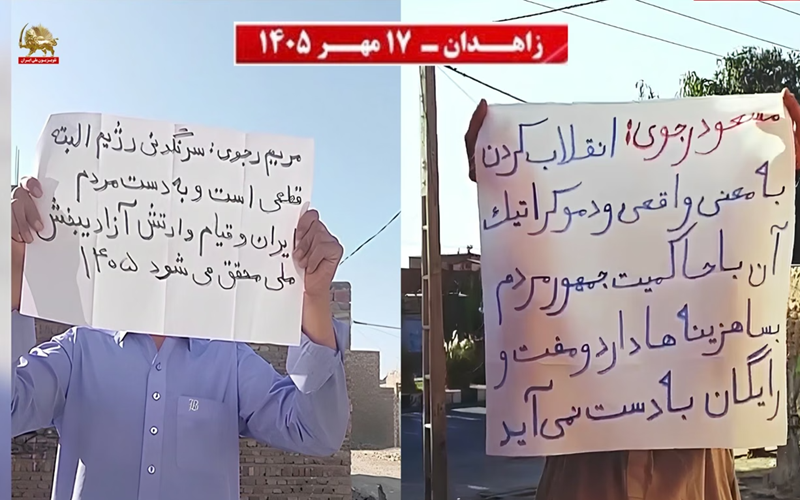

PMOI Resistance Units in Zahedan display banners and placards supporting student protests, condemning executions, and calling for university freedom, popular sovereignty, and an end to both monarchical and clerical dictatorship.
Resistance Units in Zahedan Stand Against Executions and Dictatorship
On October 9, 2026, rebellious youth associated with the People’s Mojahedin Organization of Iran (PMOI/MEK) Resistance Units in Zahedan displayed banners and placards condemning executions, supporting student protests, and demanding freedom and a democratic republic in Iran.
The activities highlighted the Iranian people’s opposition to the ruling clerical regime and rejected any return to hereditary monarchy as an alternative to the current dictatorship. Their messages emphasized a central political principle: Iran’s future must be based on popular sovereignty, equality, and freedom from all forms of authoritarian rule.
The banners featured messages from Maryam Rajavi and Massoud Rajavi, alongside slogans calling for resistance against repression, the abolition of executions, the liberation of universities from government control, and the overthrow of the clerical dictatorship.
The slogans also underscored the rejection of both the shah and the mullahs, presenting the establishment of a democratic republic as the alternative to successive forms of dictatorship.
Maryam Rajavi’s Message: “No Torture, No Repression, No Discrimination”
Several banners carried messages from Maryam Rajavi emphasizing freedom, equality, and the rejection of dictatorship in all its forms.
One declared:
“We have risen up for an Iran without torture and repression, free from discrimination and inequality and every kind of dictatorship, whether the Shah or the Sheikh.”
Another stated:
“The velayat-e faqih regime must be removed root and branch, and a democratic republic must replace it.”
These messages placed the demand for regime change within a broader vision of political transformation. The objective, as expressed in the banners, is not simply to replace the current rulers but to establish a system in which neither hereditary privilege nor clerical authority can override the people’s rights.
The explicit rejection of both the shah and the sheikh also challenged efforts to present the former monarchy as the inevitable successor to the Islamic Republic. The Resistance Units’ message was that the Iranian people must not be forced to choose between two forms of dictatorship.
Supporting Student Protests and Demanding Free Universities
Another central theme of the activities was solidarity with student protests and the struggle to restore freedom to Iran’s universities.
A banner carrying Rajavi’s message stated:
“Students have never surrendered to humiliation and submission; now the universities must be fully reclaimed.”
Another declared:
“As in the time of the Shah and the monarchical dictatorship, universities must always be at the forefront of the struggle and uprising for freedom.”
The messages portrayed universities as essential spaces for political awareness, independent thought, and resistance to authoritarian rule. They called on students to reclaim their role in the struggle for freedom rather than submit to intimidation and restrictions imposed by the regime.
By linking present-day student protests with the history of opposition under the shah, the banners also stressed that university freedom is a longstanding democratic demand in Iran, one that cannot be fulfilled through a return to the political order that preceded the Islamic Republic.
The Resistance Units thus connected the defense of students’ rights with the broader struggle for a democratic future.
Executions Reflect the Regime’s Fear of Resistance
The condemnation of executions was another major focus of the activities in Zahedan.
One message from Maryam Rajavi stated:
“The increase in executions is fully correlated with the increase in resistance and popular uprisings, and demonstrates the regime’s fear of the people and the Resistance.”
Another declared:
“Terrified of an uprising, the regime commits such crimes, but it cannot escape its inevitable overthrow at the hands of the people and the Resistance.”
These messages presented the death penalty as an instrument of political repression, used to intimidate society and prevent renewed protests. They also linked the escalating use of executions to the regime’s confrontation with a population unwilling to abandon its demands for freedom.
A further statement called for the political conflict between the people and the ruling system to be resolved, declaring:
“As long as fascism and dictatorship remain in power, and the people’s sovereignty is usurped and stolen, the front of the people and the anti-people must first settle their accounts.”
The banners therefore framed opposition to executions as part of a wider struggle over political power and the right of the Iranian people to determine their own future.
“The Overthrow of the Regime Will Be Achieved by the Iranian People”
Other messages from Maryam Rajavi focused on the prospect of ending clerical rule and restoring popular sovereignty.
One stated:
“The overthrow of the regime is, of course, certain, and it will be achieved by the Iranian people, through uprising and the National Liberation Army.”
Another declared:
“The ruling regime is in a position of overthrow and has never been as shaken, weak, and vulnerable as it is today.”
These statements reflected the Resistance Units’ conviction that the current system cannot resolve the political conflict through repression alone. They placed the Iranian people and their organized resistance at the center of the struggle for change.
The message was consistent with the other banners: the objective is not a limited change of personnel at the top of the state, but an end to the existing system and the establishment of a democratic alternative.
Massoud Rajavi: “No Sheikh, No Shah”
Messages from Massoud Rajavi reinforced the call for a democratic revolution and the rejection of both clerical and monarchical dictatorship.
One banner declared:
“Making a revolution in its true and democratic sense, with the sovereignty of the entire people, entails many sacrifices and does not come free of charge.”
The message acknowledged the cost of the struggle for freedom while emphasizing that genuine democracy cannot be achieved without sustained resistance and sacrifice.
Another statement reaffirmed the PMOI’s commitment to confronting the ruling regime:
“The Mojahedin have always been, and continue to be, steadfast and resolute, ready under all circumstances for the campaign and struggle to overthrow the anti-human enemy; with a hundredfold battle.”
The banners also carried a direct call for resistance under the slogan “No Sheikh, No Shah”:
“With the banner of ‘No Mullah, No Shah,’ the cry of freedom must be raised, arms must be taken up, and resistance must be mounted. It must be emphasized that no power in the world can prevent the uprising and victory of the Iranian people.”
Another message stated:
“Dictatorship, in any form and under any name, has no place in Iran, and the insurgents throughout Iran have cried out: ‘Death to the oppressor, whether Shah or Leader.’”
The reference to both the shah and the supreme leader placed the rejection of dictatorship above allegiance to any individual or political dynasty. The banners called for an end to the structures of authoritarian rule rather than the restoration of a former ruling family.
Two further messages reinforced this position:
“The Iranian people will consign the colonial Shah regime and the reactionary Mullah regime to the dustbin of history.”
And:
“The shops of the Sheikh and the Shah, which represent the same apparatus of despotism and dependency, must be shut down at their roots.”
Together, these statements rejected the notion that the collapse of the Islamic Republic should lead automatically to the restoration of monarchy. The banners instead called for a political order founded on the sovereignty of the people.
Zahedan’s Slogans: “Death to the Oppressor, Whether Shah or Leader”
Alongside the messages from Maryam and Massoud Rajavi, the Resistance Units displayed slogans expressing opposition to both forms of dictatorship and support for a democratic republic.
The slogans included:
- “Death to the oppressor, whether Shah or Leader.”
- “Monarchy and velayat-e faqih: a hundred years of crimes.”
- “The people and history curse the bloodstained Shah and Mullah.”
- “Baluchistan is awake; it rejects both the Shah and the Mullah.”
- “We want neither Shah nor mullah; damn the dictators.”
- “Neither Mullah nor Shah: freedom and a democratic republic.”
- “From Zahedan to Tehran, death to the oppressor, whether Shah or Leader.”
The reference to Baluchistan gave the activities a distinctly regional dimension. Zahedan, the capital of Sistan and Baluchistan Province, has been a prominent site of protest and political dissent. The slogan declaring that Baluchistan rejects both the shah and the sheikh connected the region’s demands for freedom and equality with the nationwide rejection of authoritarian rule.
The repeated formulation “Neither Sheikh nor Shah” was particularly significant. It established a clear boundary against attempts to channel opposition to the clerical regime into support for a hereditary monarchy.
Instead, the slogans placed freedom, equality, and a democratic republic at the center of the political alternative being advocated.
A Unified Message: Freedom, Equality, and Popular Sovereignty
The activities of the PMOI Resistance Units in Zahedan brought together several themes: solidarity with protesting students, condemnation of executions, resistance to political repression, and the rejection of both monarchical and clerical dictatorship.
The banners’ messages argued that the increase in executions reflects the regime’s fear of public resistance, while the calls for university freedom emphasized the importance of independent thought and student activism in the struggle for political change.
At the same time, the repeated rejection of both the shah and the sheikh underscored that opposition to the Islamic Republic does not amount to support for restoring the monarchy. The democratic alternative presented in the messages is a republic based on popular sovereignty, freedom, and equality.
From Zahedan, the Resistance Units’ slogans articulated a broader political demand: an end to executions and repression, the liberation of universities, and the establishment of a system in which no ruler or dynasty stands above the Iranian people.
Their message was summed up in the words displayed on the banners:
“Neither Mullah nor Shah: freedom and a democratic republic.”