


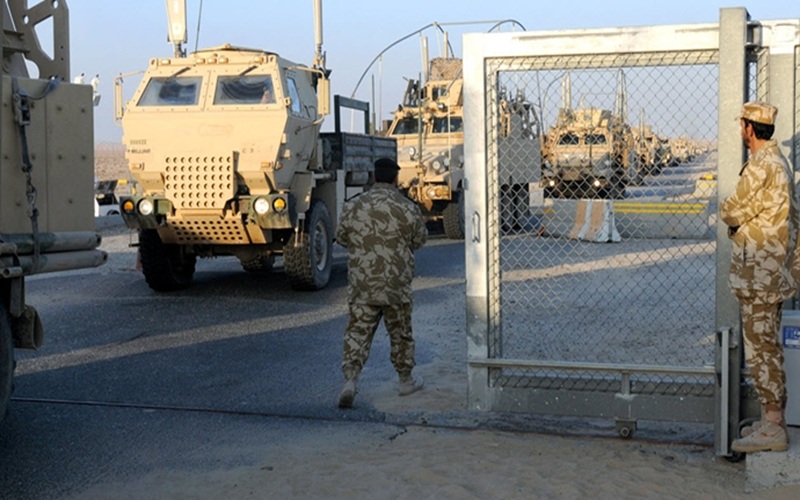

IRGC celebrates the departure of U.S. forces from Iraq while regime media question whether the withdrawal represents a genuine end to the American presence.
The Iranian regime has welcomed the completion of the U.S. military withdrawal from Iraq, with the Islamic Revolutionary Guard Corps (IRGC) describing the departure as a “historic victory” for what it calls the Islamic Resistance Front.
The United States completed the withdrawal of its remaining forces from Iraq on September 30, marking the formal end of the U.S.-led coalition’s military mission in the country. The final American personnel and equipment left Erbil, while Washington said its mission against ISIS in Iraq had formally concluded.
The departure followed the gradual drawdown of coalition forces under a U.S.-Iraqi agreement. Britain and Italy also completed the withdrawal of their remaining military personnel from Iraq as the coalition mission came to an end.
IRGC Calls Withdrawal a “Historic Victory”
In a statement carried by Iranian state-affiliated media, the IRGC congratulated what it described as the Iraqi people, the “united front of the Islamic Resistance,” and the “revolutionary fighters of the Islamic world” over the U.S. withdrawal.
The IRGC said the departure represented a “historic victory” and called for the complete withdrawal of American forces from the wider Middle East.
The Guards also warned against what they described as possible U.S. “plots” and called for vigilance. The statement said the IRGC would continue to stand alongside regional populations to remove American forces from West Asia.
The IRGC characterized the U.S. presence over the past two decades as a source of insecurity, terrorism, and instability, and called for regional countries to take responsibility for their own security.
Kayhan Questions Whether the U.S. Presence Has Really Ended
The regime’s Kayhan newspaper, affiliated with the office of the supreme leader, took a different tone while still portraying the withdrawal as incomplete.
In a September 30 editorial titled “End of Occupation or Its Transformation?”, Kayhan argued that what took place between the United States and Iraq was not the expulsion of a foreign occupying power, but rather a change in the form of the U.S. presence.
The newspaper cited former Iraqi Defense Ministry adviser Ali al-Araji as saying that American forces stationed in neighboring countries could continue pursuing objectives previously pursued from inside Iraq.
Kayhan therefore characterized the withdrawal as having a political and propaganda dimension rather than representing a complete end to the American military presence in the region.
The newspaper also cited an Iraqi military official as saying that the U.S. had transferred its remaining equipment from Iraq to Kuwait, Türkiye, and Jordan.
Javan: U.S. Presence Has Not Ended Completely
The IRGC-affiliated Javan newspaper similarly acknowledged that the withdrawal did not mean a complete end to the American presence in Iraq.
In its September 30 coverage, Javan wrote that although the withdrawal did not represent the complete termination of U.S. involvement in Iraq, it was a significant indication of changes in the region’s security arrangements amid the intensifying confrontation between Tehran and Washington.
The paper presented the U.S. departure as a development that would affect the security environment in the region while emphasizing that Washington’s regional presence had not disappeared entirely.
Disarmament of Armed Groups Becomes an Immediate Issue
The U.S. withdrawal coincided with an unresolved dispute inside Iraq over the future of armed groups operating outside direct state control.
The Iraqi government had been expected to address the issue of weapons held by armed factions following the coalition’s departure. On October 1, Iraqi Prime Minister Ali al-Zaidi announced June 30, 2027, as a new deadline for armed factions to hand their weapons over to the state.
Iran-backed factions have opposed efforts to establish a timetable for disarmament. Some have argued that any disarmament process should also include the Peshmerga forces of Iraq’s Kurdistan Region.
The issue has therefore remained a central point of contention following the end of the U.S.-led coalition mission.
For the Iranian regime, however, the immediate public response has been to celebrate the departure of U.S. forces. The IRGC has presented the withdrawal as a victory for its regional allies and called for the departure of American forces from the rest of the Middle East, while regime media have simultaneously argued that the United States has merely changed the form of its regional presence.