


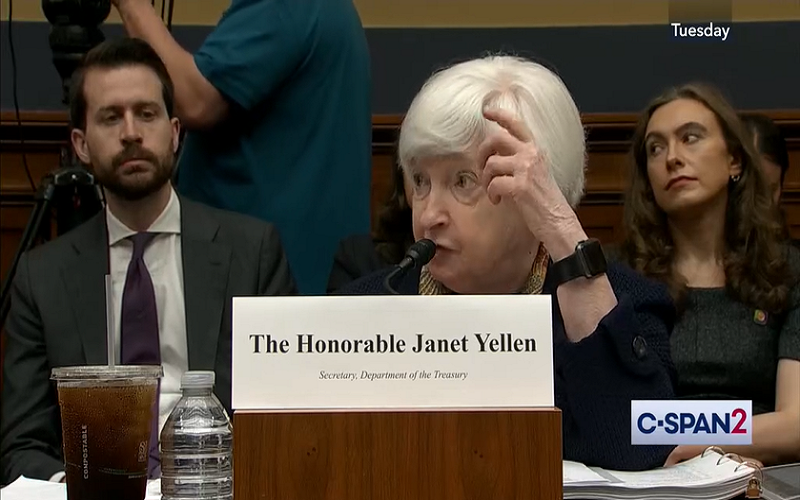

Washington, D.C. – July 9, 2024:
A hearing was held on Tuesday by the Congressional Financial Services Committee with U.S. Treasury Secretary Janet Yellen to discuss the health of the international financial system. A significant portion of the session was dedicated to addressing concerns about the Iranian regime’s oil trade and its strategies for circumventing U.S. sanctions.
During the hearing, committee members rigorously questioned Secretary Yellen on various aspects of the issue, including the involvement of U.S.-based firms in providing insurance to Iranian tankers engaged in illicit oil sales.
Secretary Yellen responded to the committee’s inquiries, stating, “That’s something that Treasury is working on. I can’t give you an exact timeline, but we are committed to meeting the deadlines you’ve set, including the November 1st target. Regarding Iranian lithium oil sales, Americans are still at risk, and Treasury is leading the sanctions efforts. Are there any U.S.-based firms providing insurance to Iran’s illicit tanker ships?”
She continued to elaborate, “We have taken a wide array of sanctions actions to try to stop the flow of illicit funds from Iran that support terrorist groups such as the Houthis, Hezbollah, and others. We’ve worked jointly with other countries to impose sanctions using every tool at our disposal, including targeting oil revenues that enable Iran to fund these terrorist organizations.”
Secretary Yellen also provided insights into the broader context of sanctions, particularly in relation to Russia’s invasion of Ukraine. She highlighted the extensive sanctions regime imposed to deny Russia military equipment and financial support, including targeting Iranian suppliers of drones.
“We have created the toughest possible sanctions regime to deny the Russian military the equipment needed for their war efforts. We have sanctioned individuals, entities, banking organizations, and virtually the entire military-industrial complex. This includes targeting financial institutions that process payments for sanctioned entities, aiming to cut off their access to the dollar-based trading system,” Yellen explained.
The committee members repeatedly emphasized the importance of stringent enforcement. One member referred to a report from The New York Times, listing 27 tankers currently supporting the illicit sale of oil from Iran to some of the United States’ worst adversaries. General Michael Kurilla had previously noted that Iran continues to sell 90% of its oil directly to China, funding a terrorist war in his area of responsibility.
The member expressed frustration, stating, “I’ve asked multiple times for Treasury to provide a list, both classified and unclassified, of how we are cracking down on insurance violators in the U.S. Are we going to see any action or answers regarding U.S. firms providing insurance to a terrorist regime?”
Another committee member highlighted the supplemental appropriations bill enacted in April, which contained the SHIP Act and the Iran-China Sanctions Act. These acts require sanctions on refineries that knowingly process Iranian oil and mandate the closure of correspondent accounts for Chinese banks involved in petroleum transactions with sanctioned Iranian institutions. The member pointed out that since President Biden took office, Iranian oil sales have increased by over $100 billion.
“Can you speak to the implementation of these laws and commit to swiftly enforcing the required sanctions?” the member asked.
Secretary Yellen assured the committee of ongoing efforts, stating, “I need to review the details of where we stand with respect to these specific acts. However, we have implemented a broad range of sanctions on Iran, including those related to oil dealings. We have sanctioned firms in other countries involved with the Iranian oil trade and continuously evaluate additional sanctions to enforce.”
The hearing underscored the ongoing efforts and challenges faced by the US Treasury in enforcing sanctions against the Iranian regime. The committee members emphasized the importance of rigorous enforcement to prevent the funding of terrorist activities and to uphold the integrity of international sanctions.