


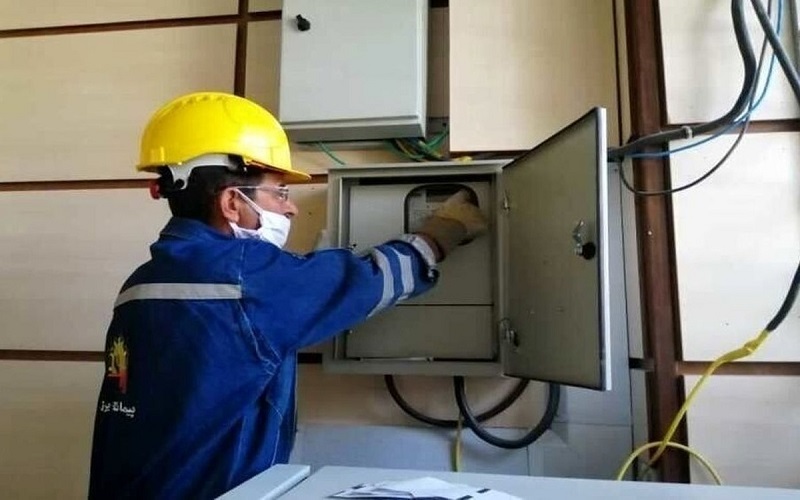

Iran is once again grappling with a deepening electricity shortage, as recurring power outages disrupt businesses, threaten vital services, and test public patience. The crisis, which officials refer to as an “imbalance” in the electricity grid, is pushing the government to implement emergency measures while citizens and industries bear the brunt of the consequences.
Government Measures Amid Surging Demand
In response to increasing electricity consumption driven by what officials call “premature warming,” the Iranian regime has rolled out new policies aimed at reducing demand. A directive issued by the Ministry of Interior mandates that office buildings maintain a temperature of 27°C, while government and non-government offices, including banks and insurance companies, will operate from 6 a.m. to 1 p.m. between May 10 and May 21. Thursdays during this period are to be observed as full closures across all provinces.
Fatemeh Mohajerani, the government spokeswoman, emphasized that all public offices are required to turn off cooling systems after 1:00 p.m. in an effort to cut post-office electricity usage by up to 60%.
Record Consumption and Warnings from Officials
Electricity usage in May has already surpassed 59,000 megawatts, according to Maziar Jamshidi, Director of Operation and Control of Iran’s Electricity Network. This level was previously only reached at the peak of summer in late May 2024. The continued upward trend is causing alarm among energy officials.
Energy Minister Abbas Aliabadi warned earlier this year that the electricity supply-demand gap could reach 30,000 megawatts in 2025. He also blamed illegal cryptocurrency mining operations for contributing to the crisis, claiming that unauthorized miners consume the equivalent of 1,000 megawatts—comparable to running air conditioners around the clock.
Scheduled and Unscheduled Outages
To cope with the crisis, the Ministry of Energy has introduced rolling blackouts in various provinces. However, citizens have reported widespread outages occurring outside of the announced schedules. The state-run Ham Mihan newspaper recently highlighted ongoing and unplanned blackouts in southern and suburban areas of Tehran, raising concerns about poor planning and lack of infrastructure preparedness.
These power cuts are affecting all aspects of life. Businesses are facing production delays, equipment failures, and even product losses. In some cases, such outages are compounding the effects of Iran’s economic recession. Regime president Masoud Pezeshkian recently assured the public that cutting electricity to the industrial sector would be a last resort, but many factories are already experiencing disruptions.
Impacts on Health and Vital Services
Beyond industry, the outages are hitting healthcare facilities hard. Reports from within Iran indicate that some pharmacies and small clinics lack backup generators, jeopardizing the storage of temperature-sensitive medications and the continuity of patient care.
In some areas, power outages are also disrupting access to water—a ripple effect particularly severe in southern and poorer regions of Tehran.
A Crisis Years in the Making
While this year’s shortages have grown more acute, Iran’s electricity crisis is not new. In 2008, widespread planned blackouts were implemented under similar circumstances. At the time, Ministry of Energy officials blamed insufficient investment in infrastructure to match rising demand.
Today, multiple factors contribute to the crisis: water and gas shortages, outdated equipment, international sanctions, transmission issues, and a lack of investment in modern power plants. Over 80% of Iran’s electricity comes from thermal plants reliant on natural gas, making them vulnerable to fuel supply constraints—especially during the winter, when demand for gas also surges.
Although renewable energy could offer a long-term solution, development in this sector remains stagnant. Low fuel prices for thermal generation have made renewable energy economically unattractive for investors.
A Growing Deficit
A recent report by the Iranian parliament’s Research Center revealed that the electricity deficit in 2024 reached 15,400 megawatts—up from 9,700 megawatts in 2022, marking a 60% increase in just two years. Mehrdad Lahouti, a member of parliament, cited a report by the Chamber of Commerce estimating economic losses of around $7 billion due to the power shortage.
Despite this growing deficit, Iran continues to export electricity to neighboring countries such as Iraq. This practice has drawn widespread criticism from Iranian citizens, who often express their frustration on social media with sarcastic or angry commentary about the government’s priorities.
Conclusion
Iran’s electricity crisis highlights deep-rooted structural and policy challenges. As demand continues to outpace supply and infrastructure remains outdated, short-term stopgaps such as changing working hours or targeting cryptocurrency miners are unlikely to offer lasting relief.
With mounting economic losses, disrupted services, and public frustration growing, the regime faces increasing pressure to overhaul its energy strategy—starting with investment in infrastructure and serious commitment to renewable energy development.