


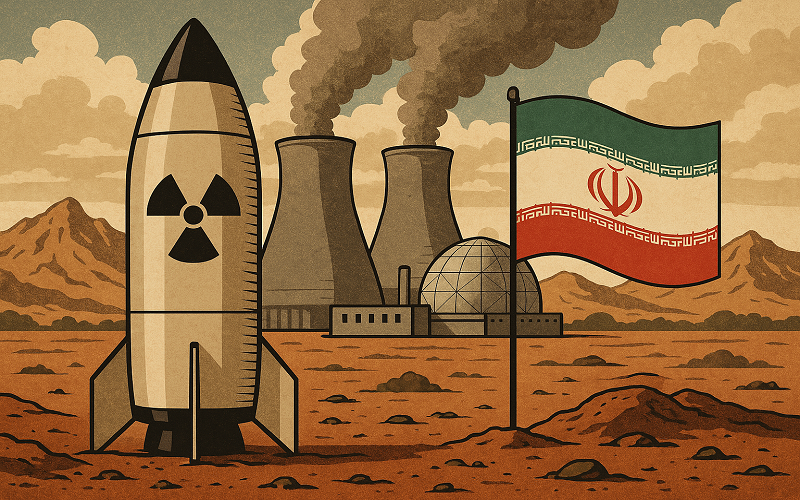

April 2025 – The threat posed by Iran’s nuclear program has significantly worsened since February 2024, reaching an “Extreme Danger” level according to a new report by the Institute for Science and International Security. The report, titled “The Iran Threat Geiger Counter: Extreme Danger Grows,” assigns a total threat score of 157 out of a possible 180, up from 151 in the previous assessment.
Key Factors Driving the Increased Threat:
- Enhanced Nuclear Capabilities: Iran possesses greater nuclear weapon capabilities and shorter timeframes to build them. It has enough 60 percent enriched uranium (highly enriched uranium or HEU) to potentially create a nuclear explosive directly.
- Rapid Breakout Potential: Iran could enrich its existing 60 percent HEU stock to 90 percent weapon-grade uranium (WGU) in less than a week using only a fraction of its HEU and a few advanced centrifuge cascades. It could produce enough WGU for its first nuclear weapon in days and enough for seven weapons within about three weeks using the Fordow facility alone. Within a month, using facilities at Natanz as well, it could potentially produce enough WGU for 10 nuclear weapons.
- Increased HEU Production & Stockpiles: Iran has significantly increased its production rate of 60 percent HEU and doubled its stockpile over the last year, reaching 275 kg (Uranium mass) as of mid-February 2025. Its 20 percent enriched uranium stock also increased overall to 607 kg.
- Advanced Centrifuge Deployment: Iran has doubled its installed advanced centrifuges in the past year, reaching over 13,355. These advanced centrifuges now constitute almost 90% of its enrichment capacity and pose a significant risk for rapid WGU production, potentially at secret sites.
- Weaponization Efforts: Evidence suggests Iran is actively working to shorten the time needed for nuclear weaponization, the process of building the weapon itself. Recent intelligence indicates exploration of faster methods, work on computer modeling relevant to nuclear explosions, and renewed activity at former nuclear weapon development sites. Iran could potentially build a crude, non-missile deliverable nuclear weapon in about six months or less.
- Lack of Transparency: Iran continues to obstruct the International Atomic Energy Agency (IAEA), refusing full cooperation and access. It hasn’t implemented its Additional Protocol for four years, fails to explain undeclared nuclear material traces, refuses to provide required design information for new reactors, and has reduced monitoring under the JCPOA, leading to a loss of “continuity of knowledge” on centrifuge production and inventories. This lack of transparency fuels uncertainty and concern about potential secret facilities or activities.
- Regional Conflicts & Rhetoric: Ongoing Middle East conflicts involving Iran and its proxies against Israel increase the possibility of Iran deciding to build nuclear weapons. Despite recent setbacks for its proxy forces (like Hamas and Hezbollah) and its own military, Iranian officials maintain extremely hostile rhetoric towards the U.S. and its allies, with some openly discussing the necessity of building a nuclear weapon.
The “Geiger Counter” Methodology:
The report uses a “Geiger Counter” methodology, assessing the threat across six categories, each scored out of 30 points:
- Hostile Actions: (Score: 20 – Considerable Danger) Reduced due to recent military setbacks for Iran and its proxies, but Iran still possesses drone and missile capabilities and supports Russia’s war effort.
- Hostile Rhetoric: (Score: 29 – Extreme Danger) Officials continue threats against Israel and the U.S., and internal discussions increasingly favor nuclear weapons.
- Lack of Transparency: (Score: 24 – High Danger) Worsening compliance with IAEA safeguards and monitoring agreements.
- Nuclear Breakout: (Score: 30 – Extreme Danger) Iran has the capability to produce enough WGU for a weapon very quickly.
- Sensitive Nuclear Capabilities: (Score: 27 – Extreme Danger) Increased enrichment capacity, HEU stockpiles, and capabilities focused on WGU production, particularly at the fortified Fordow site.
- Beyond Breakout (Weaponization): (Score: 27 – Extreme Danger) Increased ability and activity towards shortening the time needed to assemble a nuclear weapon.
The report concludes that the combination of Iran’s advanced nuclear capabilities, reduced breakout times, lack of transparency, ongoing weaponization-related activities, and hostile posture creates an extremely dangerous and uncertain situation.