


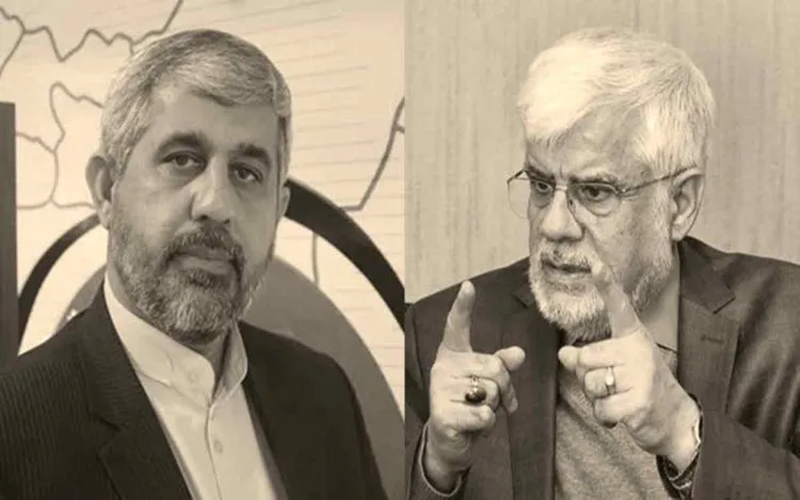

Contradictory statements by Tehran’s leaders expose confusion, desperation, and the regime’s crumbling political scaffolding
The threat by the European Troika — Britain, France, and Germany — to activate the nuclear deal’s trigger mechanism, coupled with recent warnings from the International Atomic Energy Agency (IAEA), has pushed Iran’s regime into one of its most critical diplomatic and political crossroads.
The regime’s leaders are sending out mixed, contradictory messages that expose both their fear and their lack of strategy. From Mohammad Reza Aref, the regime’s First Vice President, to Behnam Saeedi, Secretary of the National Security Commission in parliament, their words reveal a system adrift, paralyzed by confusion, and edging closer to collapse.
Empty threats from a cornered regime
On August 18, the state-run Khabar Online quoted Saeedi warning that if Europe activates the trigger mechanism — which would automatically reinstate international sanctions — then Iran’s “continued presence in the Nuclear Non-Proliferation Treaty (NPT) will be meaningless.”
This is nothing less than a threat to abandon the NPT. But far from a position of strength, it reeks of desperation. Withdrawal from the treaty would only trigger unprecedented global pressure, greater isolation, and possibly even open the path to military action against Tehran.
Meanwhile, Aref’s words on the same day were no less contradictory. He claimed: “We are not people of war, but if war starts, it will end with us.” In the same breath, he cast doubt on Europe’s seriousness while suggesting negotiations over the trigger mechanism could still be pursued.
This duality — alternating between hollow bravado and desperate appeals for dialogue — highlights a glaring truth: the regime has no coherent strategy for survival.
IAEA warning intensifies pressure
Adding to Tehran’s crisis, AFP reported on August 18 that the IAEA once again sounded the alarm on Iran’s nuclear program. The agency confirmed that Iran remains the only non-nuclear-weapon state enriching uranium at 60 percent purity — just one step below the weapons-grade threshold of 90 percent.
Combined with the European Troika’s threat to reinstate sanctions, this has escalated international pressure to new heights. Tehran now finds itself trapped between military tensions with Israel and the United States abroad, and a volatile, restive society at home that rejects its rule.
Regime’s foundation under strain
The contradictory and desperate messages of the regime’s top officials expose the fragility of its decision-making structure. What is emerging is not a regime with a unified vision, but a fractured system clinging to survival through empty threats and double standards.
This incoherence has consequences. Rather than projecting strength, such contradictory statements only deepen the regime’s diplomatic isolation and accelerate its economic and political decline.
A deadly nightmare for Khamenei
Above all, the crisis is colliding with Iran’s domestic reality. A revolutionary society that has repeatedly risen in nationwide uprisings now looms as the greatest threat to the clerical dictatorship. Khamenei and his regime are facing not just the pressure of sanctions or international isolation, but the nightmare of an awakened nation yearning for freedom.
That nightmare is fast becoming reality.