


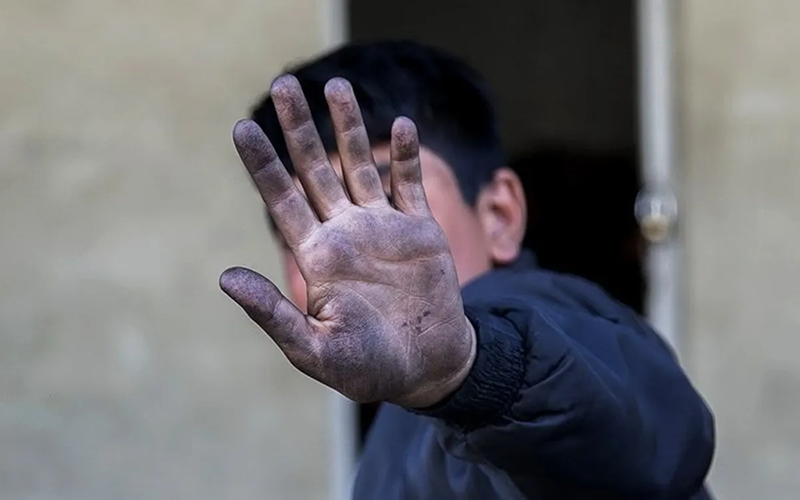

As economic collapse deepens and educational exclusion grows, millions of Iranian children are being pushed from classrooms into hazardous labor, exposing the human cost of decades of failed policies and systemic neglect.
Behind every child selling flowers at a traffic light, sorting garbage in a recycling center, carrying heavy loads in a marketplace, or weaving carpets in a remote village lies a painful reality: the systematic failure of a state that has abandoned its responsibility to protect its most vulnerable citizens.
While much of the world has made significant progress in reducing child labor, Iran is moving in the opposite direction.
According to child rights activists, worsening poverty, rising school dropout rates, weak social support systems, and the absence of transparent statistics have transformed child labor into one of Iran’s most severe and persistent social crises. The situation has become even more alarming in the wake of recent economic shocks and wartime disruptions, which have accelerated the number of children leaving school and entering the labor market.
The growing presence of child workers is not merely a symptom of economic hardship. It is a reflection of deeper structural failures that have accumulated over decades and now threaten the future of an entire generation.
A Global Problem Shrinking Everywhere Except Iran
Globally, child labor has declined considerably over the past two decades. According to international estimates by the International Labour Organization and UNICEF, the number of child laborers worldwide fell from approximately 246 million in 2000 to around 138 million in 2024.
Millions of children across the world remain trapped in dangerous work, but the overall trend has been one of progress.
Iran, however, presents a troubling exception.
No reliable and universally accepted statistics exist regarding the actual number of child laborers in the country. Estimates range from more than one million to as many as seven million children. The latest official assessment, published by the Iranian Parliament Research Center in 2023, suggested that roughly 15 percent of Iranian children are engaged in some form of labor.
Even that figure may understate the reality.
Many child rights advocates argue that the true scale is far larger because much of child labor occurs in hidden workshops, informal businesses, family enterprises, agricultural work, and domestic labor that never appears in official records.
The absence of transparency itself has become part of the crisis.
The Pipeline from School to Labor
One of the clearest indicators of the crisis is the growing number of children leaving school.
Education has traditionally served as the most effective barrier against child labor. When that barrier collapses, children are often left with few alternatives.
Activists warn that economic deterioration and the recent wartime disruptions have accelerated dropout rates across the country. Once children leave the educational system, the likelihood of returning declines dramatically, while the probability of entering the workforce rises sharply.
Millions of Iranian children are currently either out of school or at risk of dropping out. For many families struggling to afford food, housing, and basic necessities, education has become a luxury rather than a guaranteed right.
The result is a vicious cycle in which poverty pushes children out of school, and the absence of education traps them in poverty.
Poverty Is Not an Accident—It Is a Policy Failure
The expansion of child labor cannot be understood without examining Iran’s broader economic collapse.
Years of corruption, mismanagement, inflation, unemployment, and misplaced national priorities have devastated household incomes. Families increasingly rely on every available source of income, including their children.
Although Iranian law explicitly prohibits the employment of children under the age of 15, reality tells a different story.
Thousands of children below the legal working age can be found in farms, workshops, recycling facilities, markets, construction sites, and other sectors of the informal economy. These are workplaces largely beyond meaningful government oversight, where labor regulations are rarely enforced and exploitation flourishes.
For many children, workdays extend far beyond normal hours. They receive little pay, no insurance, no legal protection, and no meaningful avenue for complaint.
They are workers without rights.
The Hidden Crisis of Rural Iran
The child labor crisis is no longer confined to major cities.
Across rural regions, children increasingly leave school to support their families through agricultural labor, livestock work, carpet weaving, and household production. Many of these activities remain invisible in official data because they occur within family settings or informal local economies.
The crisis is particularly severe in underdeveloped provinces such as Sistan and Baluchestan, where educational infrastructure remains deeply inadequate.
In many communities, students face overcrowded classrooms, teacher shortages, long distances to schools, and limited access to educational resources. The expansion of online learning during recent crises further exposed existing inequalities.
Many families possess only one smartphone shared among several children. Others cannot afford internet access at all.
For families already struggling to survive, investing in digital education becomes impossible.
The result is predictable: children fall behind, disengage from school, and eventually disappear from the educational system altogether.
The Invisible Burden Carried by Girls
A significant portion of child labor in Iran remains hidden because it is performed by girls.
While boys are more visible in street vending, waste collection, and physically demanding jobs, girls often work behind closed doors. They are engaged in domestic labor, caregiving, embroidery, handicrafts, agricultural work, and other unpaid or underpaid activities that rarely appear in official statistics.
Many face additional burdens, including early marriage and permanent withdrawal from education.
Their labor is frequently invisible, but its consequences are profound.
The educational opportunities lost by these girls represent not only individual tragedies but also a long-term setback for social development and gender equality.
The Most Vulnerable: Children Without Identity
Among Iran’s child laborers, one group faces particularly severe risks: children without birth certificates or official identity documents.
Without legal recognition, these children are often denied access to education, healthcare, social services, and other forms of public support.
In practical terms, they become invisible.
Their lack of documentation makes them exceptionally vulnerable to exploitation, trafficking, abuse, and exclusion. They exist outside many of the protections available even to other disadvantaged children.
For them, poverty is compounded by legal invisibility.
A Generation at Risk
Experts consistently warn that early entry into the labor market carries devastating long-term consequences.
Children exposed to labor at a young age face greater risks of violence, substance abuse, exploitation, permanent educational exclusion, and lifelong poverty. Many eventually become trapped within the informal economy, unable to escape the conditions that forced them into work in the first place.
Some later enter correctional institutions and juvenile detention centers—not because they are criminals, but because they are victims of deprivation, neglect, and failed social policies.
The tragedy is that many of these outcomes are preventable.
The Gap Between Law and Reality
Iran’s laws formally prohibit child labor for children under the age of 15. Yet the gap between legal promises and everyday reality has become impossible to ignore.
The persistence of child labor on such a large scale reveals a broader truth about governance in Iran. Laws that exist only on paper cannot protect children. Rights that are not enforced are not rights at all.
As long as poverty deepens, educational opportunities shrink, and social protections remain inadequate, child labor will continue to expand regardless of what the law says.
The most heartbreaking aspect of this crisis is that many working children do not dream of wealth or privilege. Their aspirations are remarkably simple.
They want to return to school.
They want the opportunity to become teachers, doctors, athletes, engineers, or artists. Some simply want the chance to finish their education alongside their classmates.
Yet for millions of Iranian children, the distance between those dreams and reality continues to grow.
A society that forces its children to choose between hunger and education is not merely facing an economic crisis. It is confronting a moral and political failure whose consequences will be felt for generations.