


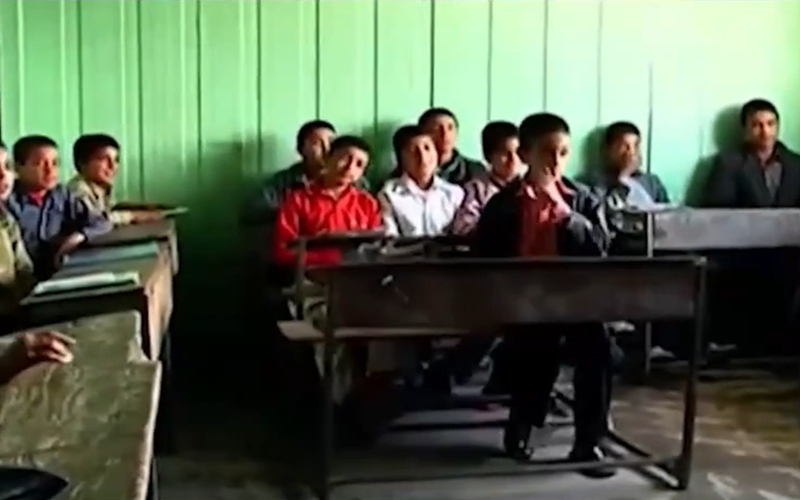

With schools facing shortages of teachers, facilities, and basic resources, Iran’s president invokes wartime conditions to justify shifting the burden onto citizens, without presenting a comprehensive plan to address the crisis.
Pezeshkian Shifts the Burden of Education onto Families
Iran’s deepening education crisis has exposed a fundamental question about the responsibilities of the state: Who is accountable for educating the next generation when schools lack adequate facilities, teachers, and resources?
President Masoud Pezeshkian recently praised citizens who have taken up shovels to build schools for their children, while invoking the country’s wartime conditions to explain the government’s inability to meet its obligations. His remarks offered little indication of a comprehensive strategy to address the structural problems confronting Iran’s education system.
Pezeshkian argued that even governments with substantial financial resources had failed to solve the problem, suggesting that his administration could hardly be expected to do better under current circumstances.
The statement effectively shifted responsibility from the state to ordinary citizens and charitable donors, leaving unanswered questions about the scale of the shortages, the resources available to the government, and the measures planned to ensure that children receive an adequate education.
Public participation in school construction can supplement government efforts. But when citizens are expected to compensate for the state’s failure to provide essential public services, voluntary assistance risks becoming a substitute for public accountability.
A School System Without a Clear Recovery Plan
The central problem extends well beyond the construction of school buildings. Iran’s education system faces a combination of inadequate facilities, teacher shortages, and broader deficiencies in educational provision. Yet Pezeshkian’s remarks offered no detailed assessment of these challenges or a measurable plan for addressing them.
How many schools are needed? How severe is the shortage of teachers? Which provinces and communities face the greatest deficiencies? What budget has been allocated to remedy the situation, and according to what timetable?
These basic questions remain central to any serious response to the crisis.
Instead of presenting clear targets, funding commitments, and implementation deadlines, the government has emphasized the willingness of citizens and charitable organizations to contribute. Such contributions may help individual communities, but they cannot provide a nationwide solution without a coordinated public policy.
The consequences are particularly serious for children in disadvantaged areas, where families have fewer resources to compensate for deficiencies in public services. Reliance on charitable construction can also leave provision uneven, depending on the capacity of local communities to raise money and mobilize volunteers.
A functioning national education system requires more than buildings. It needs qualified teachers, adequate classrooms, educational materials, maintenance, and sustained funding. Without a transparent plan covering these interconnected requirements, calls for public assistance do little to establish how the crisis will be resolved.
Wartime Conditions Do Not Erase Government Accountability
Pezeshkian’s appeal to wartime conditions raises another question: Why should ordinary families bear the consequences of the government’s financial and political priorities without receiving a clear account of how public resources are being used?
An emergency can impose genuine constraints on public spending. But invoking exceptional circumstances does not eliminate the need for transparency, prioritization, and accountability. A government that says it cannot adequately fund schools should explain the extent of the shortfall, disclose its spending priorities, and identify concrete measures to protect essential services.
Critics of the government have also pointed to corruption and reports of large-scale financial abuses, including cases discussed by media outlets within Iran itself. These issues make financial transparency particularly important when officials ask citizens to shoulder additional responsibilities.
The relevant questions are straightforward: What resources are available? How are they allocated? What safeguards ensure that public funds reach schools and teachers? And what steps are being taken to prevent waste and corruption?
Without clear answers, appeals to sacrifice risk appearing less like a recovery strategy than an attempt to deflect scrutiny from government performance.
Pezeshkian’s Record and the Credibility Gap
Pezeshkian’s appeal to ordinary citizens has also drawn criticism because his political career developed within the existing state structure rather than outside it.
He has held senior public positions, including serving as a member of parliament and health minister before becoming president. His earlier political record, including his involvement in the institutional response to student unrest and the cultural policies imposed on universities after the 1979 revolution, forms part of the broader debate over his public responsibilities and political credibility.
For critics, the contrast is stark: a president who has spent decades within the governing establishment now presents himself as constrained by circumstances beyond his control, while asking citizens to compensate for deficiencies in a fundamental public service.
This argument also challenges the suggestion that changing individual officials would necessarily resolve the problem. Education policy is shaped by institutional priorities, budgetary decisions, administrative structures, and the allocation of public resources. Replacing a minister or appointing a different official cannot, by itself, correct systemic deficiencies.
A credible response requires a transparent assessment of the entire education system and clear accountability for decisions that have contributed to its condition.
Education Is a Public Responsibility, Not a Charitable Obligation
The willingness of Iranian families and volunteers to build schools reflects the importance they attach to their children’s future. But their efforts should not obscure the state’s responsibility to guarantee access to education.
A serious national response would begin with a comprehensive public inventory of school infrastructure and staffing shortages, followed by a funded timetable for construction, recruitment, and the rehabilitation of existing facilities. It would also require transparent reporting on expenditures, measurable progress, and independent scrutiny of the implementation process.
The government must explain how it intends to protect education spending even under difficult economic and security conditions. It must also clarify how schools in poorer and remote communities will receive adequate support when local fundraising cannot cover their needs.
Pezeshkian’s remarks have brought these unresolved questions into sharper focus. By emphasizing what citizens can do in the absence of sufficient government provision, he has left the most important issue unanswered: what the state itself intends to do.
Iran’s education crisis cannot be resolved through appeals for shovels, donations, and voluntary labor alone. Ensuring that children have access to functioning schools and qualified teachers is a core public obligation. Until the government presents a transparent, adequately funded, and measurable plan, asking families to fill the gaps will remain a response to the symptoms rather than a solution to the underlying crisis.