


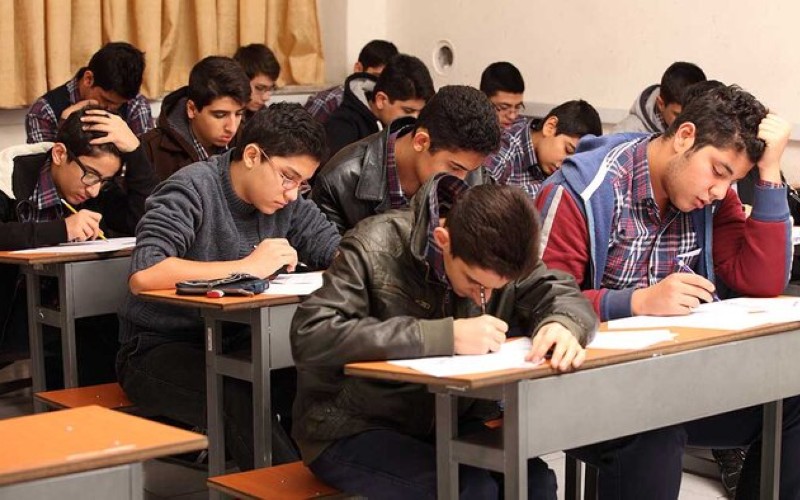

A rare admission from Iran’s education minister exposes the deep crisis within a system crippled by decades of ideological indoctrination, budget neglect, and social inequality.
A Minister’s Admission Exposes a System in Freefall
When the Iranian regime’s own officials sound the alarm, it’s often because the collapse can no longer be hidden. On October 7, the state-run ISNA news agency quoted Education Minister Alireza Kazemi acknowledging a 0.43% decline in national high school exam scores — a figure seemingly small but symbolically immense.
The regime blamed the drop on school closures due to air pollution and energy shortages, but that explanation barely scratches the surface. What lies beneath is a system hollowed out by four decades of ideological indoctrination, corruption, and neglect — an education model designed not to develop minds, but to mold obedience.
Four Decades of Decline: From Knowledge to Indoctrination
Under the doctrine of Velayat-e Faqih (absolute clerical rule), Iran’s education system has been stripped of its human and developmental mission. Instead, schools have become extensions of the regime’s propaganda apparatus — training grounds for ideological conformity rather than centers of learning.
Curricula remain rooted in rote memorization and religious indoctrination, disconnected from the realities of modern life and the demands of a 21st-century economy. From the earliest grades, students face an overload of irrelevant content, stifling curiosity and creativity.
In deprived regions, the situation is even more dire. Preschool education is nearly nonexistent, meaning many children start school without basic language or cognitive skills — a gap that widens into lifelong inequality. Schools often lack laboratories, libraries, and workshops; classroom overcrowding exceeds 40 students per class, and outdated teaching methods persist.
Teachers, meanwhile, face job insecurity and poverty wages, leaving morale at rock bottom.
Starving Education, Feeding the Security Apparatus
Iran spends only 2.93% of its GDP on education — barely half the global average of 4–5%. The result is a per-student annual expenditure of just $340, compared to $9,000 globally and $12,000 in Japan.
While classrooms crumble, billions of tomans flow instead to security and propaganda institutions, from the Revolutionary Guards’ cultural arms to seminaries and agencies tasked with exporting extremism abroad. The message is unmistakable: indoctrination and repression take priority over education and progress.
A Lost Generation: One Million Children Out of School
Even official media can no longer hide the human toll. According to regime statistics, 900,000 students dropped out of school last year alone — a staggering number that reflects deep social despair.
In marginalized areas, poverty, child labor, and early marriage drive children away from classrooms. For countless families, survival has replaced schooling as the main priority. Yet the education minister’s response — a vague promise of a “seven-year transformation plan” — sounds less like a reform strategy and more like a grim joke.
Indoctrination Over Education
Since its inception, the regime’s education system has been built around political loyalty, not intellectual growth. Textbooks glorify clerical rule and obedience to the Supreme Leader, while critical thinking, civic awareness, and scientific innovation are systematically suppressed.
The regime seeks to produce what it calls “faithful and obedient believers” — not skilled, informed citizens.
This policy has left a lasting mark: Iran’s young graduates face 25% unemployment, while mental health crises among teenagers have reached alarming levels. Deprived of opportunity and hope, a generation stands at the edge of despair.
Education as a Casualty of Authoritarianism
After four decades, the regime has turned what should have been a driver of national progress into a sinkhole of backwardness. Chronic underfunding, ideological content, and rigid control have robbed Iran’s youth of their potential.
The education minister’s recent confession is not merely an acknowledgment of failure — it is the official obituary of a bankrupt ideology. As long as education remains captive to the doctrine of Velayat-e Faqih, no reform, however ambitious in name, can succeed.
Iran possesses the human potential to become a regional leader in science and innovation. Yet that potential lies buried beneath layers of clerical dogma, repression, and inequality.
The collapse of education is not just a policy failure — it is a moral and national tragedy.