


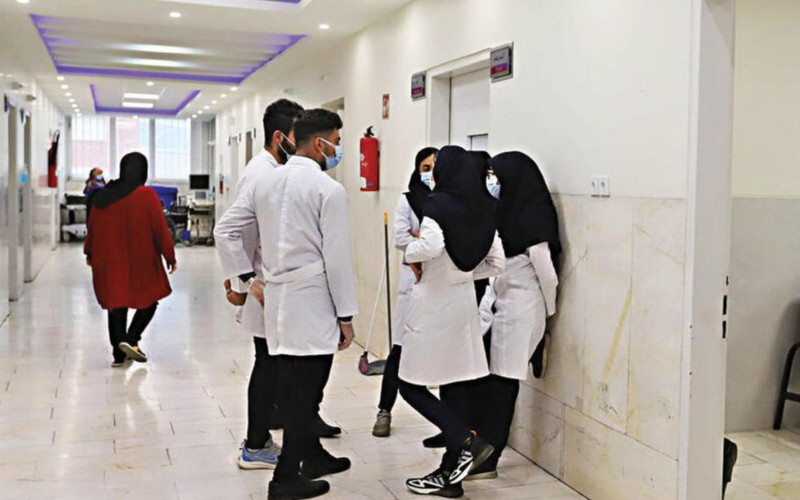

Mounting economic pressure, mismanagement, and mass migration cripple hospitals amid unprecedented staffing shortages
The healthcare crisis in the Islamic Republic is deepening at an alarming pace, revealing yet another layer of systemic failure. This time, the warning comes from inside the sector itself: the head of Iran’s Association of General Practitioners has confirmed that nearly one-third of general practitioners have effectively abandoned medical practice.
According to the association, more than 30,000 GPs have either migrated, switched careers, or turned to entirely unrelated fields such as beauty product sales or methadone distribution, driven out by destructive policies, crushing taxes, suppressed tariffs, and the overwhelming economic, political, and social crises engulfing the country.
Hospitals Struggle Amid Critical Staff Shortages
This official admission comes as hospitals across Iran face severe shortages of doctors and nurses. Emergency wards and inpatient units are overwhelmed, while officials loyal to the regime continue to dismiss the crisis as “media exaggeration.”
Ahmad Valipour, head of the Association of General Practitioners, described the core of the crisis:
“Medical tariffs have been suppressed for years. The cost of renting an office, equipment, staff, and taxes is so high that with a 100,000 or 150,000-toman visit fee, running a clinic is nearly impossible.”
He added that general practitioners are shutting down their practices one after another as they face unfair competition from low-cost state-owned clinics.
Official data show just how distorted the system has become. In some private hospitals, childbirth costs reach 350 million tomans, yet the physician’s share is less than 10%. This imbalance has fueled under-the-table payments, widespread patient dissatisfaction, and deep frustration among medical professionals.
Decades of Mismanagement Take Their Toll
Experts argue that Iran’s healthcare disaster is the product of decades of policy decisions made by unqualified officials. Valipour warned that these interventions have produced “nothing but distrust, exhaustion, and discouragement” within the medical community.
The widening gap between the real cost of healthcare services and the meager portion received by doctors has intensified migration. Valipour also highlighted the punishing workload for young doctors: four years of residency, followed by two years of mandatory service, with minimal pay and grueling hours that drive many away from the profession.
His comments align with warnings from within the Ministry of Health itself. Shahin Akhoundzadeh, deputy minister for research, recently admitted that many of the top 100 medical students migrate after graduation because the system cannot retain them.
Specialists Also Leaving; Surgeries Delayed Until 2027
The exodus extends far beyond general practitioners. The Iranian Medical Council has repeatedly warned about:
- severe shortages of pediatric cardiologists
- a lack of neurosurgeons
- mass migration of anesthesiology specialists
In some referral hospitals, including the renowned Rajaei Heart Center, surgical waiting lists are already booked until late 2026–2027 (1395).
Nursing Sector in Even Worse Condition
While physicians are struggling, nurses appear to be in an even more catastrophic situation. Iran faces a shortage of at least 100,000 nurses, with the nurse-to-patient ratio dropping to 0.6, far below the global standard of 1.8.
A nurse working in Tehran told ILNA:
“I earn 16 million tomans a month, but fixing two decayed teeth cost me 18 million. The workload is unbearable, the 24-hour shifts are exhausting, and half of my colleagues are considering migration.”
Official data show that around 19 doctors and nurses leave Iran every day, amid high demand from European and Gulf countries eager to recruit Iranian medical staff.
Methadone Market Becomes a Refuge for Disillusioned Doctors
Another alarming dimension of the crisis is the shift of thousands of medical practitioners into Iran’s highly profitable methadone market. A child and adolescent psychiatrist warned that 9,000 physicians have turned to methadone distribution instead of medical care, making Iran the world’s largest consumer and producer of methadone after the United States.
“When a healthcare system collapses, doctors stop healing and start selling whatever is profitable—and methadone brings far more revenue than medical practice,” the psychiatrist said.
A System on the Brink
Iran’s healthcare system is collapsing under the weight of:
- chronic drug shortages
- declining quality of medical education
- rising violence against medical staff
- severe delays in payments to healthcare workers
- plummeting motivation among medical students
- critical shortages of on-call physicians, anesthesiologists, surgeons, and nurses
Many hospital departments are now operating at half capacity, and emergency rooms are overflowing with patients who wait hours—sometimes days—for basic evaluation.