


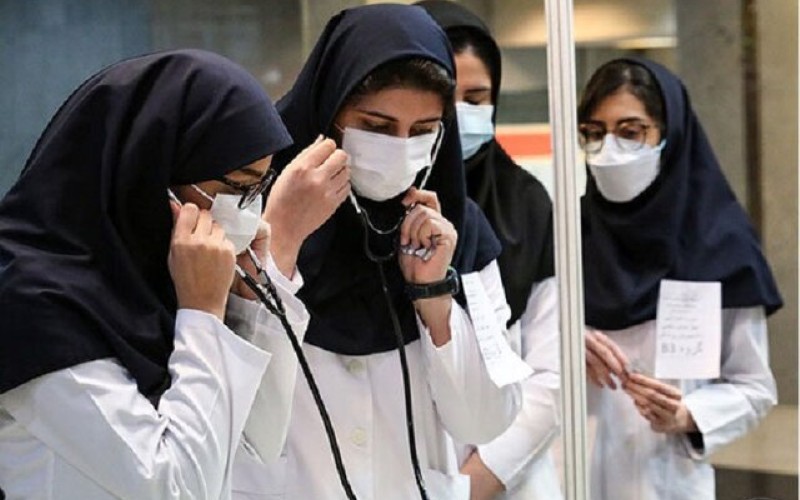

Official statistics reveal widespread inefficiency and rising doctor migration
A new report has shed light on a growing crisis within Iran’s healthcare system: despite a surplus of general practitioners on paper, the country continues to face a severe shortage of specialist doctors and an unequal distribution of healthcare services.
Citing data from the Medical System Organization, the state-affiliated Nournews reported on September 18 that nearly 29 percent of registered general practitioners in Iran are not practicing medicine. Of the more than 104,000 registered general practitioners, at least 30,000 have left the medical field altogether.
“This number alone indicates the waste of educational, financial, and human capacities in a country that is continuously facing a crisis of shortage of specialist doctors and unfair distribution of health services,” Nournews wrote.
Misguided policies and wasted resources
The report criticized the authorities’ continued emphasis on expanding the number of general practitioners as a solution to the doctor shortage. According to the outlet, the regime’s policy of boosting admissions for general medical studies has produced nothing more than an “inefficient human resource inflation,” while failing to address the real need: the training and retention of specialists.
The cost of training a single general practitioner is estimated at tens of thousands of dollars. Yet many graduates have either shifted to other professions for financial survival, taken non-medical jobs, or abandoned medicine entirely.
Shortage of specialists threatens the system
The shortage of specialist physicians has been a recurring concern voiced by health officials and experts in recent years. On July 7, Abbasali Raiskarami, president of Tehran University of Medical Sciences, warned that there was declining interest among medical graduates in six specialized and subspecialty fields, including pediatrics, anesthesia, and infectious diseases. He noted that the lack of volunteers in these key disciplines poses a serious challenge to Iran’s healthcare system.
This concern was underscored in the most recent medical assistant examination, where large portions of the available slots in vital specialties went unfilled. Only 10 percent of capacity in emergency medicine, 32 percent in anesthesia, 22 percent in pediatrics, and 15 percent in infectious diseases were filled, leaving critical gaps in the health system.
Migration adds to the crisis
The Nournews report also highlighted the rising trend of physician migration to Europe and North America, calling it a “worrying development.” The outlet cited poor working conditions, low pay, heavy workloads, lack of job security, and uncertainty about career prospects as key factors driving doctors—especially younger ones—to seek opportunities abroad.
On September 15, Shahin Akhundzadeh, Deputy Minister of Research and Technology at the Ministry of Health, admitted that meritocracy is essential for retaining medical elites. He revealed that “often the top 100 candidates” in medical science fields emigrate due to the lack of favorable recruitment conditions in Iran.
Unequal distribution deepens inequalities
Beyond the overall shortage of specialists, distribution across the country is deeply unequal. According to official statistics, 42 percent of specialist physicians are concentrated in just five metropolitan cities. In some specialties, up to 60 percent of doctors are based in Tehran alone, leaving vast regions of the country underserved and worsening health inequalities.
A deepening healthcare dilemma
The findings highlight a structural crisis in Iran’s healthcare system: while thousands of general practitioners remain inactive or migrate abroad, shortages of specialists in critical fields continue to undermine patient care. The combination of wasted training costs, poor workforce planning, and inequitable distribution threatens the sustainability of healthcare delivery in the country—leaving millions of Iranians without access to vital medical services.