


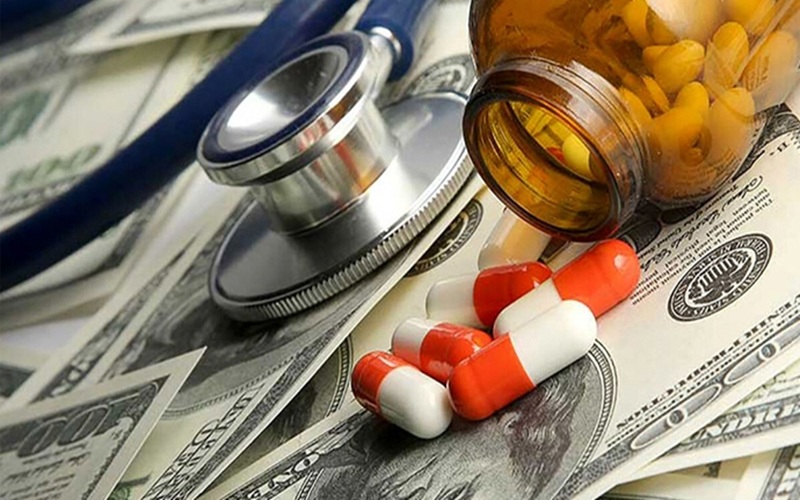

Iran’s medicine crisis exposes a health system starved of funding while regime-controlled monopolies and financial mismanagement leave patients unable to afford life-saving treatment.
Iran’s deepening economic crisis is now directly threatening access to life-saving medicine. With official annual inflation reaching 89 percent in August and food and beverage inflation climbing to 127 percent, the cost of essential goods has become increasingly unbearable for workers and wage earners. But medicine is becoming an even more devastating burden.
According to Hadi Ahmadi, spokesperson for the Iranian Association of Pharmacists, medicine prices have risen by an average of about 80 percent since the beginning of 2026, with increases reaching 300 percent for some products. In annualized terms, this represents an extraordinary escalation in the cost of medicines, with some drugs experiencing several-fold increases.
At the same time, shortages are becoming increasingly widespread. The Iranian Pharmacists Association and the regime’s parliamentary Health Commission have acknowledged shortages ranging from approximately 400 to 1,000 different medicines.
For patients suffering from cancer, chronic illnesses and other serious conditions, these are not merely economic statistics. They can determine whether treatment continues—or whether a patient survives.
Patients Forced to Sell Everything to Pay for Treatment
A pharmacy official in central Tehran described the human consequences of the crisis:
“I had a customer whose 22-year-old child had liver cancer. He sold his house, his car and all his wife’s gold jewelry to save his child’s life. In the end, he lost his child. The couple lost everything they had in the world.”
This account illustrates the devastating intersection of poverty, inflation and the collapse of access to healthcare.
For millions of Iranian families, medical expenses are no longer an unexpected financial burden that can be managed through savings or insurance. They can mean the liquidation of everything a family owns.
The crisis is particularly severe for wage earners whose incomes have failed to keep pace with inflation. When food prices are already consuming an ever-larger share of household income, purchasing expensive medicines becomes an impossible choice between treatment and basic necessities.
A Crisis That Predates the Recent War
The regime frequently attributes economic disruptions to external pressure and recent wartime conditions. But officials and industry representatives themselves acknowledge that Iran’s medicine crisis is structural and has been developing for years.
The Iranian pharmaceutical industry suffers from aging infrastructure, inadequate investment, chronic liquidity shortages and unstable government policies.
One industry assessment stated:
“The pharmaceutical industry in Iran is an old and somewhat worn-out industry that today needs reconstruction and modernization more than ever.”
Another warning makes clear that the problem cannot simply be attributed to recent events:
“This issue is not limited to today or the recent wartime conditions. The pharmaceutical industry has been struggling with it for years.”
In 2025, the government was supposed to allocate approximately $3.5 billion for medicines and medical equipment. Yet less than half of that amount had reportedly been realized by the end of the year.
The consequences are predictable. According to industry officials, the country is continually adding new medicines to its shortage list, while pharmacies and pharmaceutical manufacturers struggle to obtain the financing and foreign currency necessary to maintain supply.
Billions Allocated on Paper, but Not Delivered
One of the central problems is the regime’s chronic failure to provide pharmaceutical companies with the funds owed to them.
The pharmaceutical industry is reportedly facing approximately 200 trillion tomans in outstanding debts from the government, healthcare centers and the private sector. At the same time, delays of up to six months in transferring foreign currency have been cited as a major factor behind medicine shortages.
Pharmacies are also being pushed toward bankruptcy because insurance organizations have failed to reimburse them for medicines already provided to patients.
According to Ettelaat Online on August 28, insurance companies owe pharmacies approximately 20 trillion tomans, a debt that has reportedly pushed many pharmacies to the brink of closure.
This creates a vicious cycle: pharmacies lack liquidity, pharmaceutical companies cannot reliably finance production and distribution, shortages increase, and patients are forced to pay more out of pocket.
Removal of Preferential Currency Sends Prices Soaring
Foreign-currency policy has further intensified the crisis.
According to pharmaceutical-sector reports, medicine prices have increased by an average of 68 percent, while medicines removed from the preferential foreign-exchange system have experienced price increases ranging from zero to 200 percent—and in some cases as much as fourfold.
This is particularly devastating in an economy where official annual inflation is already approaching 90 percent.
The problem is therefore not simply that medicines are becoming more expensive. Their prices are rising at a rate that far exceeds the ability of ordinary households to compensate through wages.
For a worker or pensioner whose income rises only modestly while medicine prices multiply, healthcare effectively becomes inaccessible.
A Pharmaceutical Monopoly at the Heart of the Crisis
The deeper question is why a country that reportedly produces the overwhelming majority of its own medicines is nevertheless experiencing persistent shortages and dramatic price increases.
According to Dr. Hojjatollah Yazdanshenas, former head of the Iranian Pharmacists Association, approximately 97 percent of Iran’s required medicines are produced domestically.
Yet domestic production has not translated into affordable or reliable access.
A major part of the pharmaceutical sector is concentrated in large entities associated with powerful state-linked institutions. Two of the most important are the Barekat Pharmaceutical Group and Tamin Pharmaceutical Investment Company (TPICO).
Barekat, established in 2010, operates more than 15 subsidiaries, including Alborz Darou. TPICO has 26 pharmaceutical subsidiaries involved in production, distribution and related activities. One of its major subsidiaries, Darou Pakhsh, reportedly employs approximately 4,400 workers.
Such concentration gives politically connected institutions enormous influence over pharmaceutical production, distribution and pricing.
From Production Cost to Absurd Retail Prices
The scale of the dysfunction can be seen in examples reported by the regime’s own media.
In February 2022, Shargh reported that a medicine produced domestically for approximately 500,000 tomans was being sold for 25 million tomans despite what the newspaper described as a fully transparent distribution chain.
That represents a retail price approximately 50 times the production cost.
Another example emerged in March 2025, when Pirsalehi, former head of the Food and Drug Administration, acknowledged that some ampoules that previously cost 5,000–6,000 tomans had risen to approximately 19,000 tomans.
These cases demonstrate that the medicine crisis cannot be explained solely by foreign sanctions, war or international supply disruptions. Domestic mismanagement, monopolization, liquidity shortages, currency policies and corruption are all embedded in the system.
A Political Choice With Human Consequences
The regime has repeatedly demonstrated that it can mobilize enormous resources for its political, military and security priorities. Yet when it comes to ensuring affordable healthcare, hospitals, pharmacies and medicine manufacturers, the system repeatedly claims that resources are unavailable.
The result is a stark contradiction.
The regime has institutions and budgets for repression, surveillance, arrests, executions and military ambitions. But the basic infrastructure required to protect the physical and mental health of the population is allowed to deteriorate.
The medicine crisis therefore exposes more than an administrative failure. It reveals the regime’s priorities.
A healthcare system serving the population cannot function when pharmaceutical companies are starved of liquidity, pharmacies wait months for reimbursement, foreign currency transfers are delayed, medicine prices rise several hundred percent and monopolistic structures dominate production and distribution.
The ultimate victims are ordinary Iranians—particularly workers, low-income families and patients with chronic or life-threatening illnesses.
For a family forced to sell its home, car and jewelry to purchase treatment, the medicine crisis is not an economic abstraction. It is a matter of life and death.
As long as the regime’s political and economic structures remain unchanged, poverty, inflation, corruption and the erosion of access to healthcare will continue to deepen. The growing medicine crisis is yet another manifestation of a system in which the preservation of the regime takes precedence over the welfare and even the lives of the people it governs.