


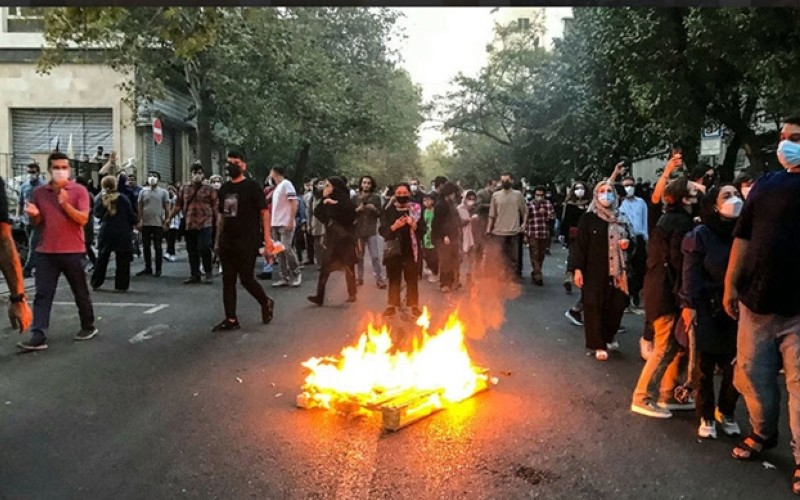

From fragmented identities to digital solidarity, Iran’s young generation is emerging as the driving force of a new revolutionary cycle
Iran is witnessing the rise of a generation fundamentally different from those that came before it—one whose identity, social bonds, and political consciousness are no longer shaped by state-controlled institutions but by decentralized digital networks. This transformation has created not only a cultural rupture with the past, but also a structural challenge to the Iran regime’s ability to control meaning, loyalty, and power.
In previous decades, youth identity in Iran was largely formed within institutions such as the family, schools, or tightly monitored local communities. Today, that model has collapsed. Iranian youth—especially those active on social media—constantly experiment with multiple identities, receive immediate feedback, and continuously redefine who they are. This network-based identity formation provides unprecedented freedom in choosing lifestyles, values, and social affiliations, directly undermining the regime’s rigid ideological frameworks.
Social relations have undergone a similar transformation. Iranian youth are more digitally connected than any previous generation, forming relationships based on shared interests rather than geography, class, or regime-sanctioned norms. These expansive and pluralistic digital networks give rise to new forms of community, enabling young people to play an active role in cultural and social life beyond the regime’s reach.
Sociologist Manuel Castells argues that power in the modern era flows through networks, because control of networks means control over meaning, identity, and information. In Iran, this insight carries revolutionary implications. The regime’s authority has long relied on monopolizing narratives—through state media, education, and religious institutions. That monopoly is now broken. Cyberspace has become a critical arena for learning, organizing, and resistance, where knowledge flows horizontally rather than hierarchically.
Iranian youth are not passive consumers of information. They are content creators, educators, and agenda-setters. With access to global educational resources and digital tools, they acquire skills, exchange ideas, and align themselves with global cultural and intellectual currents. This global connectivity has intensified their awareness of how deeply Iran lags behind the world—not due to lack of talent, but because of regime-imposed isolation, repression, and mismanagement.
Demographically, this generation represents a decisive force. Generation Z—aged roughly 15 to 30—is the largest generation in Iran’s history, comprising about 25 percent of the population, or more than 22 million people. This sheer size alone makes them the central engine of social change. Generation Alpha, though smaller due to declining birth rates driven by economic hardship and delayed marriage, still represents nearly one-fifth of the population and is being shaped by the same digital environment.
Any serious analysis of these generations must account for a range of structural factors: Iran’s historical and civilizational identity as rediscovered and reinterpreted in digital spaces; young people’s exposure to competing narratives about Iran’s past and present without endorsing any former or current system of rule; pervasive social, political, and cultural restrictions; the widening divide between state and society; the persistent failure of the ruling system to manage national resources in the public interest; overlapping economic, environmental, and social crises; the evolving digital divide; and the unresolved tension between tradition and modernity in a society undergoing forced stagnation amid global change.
Above all, Iranian youth are acutely aware of the regime’s inability—or unwillingness—to translate the country’s vast human and natural wealth into a dignified life for its people. The collapse of economic prospects, soaring inflation, unemployment, and an increasingly opaque future have stripped the regime of credibility in the eyes of young Iranians.
Yet this generation is neither lost nor hopeless. On the contrary, Iran’s Generation Z is widely described—even in cautious sociological assessments—as “brave, hopeful, and unbreakable.” Unlike their global counterparts, who often prioritize individual transformation, Iranian youth have emerged as leaders of collective protest. They have been at the forefront of nationwide uprisings, digital campaigns, and acts of civil resistance.
Faced with deep political and economic crises, Iran’s youth have turned digital space into a platform for solidarity and mobilization. They define the rules of engagement themselves, bypassing official structures and censorship. In political terms, Iranian Generation Z is more active, more confrontational, and more future-oriented than its peers elsewhere in the world.
The contradiction is stark: while the Iran regime remains trapped in outdated modes of control—repression, censorship, and ideological enforcement—Iranian youth operate in a fluid, global, and networked reality. Cultural time in Iran, which the regime attempts to regulate, is increasingly out of sync with technological time, which it cannot stop. This mismatch is eroding the foundations of authoritarian rule.
What is emerging is not merely generational discontent, but revolutionary potential. A digitally empowered youth population, conscious of its power, connected across borders, and united by shared grievances, represents the most serious challenge the Iran regime has faced in decades. The struggle ahead is not only about politics—it is about reclaiming identity, future, and agency.
In this sense, Iran’s youth are not just witnesses to history. They are positioned to be its authors.