


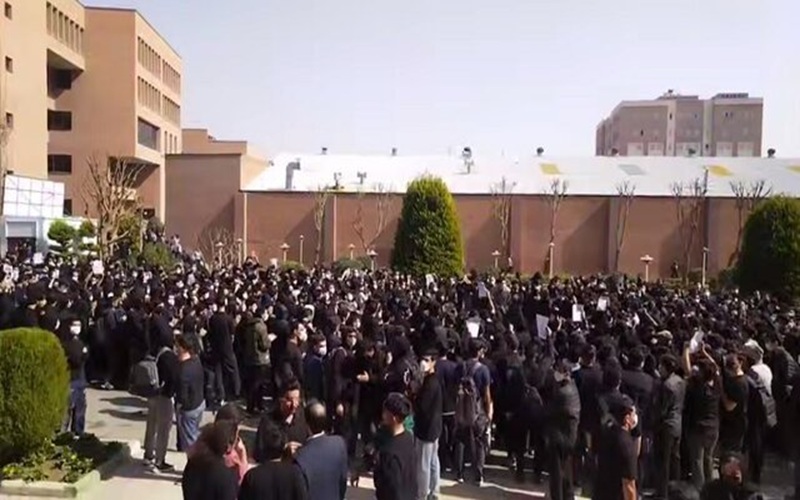

New disciplinary rulings against three Sharif University students have brought the number of students facing expulsion to 10, raising renewed concerns over academic freedom and the right to protest.
Sharif University of Technology has once again become a focal point of disciplinary action against students, with three more students receiving preliminary expulsion orders. The latest decisions bring the number of Sharif University students who have received expulsion rulings to 10, while reports indicate that the number could increase further.
The latest cases involve Ariana Kuchaki, an industrial engineering student who entered the university in 2021; Ali Alirezaei, a mathematics student admitted in 2023; and Arash Hatami, a physics student who entered the university in 2023.
According to information published about the cases, Kuchaki and Hatami have each been sentenced to one year of exclusion from study at all universities across Iran. Alirezaei has received a five-year ban from studying at universities nationwide.
The rulings are currently preliminary and can therefore be appealed. Nevertheless, expulsion or lengthy suspension from higher education can have serious consequences for a student’s academic trajectory and future professional opportunities. Ensuring the right to defense and fair proceedings is therefore particularly important in cases carrying such severe penalties.
Expulsions Continue at Sharif University
The three latest cases follow disciplinary action against seven other Sharif University students who had previously received expulsion orders. Among those cases, the ruling against Reza Dalman has reportedly become final, while the other decisions remain at the preliminary stage according to available reports.
The pattern suggests that the disciplinary measures are not limited to an isolated case or a single period of unrest. Reports by state-affiliated media have linked several of the cases to participation in gatherings, chanting slogans, publishing material on social media, and allegations such as acting against national security.
A report published by Fars News Agency on June 20, 2026, named several students in connection with such disciplinary cases, including Sepanta Saeedi, Hossein Shadman, Masiha Bagheri, Fatemeh Khakpour, Fariborz Kohanzad, and Parnian Khodabakhshi. Some of the decisions reportedly included not only expulsion but also multi-year bans on continuing education.
According to the account published by Fars, three of these cases were primarily related to activity and content published on social media, while the cases involving other students were connected to participation in gatherings and events in March.
One case was different in nature: according to Fars, a student accused of carrying a cold weapon on campus was sentenced to two semesters of suspension. The nature of that allegation distinguishes it from cases centered primarily on protest activity or the publication of political content.
Meanwhile, the state-affiliated Student News Network reported on August 19 that the expulsion orders against 13 students described as having engaged in “insults” during the March 2026 events had become final after review by university disciplinary committees and the Ministry of Science’s appeals committee.
These reports indicate that disciplinary action against students is becoming an increasingly broad phenomenon rather than a matter confined to individual cases.
Protest, Academic Discipline, and the Right to Education
The distinction between criminal conduct, disciplinary violations, and peaceful political expression is particularly important in student cases. Criticism of officials or the expression of political views should not, in the absence of established criminal conduct, automatically become grounds for the most severe educational penalties.
Universities are supposed to provide environments for education, research, intellectual debate, and the exchange of ideas. Disciplinary proceedings should therefore be based on clearly defined allegations, identifiable evidence, and an effective opportunity for the accused student to defend themselves.
The repeated use of expulsion and lengthy educational bans raises broader concerns about the space available for freedom of expression on Iranian university campuses.
The consequences also extend beyond the students directly affected. Universities are among the most important environments in which young people develop social, political, and intellectual ideas. Restricting that environment does not eliminate disagreement within society; it can instead deepen the distance between students and the structures of power.
A Growing Climate of Pressure on Universities
The continued disciplinary measures at Sharif University come amid broader concerns about academic security and freedom of expression. The lack of transparency surrounding some cases makes it particularly important for universities and authorities to clarify the allegations, evidence, and procedures behind severe disciplinary decisions.
Expulsion is not merely an educational measure when it is imposed in response to political activity or protest. It can affect a student’s entire academic and professional future. When such decisions are made without transparent procedures and meaningful guarantees of the right to defense, they risk becoming instruments of political pressure rather than ordinary disciplinary measures.
The accumulating cases at Sharif University therefore raise a fundamental question: Is the purpose of university discipline to protect an academic environment, or to suppress dissent within it?
The experience of recent years has demonstrated that pressure on universities does not erase students’ demands for freedom and civil rights. Suppressing protest may temporarily restrict visible dissent, but it does not remove the grievances that produce it.
As the number of students facing expulsion continues to rise, the issue is no longer confined to individual disciplinary cases. It reflects a broader struggle over the meaning of academic freedom, freedom of expression, and the right of Iranian students to participate in the social and political life of their country without risking their education and future.