


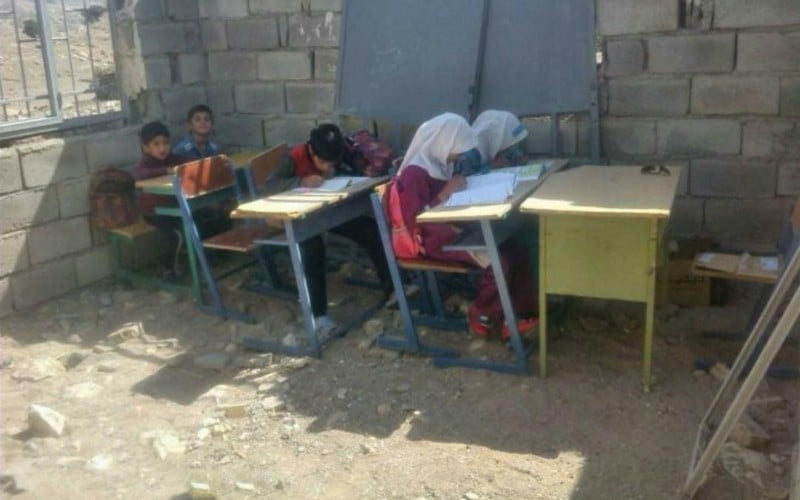

A state-run daily unintentionally reveals a deliberate system that privileges elite and loyalist schools while abandoning public education and marginalized provinces.
A new report published by the state-run daily Farhikhtegan has inadvertently exposed the depth of state-engineered educational discrimination in Iran. The newspaper’s attempt to analyze academic performance and national exam results instead reveals a structural system designed by the Iranian regime to privilege wealthy and politically connected families while abandoning millions of students in public schools and marginalized provinces.
The report notes that among the top thirty students in the 2025 nationwide entrance exam, twenty-three came from NODET (Sampad) elite schools, four from expensive non-profit private schools, and only three from public schools. This disproportionate outcome is not a coincidence. It is the result of two decades of deliberate policies that underfund public education, expand elite and non-profit schools for those who can pay, and reserve the highest-quality instruction and facilities for a narrow segment of the population. The children of regime officials, military personnel, and affluent families benefit from an education pipeline that guarantees superior academic outcomes, while ordinary families remain trapped in deteriorating public schools.
The newspaper also emphasizes a concerning decline in national learning performance, using international mathematics benchmarks that take a score of five hundred as the global average. Students in public schools consistently fall below this standard, and the gap widens sharply when compared to private and elite institutions. The data demonstrates that students in private schools achieve the highest scores, followed by Shahed schools linked to war veterans and security forces. The superior performance of politically affiliated schools underscores how the regime channels educational resources toward groups with loyalty to the ruling establishment.
The picture becomes even more alarming at the provincial level. The report admits that in Sistan and Baluchestan, sixty-three percent of students fail to reach the basic learning threshold, while in Khuzestan nearly half fall below the minimum standard. These regions, heavily populated by marginalized ethnic communities, have suffered from chronic underinvestment, poor school infrastructure, and widespread poverty. The failure of educational systems in these provinces is not accidental. It reflects decades of discriminatory allocation of resources that prioritizes central and wealthier regions while leaving peripheral communities in a state of permanent disadvantage.
The consequences of these policies are visible across the country through widening educational gaps, unequal access to opportunity, and the perpetuation of social inequality. Public schools operate with overcrowded classrooms, a lack of qualified teachers, limited technology, and outdated materials, leaving students fundamentally unprepared for national exams and higher education. Meanwhile, elite schools benefit from smaller class sizes, comprehensive preparatory programs, and direct support from the state.
Although Farhikhtegan attempts to frame the crisis as a general “educational imbalance,” the pattern it describes is unmistakable. The Islamic Republic has constructed a system where access to quality schooling depends on wealth, political affiliation, and geography. This is not a natural inequality nor a pedagogical failure. It represents a deliberate political strategy that reproduces privilege for a small ruling class while systematically excluding the majority of Iranian children.
The report has inadvertently documented the full architecture of discrimination. Elite and private schools receive top resources, politically loyalist institutions are elevated, and public schools are left to collapse. Marginalized provinces confront learning poverty at catastrophic levels. Together, these conditions reflect a state-designed mechanism that shapes the future of children according to the interests of the ruling establishment rather than the needs of society.
In exposing these disparities, the regime’s own media has confirmed what parents, teachers, and students have long known. Iran’s educational inequality is not the product of chance; it is an outcome of policy. And as long as this system persists, state-engineered educational discrimination will deepen the divide between privileged elites and millions of students left behind.